9 Best HARO Alternatives in 2026 (Free and Paid)
HARO was shut down, sold and revived. Compare 9 HARO alternatives for getting quoted, from free request emails to Qwoted, plus how to pitch journalists directly.
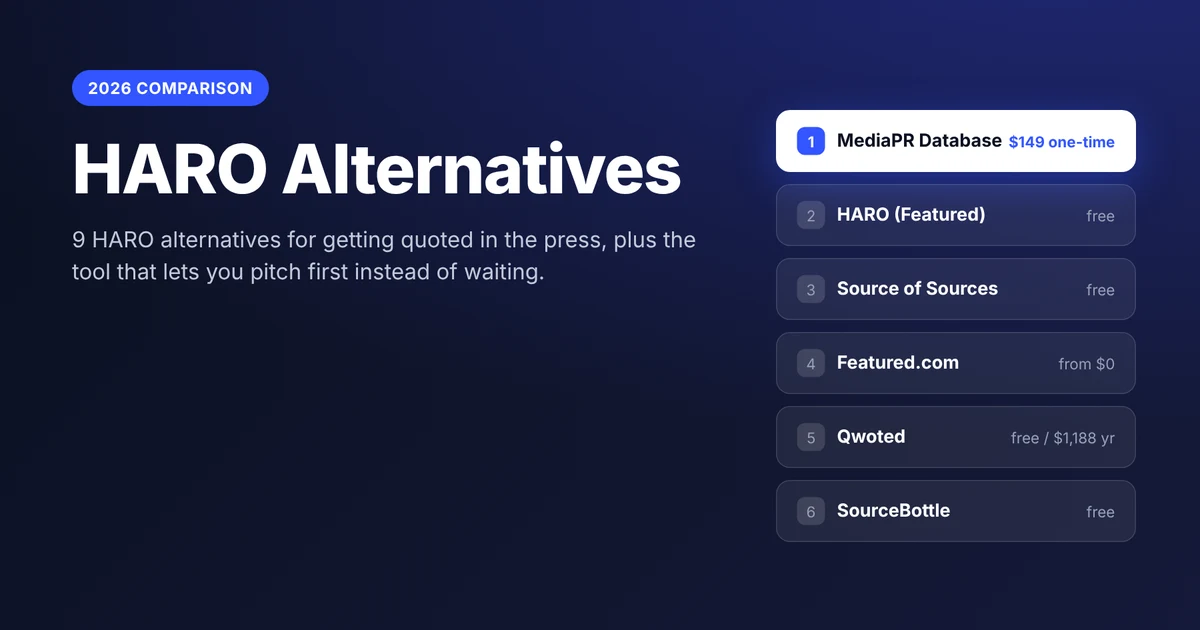
The best HARO alternative depends on how you want to get coverage. If you want to answer journalist requests, the free options are the revived HARO, Source of Sources and SourceBottle, with Qwoted and Featured.com as paid upgrades. If you want to pitch your own story to the right newsrooms instead of waiting for a request, MediaPR Database gives you worldwide media lists with newsroom emails for $149 one-time.
Most PR people end up using both: a request feed for quotes, and a media list for launches and announcements.
What happened to HARO?
Help a Reporter Out (HARO) connected journalists with expert sources by email for years. Then it disappeared, and many people switched to other platforms. Here is the short history, from the companies' own announcements:
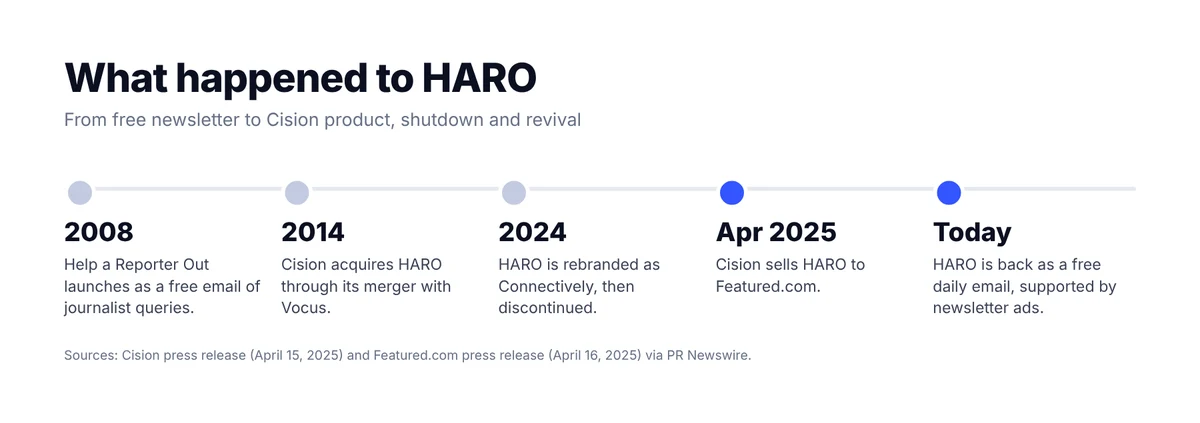
- 2008: HARO launches. Cision acquired it in 2014 through its merger with Vocus.
- 2024: Cision rebranded HARO as Connectively and later discontinued it.
- April 2025: Cision sold HARO to Featured.com and confirmed it "no longer offers the Help A Reporter Out or Connectively services" (Cision).
- Revival: Featured.com said HARO would stay free for journalists and sources, supported by newsletter ads, and return to daily email opportunities (Featured.com).
So HARO exists again, but it is now one of several request services, not the only one.
Request platforms vs. media lists
Before choosing, decide which kind of PR you are doing. They work very differently.
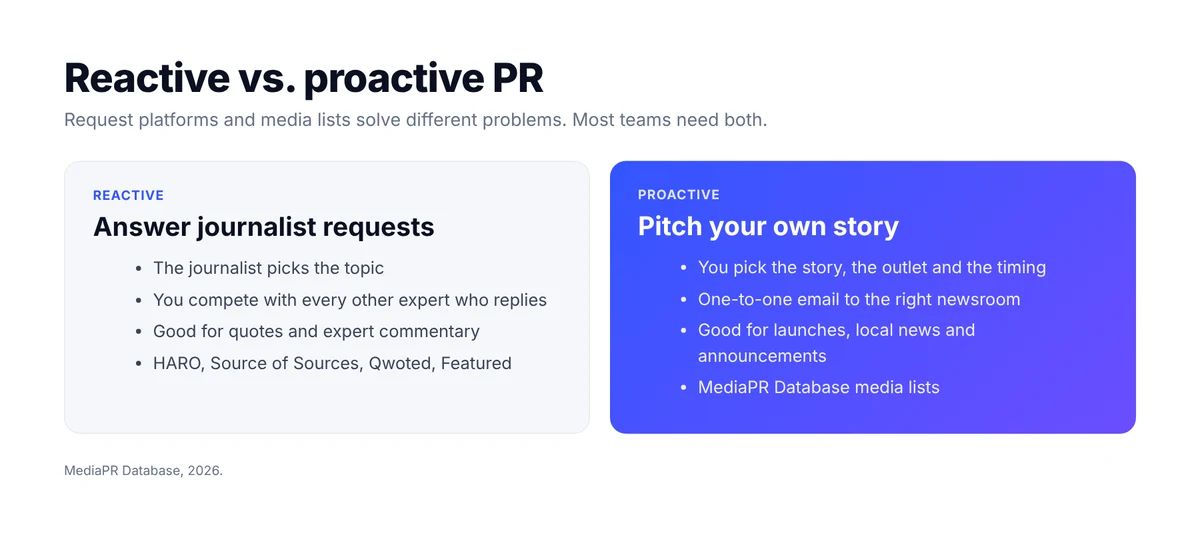
- Request platforms are reactive. A journalist posts a query and you reply. It is great for expert quotes, but you compete with every other source who answers, and you cannot choose the outlet.
- Media lists are proactive. You choose the story, the outlets and the timing, then send a one-to-one email. That is how you get a product launch, a local story or a funding announcement covered.
Journalists respond to the proactive kind when it is relevant. In Muck Rack's State of Journalism 2026, 86% of journalists said at least some of their stories started from a PR pitch, and 62% said they prefer a one-to-one email (University of Minnesota summary).
Quick comparison: HARO alternatives at a glance
| Tool | Type | Price | Best for |
|---|---|---|---|
| MediaPR Database | Media lists and emails | $149 one-time | Pitching your own story to chosen outlets |
| HARO (by Featured.com) | Request email | Free | Classic daily journalist queries |
| Source of Sources | Request email | Free | Queries from HARO's founder, strict rules |
| Featured.com | AI PR platform | Free, Lite $29/mo, Pro $79/mo (yearly) | Tracking many request feeds in one place |
| Connectively | Expert platform | Free to join | Expert pages and publisher questions |
| Qwoted | Request marketplace | Free plan, Pro $1,188/yr | Higher-quality requests with profiles |
| SourceBottle | Request email | Free | Australian and New Zealand media |
| ResponseSource | Enquiry service | Quote | UK journalists and enquiries |
| #JournoRequest | Social hashtag | Free | Fast requests on X, LinkedIn and Bluesky |
The 9 best HARO alternatives
1. MediaPR Database: best for pitching first instead of waiting
MediaPR Database is our own product, so judge it by the facts below. It is not a request feed. It is a searchable database of 9,596 news outlets in 195 countries, plus 2,997 podcasts and 123 newsletters, with 16,692 contact emails. Instead of waiting for a journalist to ask for a source, you find the newsrooms that cover your story and email them.
Example: a local story in Newport, Rhode Island. A free search for "newport" shows the two local outlets, Newport Life Magazine and Newport This Week, with five newsroom emails between them. Emails unlock with Pro.
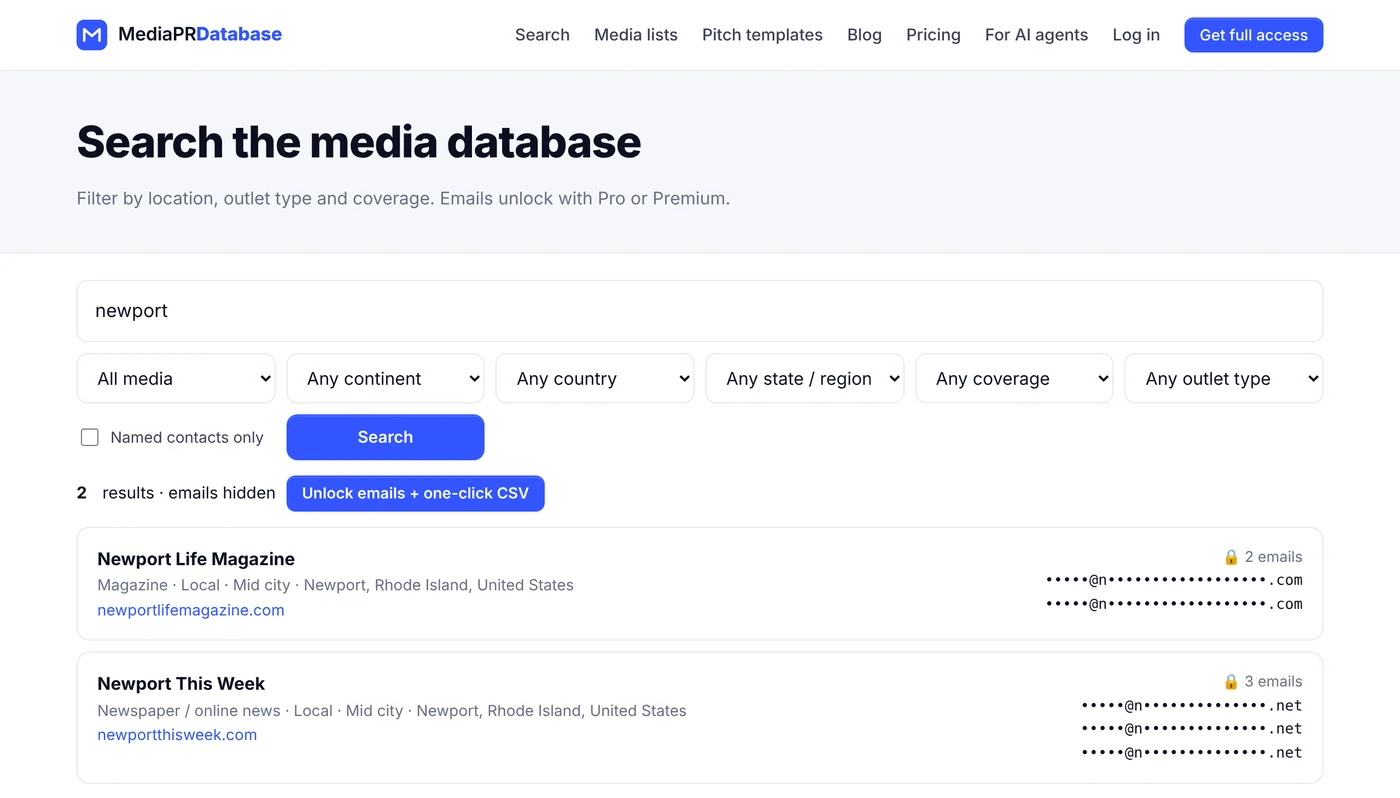
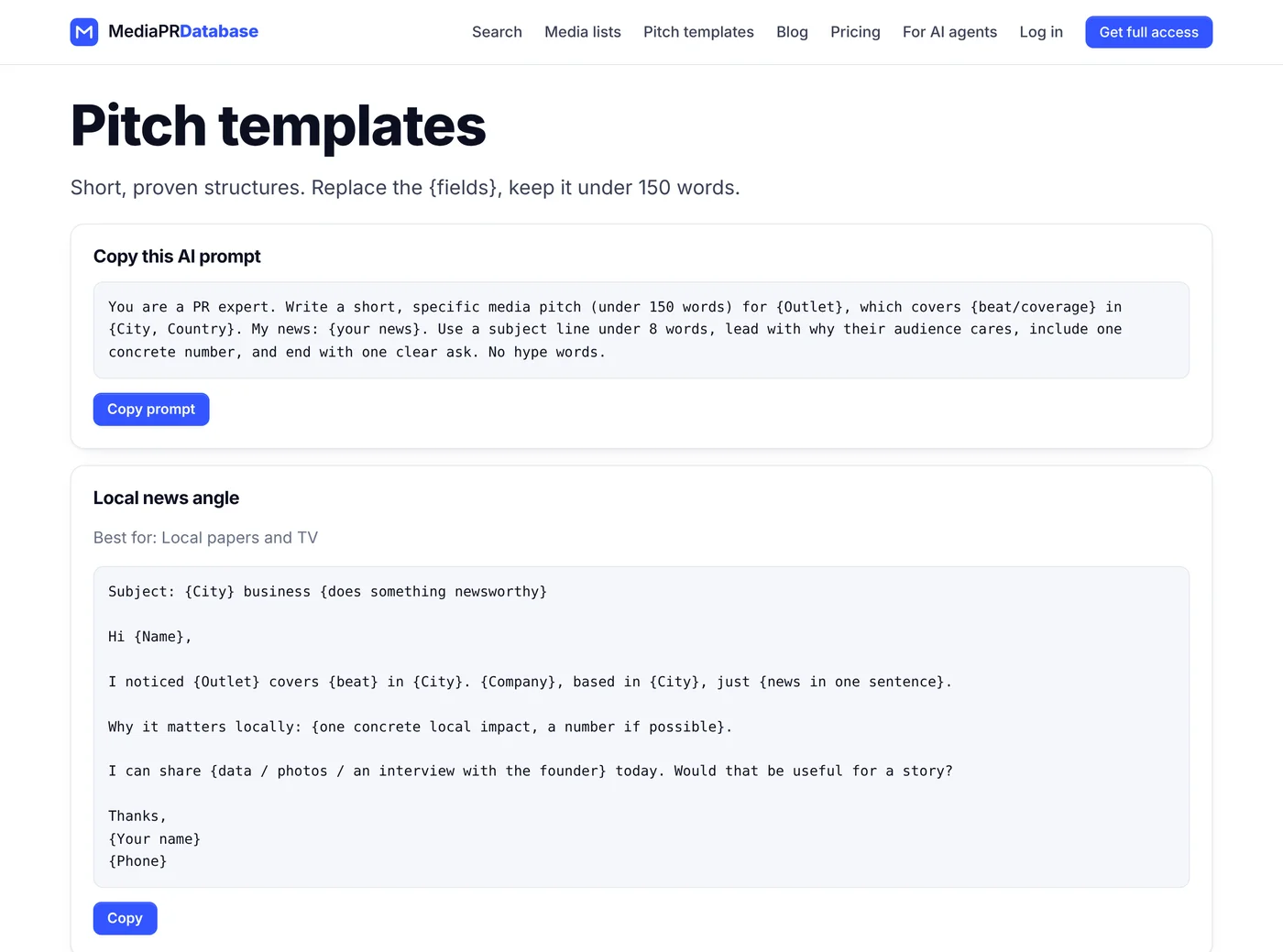
Then write a short pitch. Our free pitch templates include a local news angle and an AI prompt that keeps every pitch under 150 words.
Pricing (see plans):
- Free: search every outlet, podcast and newsletter, emails hidden.
- Pro, $149 one-time: all news outlet and journalist emails and one-click CSV downloads.
- Premium, $299 one-time: everything in Pro, plus podcasts and newsletters with contacts, and exports for Instantly, Smartlead and Lemlist.
Where it falls short: it does not send you journalist requests, and contacts are mostly newsroom and editor addresses. Use it alongside one of the free request feeds below.
2. HARO (now run by Featured.com): best free classic
The original service is back under Featured.com. Journalists submit queries and sources receive them by email.
- Price: free for journalists and sources, supported by newsletter ads (HARO).
- Strength: a familiar format with no account fees.
- Weak spot: popular queries attract many replies, so speed and relevance decide who gets quoted.
3. Source of Sources: best free option with strict rules
Source of Sources (SOS) was started by Peter Shankman, who founded HARO. Sources get up to three emails a day with journalist queries and reply to the reporter directly.
- Price: free. SOS asks users to donate to an animal charity instead of paying (Source of Sources).
- Strength: a hard rule against off-topic pitches, which keeps quality up. SOS says pitching a reporter off topic even once gets you removed.
- Weak spot: email only, so you need to check it several times a day.
4. Featured.com: best for managing many request feeds
Featured.com describes itself as an AI co-pilot for PR. Its plans include journalist request matching from HARO, LinkedIn and other sources, plus podcast, speaking and award opportunities.
- Price: Free plan, Lite $29/month (billed $348 a year) and Pro $79/month (billed $948 a year). Every plan has the same features and only AI usage changes (Featured pricing).
- Strength: one place to watch requests instead of several inboxes.
- Weak spot: daily usage limits on the cheaper plans.
5. Connectively: best for expert pages
The Connectively name lives on as a platform where experts answer publisher questions and create an expert page. It is now operated alongside Featured.com, which announced in 2026 that Connectively had passed 100,000 users (PR Newswire).
- Price: free to sign up and create an expert page (Connectively).
- Strength: a public profile publishers can find.
- Weak spot: answers are often used in contributed roundups rather than news reporting.
6. Qwoted: best paid request marketplace
Qwoted matches journalists with experts and PR people through requests and source profiles.
- Price: a free Basic plan, and Pro at $1,188 a year with 35 pitches a month (Qwoted).
- Strength: pitch limits mean less noise for journalists, which helps response rates.
- Weak spot: the useful volume of pitches sits behind the paid plan.
7. SourceBottle: best for Australia and New Zealand
SourceBottle has run since 2009 and lists call-outs from outlets such as The Sydney Morning Herald, The Australian, ABC Australia and The Guardian.
- Price: free for journalists and for sources, with a free expert profile and optional paid pitching help (SourceBottle).
- Strength: also covers podcast guests, giveaways and speaker requests.
- Weak spot: most requests come from Australian media.
8. ResponseSource: best for UK media
ResponseSource offers a journalist enquiry service, a media database and a press release wire for the UK market (ResponseSource).
- Price: on request.
- Strength: long-standing use by UK journalists.
- Weak spot: no public price and a UK focus.
9. #JournoRequest: best free fast lane
Many journalists post source requests with the hashtag #JournoRequest on X, LinkedIn and Bluesky.
- Price: free.
- Strength: requests appear in real time, often with tight deadlines that reward fast replies.
- Weak spot: no filtering, so you have to search and check it yourself.
Which HARO alternative fits your job?
| If you want to… | Pick |
|---|---|
| Pitch a launch or announcement to chosen outlets | MediaPR Database |
| Reach local newsrooms in a city, state or country | MediaPR Database |
| Get booked on podcasts and in newsletters | MediaPR Database Premium |
| Get quoted as an expert for free | HARO, Source of Sources |
| Track many request feeds with AI help | Featured.com |
| Get fewer, higher-quality requests | Qwoted |
| Reach Australian or UK media | SourceBottle, ResponseSource |
How to win more requests and pitches
- Reply fast and on topic. Answer only the requests where you are a genuine fit, and answer the question in the first two lines.
- Keep it short. 69% of journalists prefer pitches under 200 words, according to Muck Rack's 2026 survey.
- Make it easy to quote. Give one sharp, quotable sentence, your name, title and a link.
- Do not wait for requests. Every week, pick one story and pitch it to a short list of relevant outlets you found yourself.
- Track what worked. Note which outlets replied, so your next list starts with the newsrooms that already know you.
The bottom line
HARO is back, and free request emails such as HARO, Source of Sources and SourceBottle are worth subscribing to. But request feeds only cover the stories journalists already want to write. For your own news, build a list of the right outlets and pitch them directly. Start with a free search of the newsrooms in your market.
FAQ
Is HARO still running?
Yes. Cision rebranded HARO as Connectively in 2024 and later discontinued it, then sold HARO to Featured.com in April 2025. Featured.com revived it as a free daily email for journalists and sources, supported by newsletter ads.
What is the best free HARO alternative?
The revived HARO, Source of Sources (run by HARO's founder Peter Shankman) and SourceBottle are all free. Qwoted and Featured.com also have free plans with paid upgrades. The #JournoRequest hashtag on social media is free too.
Who owns HARO now?
Featured.com, a platform that connects subject-matter experts with publishers, acquired HARO from Cision. Both companies announced the sale in April 2025.
Is Qwoted better than HARO?
It depends on your budget. Qwoted limits pitches and uses source profiles, which can mean less noise and better requests, but the useful volume sits in the Pro plan at $1,188 a year. HARO is free but more crowded.
How do I get press coverage without HARO?
Pitch journalists directly. Find the outlets that cover your topic and location, then send a short one-to-one email. MediaPR Database lets you search newsrooms by country, state and city for free and unlock their emails for $149 one-time.
Build your media list in minutes
Search free, then download any country or state list as CSV in one click.
Keep reading
9 Best PR Newswire Alternatives in 2026 (With Real Prices)
PR Newswire starts at $355 a release and $850 for national reach. Compare 9 PR Newswire alternatives by published price, from $149 wires to pitching journalists directly.
Alternatives10 Best Meltwater Alternatives in 2026 (With Real Prices)
Meltwater's median contract is $25,800 a year with a 12-month minimum. Compare 10 Meltwater alternatives for media lists and monitoring, from free to $149 one-time.
Alternatives10 Best Cision Alternatives in 2026 (Prices, Contracts, Best Use)
Cision contracts have a median of $12,625 a year, plus onboarding and PR Newswire fees. Compare 10 Cision alternatives by sourced price and terms, from $149 one-time.