Media Pitch Email Template: Copy, Paste and Get Replies (2026)
A media pitch email template broken down line by line, plus 8 copy-paste variants, 30+ subject line examples, follow-up rules and the mistakes journalists hate.
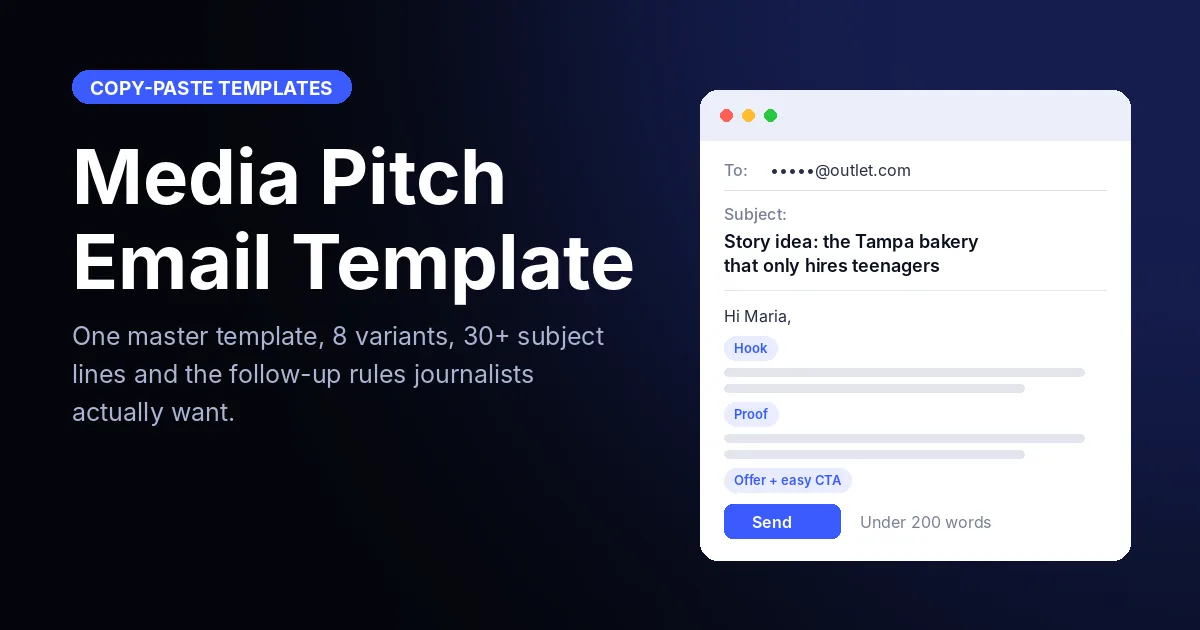
A good media pitch email template has six parts: a subject line that states the story, one personal line, the hook, one piece of proof, what you can offer, and an easy question to finish. Keep it under 200 words, send it one-to-one, and follow up once.
Below is the master template we recommend, explained line by line, followed by eight variants you can copy (launch, local story, data, expert comment, media advisory, exclusive, follow-up and podcast guest), 30+ subject line examples and the timing rules backed by journalist surveys. If you need the newsroom emails to send it to, Media PR Database covers 9,596 news outlets in 195 countries.
What journalists say they want from a pitch
Before the template, the data. These are the numbers that shape every line below.
- 86% of journalists say at least some of their work began with a PR pitch, so pitching still works (Muck Rack State of Journalism 2026, via University of Minnesota).
- 62% prefer to be pitched in a one-to-one email, and 69% prefer pitches under 200 words.
- 78% prefer pitches sent before noon. Half do not care which weekday; of those who do, 18% prefer Monday.
- What they value most in a pitch: clear relevance to their beat (70%), access to relevant sources for interviews (58%), original data or research (40%) and high-resolution images (37%).
- 43% say pitches relevant to their beat are rare.
- In Cision's 2025 State of the Media survey of more than 3,000 journalists, 86% said they will immediately reject a pitch that is not aligned with their beat or audience, and 72% named press releases the most useful thing PR teams provide (Cision).
The takeaway is simple. A short, relevant, one-to-one email with something concrete to offer beats any clever trick. The template does the short part. Relevance comes from sending it to the right person, which is a list problem, not a writing problem.
The master media pitch email template
Copy this, fill in the brackets, then delete anything that does not earn its place. Every variant later in the article is built on this structure.
Subject: [The story in one line, like a headline]

Hi [First name],

[One line that shows you know their work: a recent article, their beat, their section.]

[The hook: what happened or what you found, and why it matters to their readers now.]

[The proof: one number, fact, customer or local detail that makes it real.]

[The offer: who they can interview, what data, images or documents you can send, and any embargo or exclusive.]

Would this be useful for [section or show]? Happy to send [the full data / photos / release] if so.

[Your name]
[Role, company]
[Phone] | [One link]
How to write a media pitch, line by line
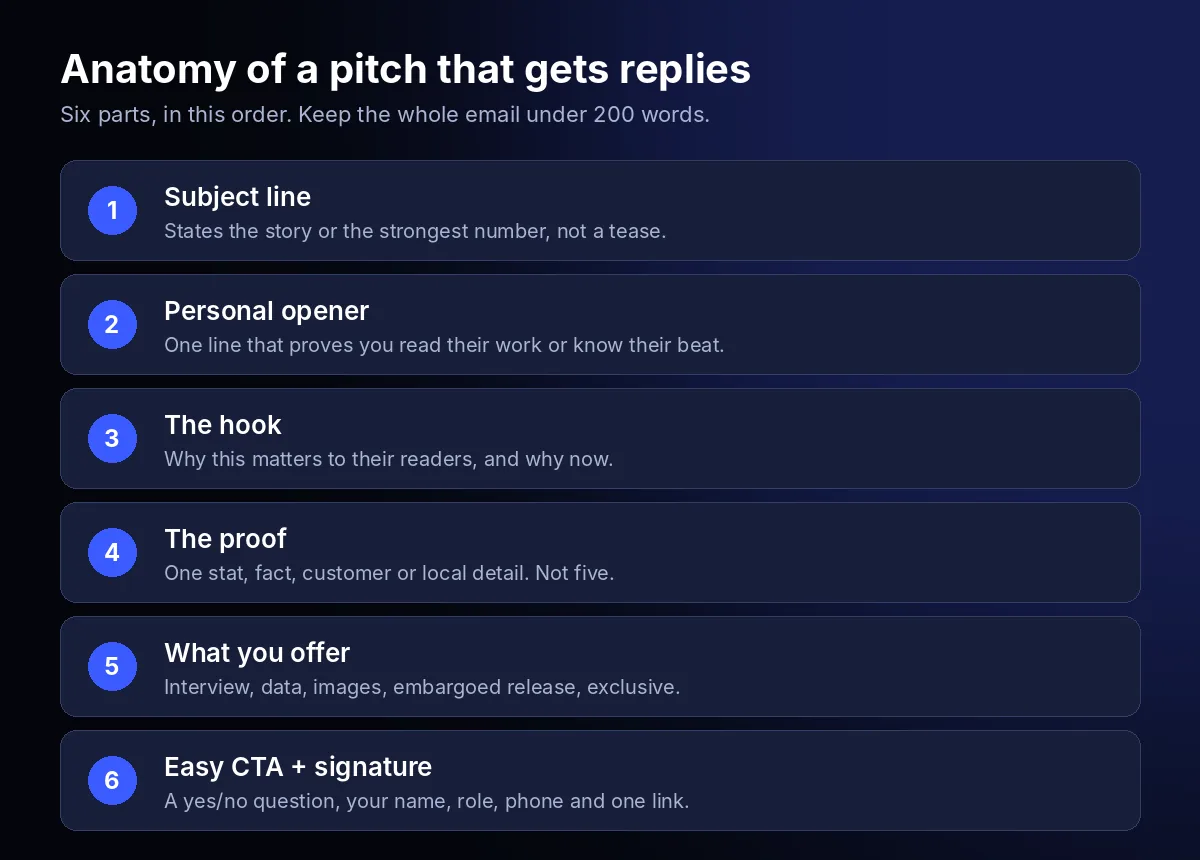
1. The subject line
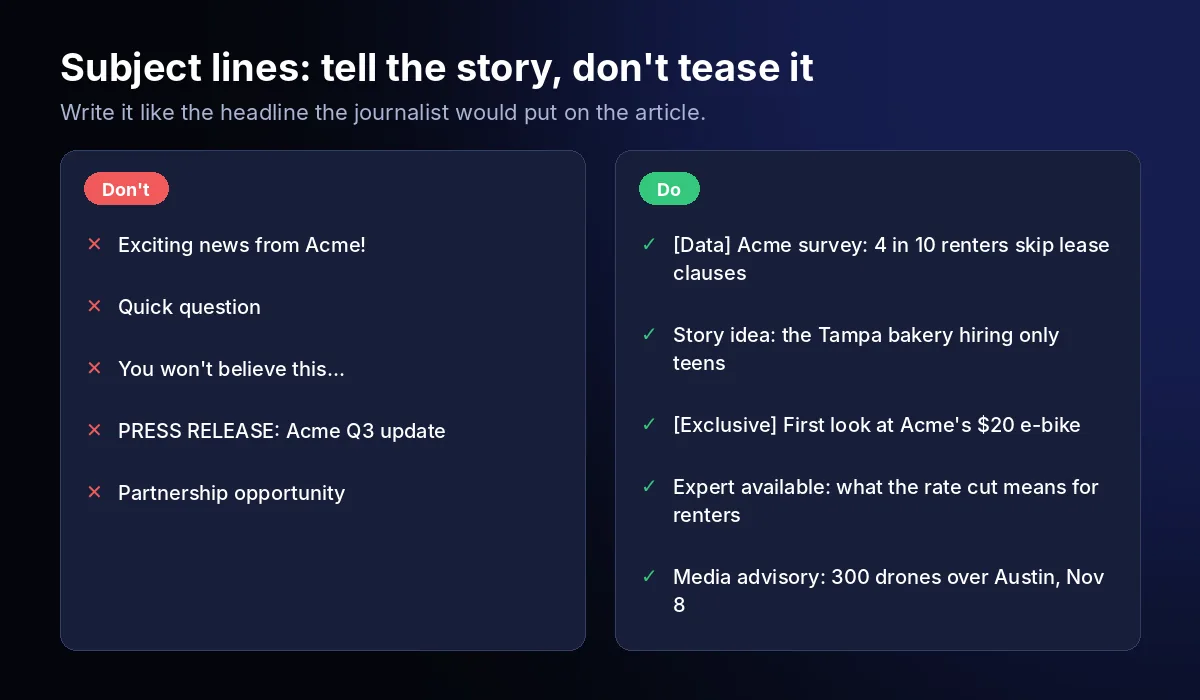
Write it like the headline the journalist would put on the story. State the finding instead of teasing it. In BuzzStream's analysis of more than 6 million digital PR subject lines, lines starting with "Study finds" had the best open and reply rates (nearly 41% opens), and 9 to 13 words performed best for length (BuzzStream). There are 30+ examples further down.
2. The personal opener
One sentence, not a paragraph. Mention a specific recent article or the beat they cover, and connect it to your story. Skip "I hope this email finds you well." The first line often shows in the inbox preview, so it should add information, not pleasantries.
3. The hook
Answer two questions: why would their readers care, and why now? A seasonal moment, a new law, a local first, a trend in the news this week. If you cannot answer "why now", the pitch is not ready.
4. The proof
Give one strong fact, not five. A number from your own data, a named customer, a location, a date. Original data is valued by 40% of journalists in Muck Rack's survey, so if you have it, lead with it.
5. The offer
Tell them exactly what they get: an interview with a named person, the full dataset, photos, a product sample, an embargoed release. Interview access was the second most valued element of a pitch (58%), ahead of data and images.
6. The call to action and signature
End with a question they can answer in one word, such as "Would this work for your weekend section?" Then a short signature with a phone number and one link. Do not attach files to a first email; offer them instead.
Shortcut: if you would rather start from a draft, the free media pitch generator turns your story details into a first version that follows this structure. Then edit it in your own words.
8 media pitch email templates you can copy
Each one is under 200 words. Replace everything in brackets. For pitches written for specific industries, see our sister article with media pitch samples by industry, and for more ready-made formats browse the PR pitch templates page.
1. Product or company launch pitch
Subject: [Company] launches [product], [the one thing that makes it new]

Hi [First name],

I saw your piece on [related topic] last week. [Company] is launching [product] on [date], and it [the specific problem it solves for whom].

What is new: [the one difference from what already exists, in plain words].
Early numbers: [one real figure, e.g. pilot customers, waitlist, test results].

I can offer an interview with [founder name, role], a demo before launch, and product photos. The release is under embargo until [date, time, time zone].

Would a preview be useful for your coverage of [beat]?

[Signature]
2. Local story pitch
Subject: [Town] [business/person] [does something unusual or first]

Hi [First name],

You cover [neighborhood/city] for [outlet], so I thought this might fit. [Short description of the local story in one sentence.]

Why it matters locally: [jobs created, a local problem solved, a community link, a local first].

[Name] is happy to meet in person at [address] any day this week, and we have photos of [subject].

Would this work for [section]?

[Signature]
Local outlets only care about local angles, so name the town in the subject line. To find the papers, TV and radio stations in one area, use the local news finder or browse a ready list such as newspapers in Florida.
3. Data or report pitch
Subject: Study finds [the single most surprising finding]

Hi [First name],

[Company] surveyed [number] [who] in [where] about [topic]. The headline finding: [finding].

Three more results your readers may care about:
- [finding 2]
- [finding 3]
- [finding 4]

Method: [sample size, dates, how it was run]. I can send the full data, charts and regional breakdowns, and [analyst name] is available to explain the numbers.

Would you like the full report before it goes public on [date]?

[Signature]
4. Expert comment pitch (reacting to news)
Subject: Expert available: [what the news means for a specific group]

Hi [First name],

With [news event] today, [expert name], [title] at [company], can explain [the angle your readers need, e.g. what changes for renters next month].

Two points [he/she/they] can speak to:
- [point 1, specific and quotable]
- [point 2]

[Name] is available by phone or video today until [time, time zone]. A short written quote is ready if that is easier.

[Signature]
Speed matters more than polish here. Send it within hours of the news, not days.
5. Event pitch or media advisory
Subject: Media advisory: [what] at [where], [date]

Hi [First name],

WHAT: [event in one line]
WHEN: [date, start and end time, best time for cameras]
WHERE: [full address, parking or access notes]
WHO: [speakers, people available for interviews]
VISUALS: [what a photographer or camera crew will see]

Press can register by replying to this email. [Contact name] will be on site at [phone].

[Signature]
6. Exclusive offer pitch
Subject: [Exclusive for (outlet)] [the story in one line]

Hi [First name],

I would like to offer you this story as an exclusive before anyone else gets it: [story in one sentence].

You would get [interview with X, first look at Y, data Z]. We plan to announce publicly on [date, time, time zone], so you would have until then to publish first.

Could you let me know by [day] if you are interested? If not, no problem at all, I will offer it elsewhere.

[Signature]
Only use the word "exclusive" when it is true, and only offer it to one outlet at a time. In BuzzStream's subject line data, pitches mentioning an exclusive had a 54.16% open rate versus 37.16% without, yet only 13.38% of pitches used one.
7. Follow-up email
Subject: Re: [original subject]

Hi [First name],

Quick follow-up on [story] with one new detail: [new stat, new date, new photo, new person available].

Happy to send [the full data / an interview slot] if it helps. If it is not a fit, no worries, I will keep you in mind for [topic] stories.

[Signature]
8. Podcast guest pitch
Subject: Guest idea for [show name]: [episode topic in one line]

Hi [Host first name],

I enjoyed your episode with [guest] on [topic], especially [specific point]. [Guest name], [title], could go deeper on [related angle].

Possible episode: "[working title]"
Three things listeners would take away:
- [takeaway 1]
- [takeaway 2]
- [takeaway 3]

[Guest] has appeared on [real previous show, if any] and records with a proper mic. Available [days/times].

Would this fit an upcoming episode?

[Signature]
Premium buyers of Media PR Database also get 2,997 podcasts and 123 newsletters as a bonus, which makes this template easy to send to a targeted list of shows.
30+ media pitch subject line examples
All examples below use a fictional company (Acme) or brackets. Swap in your real story and real numbers. Never put a number in a subject line that you cannot back up.
Launch and company news
- Acme launches a $20 e-bike rental for [city] commuters
- [Exclusive] First look at Acme's [product] before [date]
- [City] startup Acme raises [amount] to [do what]
- Acme opens [number] stores in [region], hiring [number] locally
- Acme's new app lets [who] [do what] in [time]
Data and research
- Study finds [X] in [Y] [audience] [do something surprising]
- [Data] [City] ranks [rank] for [topic] in new Acme index
- Data reveals the [state/city] where [thing] costs the most
- Survey: [ratio, e.g. 4 in 10] [audience] [finding]
- [Data] [Topic] up [X]% since [year], Acme analysis shows
- New report ranks [number] [cities/brands] by [metric]
Local stories
- Story idea: the [town] bakery that only hires teenagers
- [Town] family business turns 100 this [month]
- [Neighborhood] residents rebuild [place] after [event]
- [Town] teacher's [project] goes national
- Local angle: what [national news] means for [town]
Expert comment and reactive
- Expert available: what [news] means for [group]
- [Title] can explain [news] today, until [time]
- Comment on [news]: [one-line quotable view]
- [Number] things [group] should do after [news]
- Re your [topic] story: [expert] has new data
Events and advisories
- Media advisory: [event] at [place], [date]
- Photo op: [visual moment] at [place], [date, time]
- Press invite: [event], interviews with [who]
- [Event] returns to [city] on [date] with [new element]
Exclusives, features and podcasts
- [Exclusive for (outlet)] [story in one line]
- Offering you first: [story], embargo [date]
- Feature idea: inside [unusual place or process]
- Guest idea for [show]: [episode topic]
- Podcast guest: [title] on [specific, timely angle]
Follow-ups
- Re: [original subject] (always reply in the same thread)
- Re: [original subject], new photos added
- Re: [original subject], [expert] free [day]
Subject line rules from the data
- Tell, do not tease. In BuzzStream's phrasing study, subject lines that state the finding beat lines that tease it on both opens and replies, and numbers in the first three words performed best (BuzzStream).
- Use one honest bracket tag. [Data], [Expert] or [Exclusive] at the front tells the journalist what is inside. Front-loaded brackets had the best open (52.08%) and reply (2.24%) rates in BuzzStream's study.
- Name the outlet only on real exclusives. Mentioning the publication lifted opens to 50.81% from 39.25%, but it only makes sense when the offer is truly for them.
- No all caps, no "Quick question", no "Press release:" alone. They say nothing about the story.
When to send a media pitch
- Before noon in the journalist's time zone. 78% of journalists prefer morning pitches (Muck Rack 2026).
- Day of the week matters less than you think. Half of journalists do not care; Monday is the most named preference at 18%.
- Weeks ahead for planned stories. Magazines, holiday gift guides and event previews are planned well in advance, so pitch them early.
- Hours, not days, for reactive comment. An expert comment is only useful while the story is being written.
- Give embargoes a clear date, time and time zone. Ambiguity there causes broken embargoes and angry reporters.
Follow-up rules: one nudge, then a new story
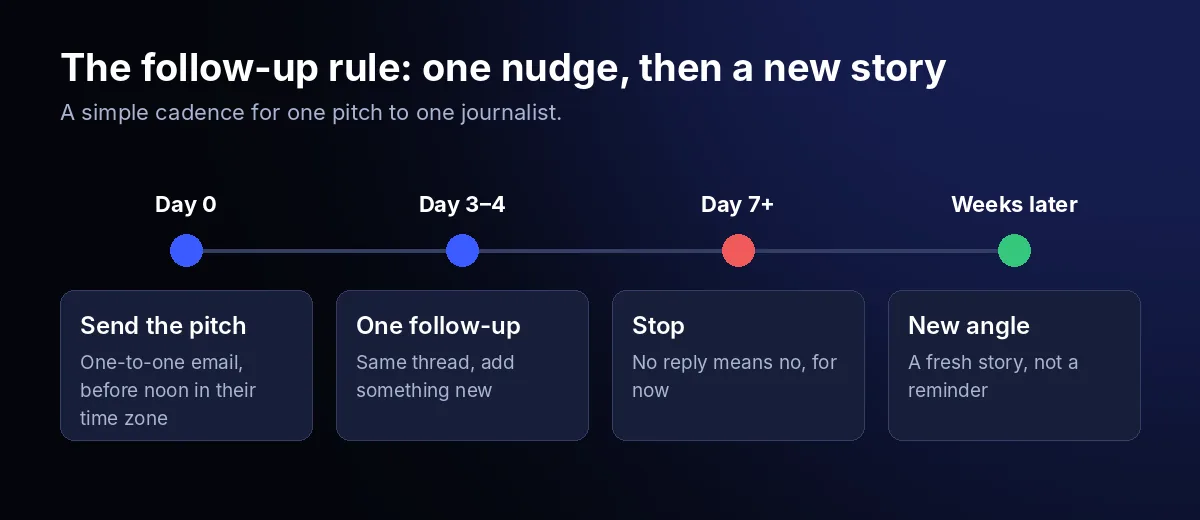
Silence is normal. Propel, citing a large study of pitches, says reporters opened just under half and replied to only about 3% (Propel). That makes a follow-up worth sending, but only one. Propel's guidance matches what most journalists say:
- Wait two to four business days after the first email.
- Reply in the same thread, so the journalist has the context.
- Add something new: a fresh stat, a new photo, an interview slot. "Just checking in" adds nothing.
- Make it shorter than the pitch, two or three sentences.
- Stop after one. No reply means no for this story. Come back later with a different angle.
Repeated chasing is how senders get blocked. If you send pitches as a sequence from a tool, set it to one follow-up and to stop automatically on any reply.
Mistakes that kill a media pitch
- Pitching the wrong beat. This is the number one reason for instant rejection (86% in Cision's survey). Check what the journalist covered in the last few months.
- Mass "Dear editor" blasts. 62% of journalists prefer one-to-one email. Use their first name and a line that only makes sense for them.
- Too long. Over 200 words and the hook gets lost. Put the press release below your signature or offer it as a link.
- Burying the story. If the news is in paragraph three, move it to line two.
- Attachments on first contact. Large files can trigger spam filters. Offer them, or use a link.
- Fake exclusives and fake urgency. An exclusive offered to five outlets is not an exclusive, and journalists talk.
- Unchecked AI copy. Over half of journalists use generative AI themselves, yet 72% worry about factual errors in AI-generated PR content (Cision 2025). If an AI tool helps you draft, check every fact and name before sending.
- Following up three times. One follow-up, then move on.
How to get the right emails for your template
Even a perfect template fails when it goes to the wrong inbox. Relevance is mostly decided before you write: by which outlets and desks you choose.
- Pick the outlets that cover your story. Local news goes to papers, TV and radio in that town; trade news goes to trade titles; national stories go to the right desk, not the general inbox.
- Build a short list. The free media list builder helps you pick outlets by country, state, city and type. For big markets, start from a ready list such as the New York media list or the Canada media list.
- Unlock the newsroom emails. Media PR Database has 16,692 newsroom and journalist emails across 9,596 outlets in 195 countries, including all 50 US states. Pro is $149 one-time for outlet emails and CSV export. Premium is $299 one-time and adds everything, including podcasts and newsletters, plus export formatted for Instantly, Smartlead and Lemlist, so you can load this template and its single follow-up as a sequence. No subscription.
- Personalize the first line for each contact, then send in small batches and track replies.
If you are comparing paid databases, our guides to Cision alternatives and HARO alternatives cover the other ways to reach journalists, including free request feeds.
Media pitch checklist before you hit send
- Subject line states the story, ideally in 9 to 13 words.
- Journalist's first name, spelled correctly, and a line about their work.
- The news is in the first two sentences, with a clear "why now".
- One concrete fact, and every number is sourced.
- A clear offer: interview, data, images, embargo or exclusive.
- Under 200 words, no attachments.
- Sent before noon in their time zone.
- One follow-up scheduled for three or four business days later, in the same thread.
The bottom line
The best media pitch email template is short and specific: a headline-style subject, one personal line, the story, one fact, a clear offer and an easy question. Send it one-to-one to journalists who cover your topic, follow up once with something new, and then move on to your next story. Start with the free media pitch generator for a first draft, and find the right newsrooms with a free search of Media PR Database.
FAQ
What is a media pitch email template?
It is a reusable structure for emailing a journalist about a story: a headline-style subject line, a personal opening line, the hook, one piece of proof, what you can offer (interviews, data, images) and a simple question to finish. You fill in the specifics for each story and each journalist.
How long should a media pitch email be?
Under 200 words. In Muck Rack's State of Journalism 2026, 69% of journalists said they prefer pitches under 200 words. Put the full press release below your signature or offer it as a link instead of making the pitch longer.
What is a good subject line for a media pitch?
One that states the story like a headline, for example 'Study finds...' or '[Data] [City] ranks first for...'. BuzzStream's analysis of 6 million PR subject lines found that 9 to 13 words, a front-loaded bracket tag such as [Data] or [Exclusive], and stating the finding instead of teasing it performed best.
When is the best time to send a media pitch?
Before noon in the journalist's time zone. 78% of journalists prefer morning pitches, according to Muck Rack's 2026 survey. Half do not mind which weekday; Monday is the most common preference among those who do.
How many times should I follow up on a pitch?
Once. Wait two to four business days, reply in the same thread and add something new, such as a fresh stat or an interview slot. If there is still no reply, treat it as a no and come back later with a different story.
Where can I find journalist emails to send my pitch to?
Media PR Database lists 9,596 news outlets in 195 countries with 16,692 newsroom and journalist emails. You can search for free and unlock the emails for $149 one-time (Pro), or $299 one-time (Premium) with podcasts, newsletters and export for cold email tools like Instantly, Smartlead and Lemlist.
Build your media list in minutes
Search free, then download any country or state list as CSV in one click.
Keep reading
17 Media Pitch Samples by Industry (Tech, Food, Health, Local, B2B)
17 copy-paste media pitch samples by industry: tech launch, food, health, local business, B2B data, expert source, event, podcast, newsletter and follow-up, with subject lines and why each works.
Alternatives9 Best PR Newswire Alternatives in 2026 (With Real Prices)
PR Newswire starts at $355 a release and $850 for national reach. Compare 9 PR Newswire alternatives by published price, from $149 wires to pitching journalists directly.
Alternatives9 Best HARO Alternatives in 2026 (Free and Paid)
HARO was shut down, sold and revived. Compare 9 HARO alternatives for getting quoted, from free request emails to Qwoted, plus how to pitch journalists directly.