AP Style for Press Releases: Dateline, Dates, Numbers and Titles (Cheat Sheet)
AP style for press releases in one cheat sheet: how to write the press release dateline, which cities stand alone, AP state abbreviations, dates, times, numbers, percentages, titles, quotes and phone numbers, with a before and after example.
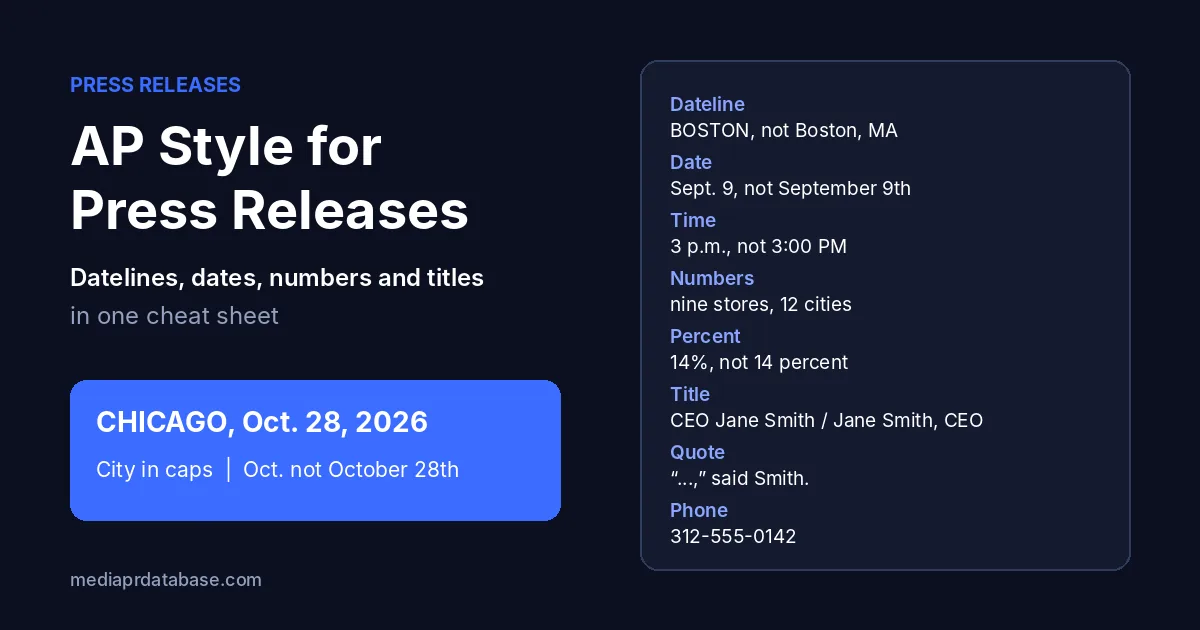
Short answer: AP style for press releases means writing your release the way a newsroom would write the story. Start with a dateline (the city in capital letters, plus the state in AP's abbreviated form unless the city stands alone), use Oct. 28 rather than "October 28th," spell out one to nine and use figures for 10 and up, write 14%, put long job titles after the name in lowercase, and attribute quotes with said.
This guide covers every rule you need for a normal release: the dateline, dates, times, numbers, money, titles, company names, quotes, the serial comma, phone numbers and web addresses. Each rule is checked against public style guides that follow the Associated Press Stylebook, and the sources are linked at the end. You will also find a copy-paste cheat sheet, a release paragraph rewritten from "before" to "after," and the mistakes we see most often. It comes from Media PR Database, a directory of 9,596 news outlets in 195 countries with 16,692 newsroom and journalist emails, so we read a lot of press releases.
Why press releases use AP style
The Associated Press Stylebook is the style guide most American newsrooms use for grammar, spelling, punctuation, numbers and abbreviations. A Prince George's Community College public relations course calls it the standard reference for newspapers, news sites and PR practitioners, and notes that even outlets with their own house style build on it (PGCC PRJ 2000 on LibreTexts).
For a press release, that matters for three practical reasons:
- Less editing for the reporter. A reporter who wants to reuse a sentence or a quote does not have to fix "Sept. 9th" or "Chicago, IL" first.
- It looks like news. A release in newsroom style reads like a story. One full of capitalized job titles and exclamation points reads like an ad.
- It signals care. If the dateline and dates are right, the reader trusts that the facts are right too.
You do not need to own the full Stylebook to get this right. Ten or so rules cover nearly everything that appears in a release. If you want the full reference, the AP Stylebook is sold in print and as an online subscription, and it is updated every year.
The press release dateline in AP style
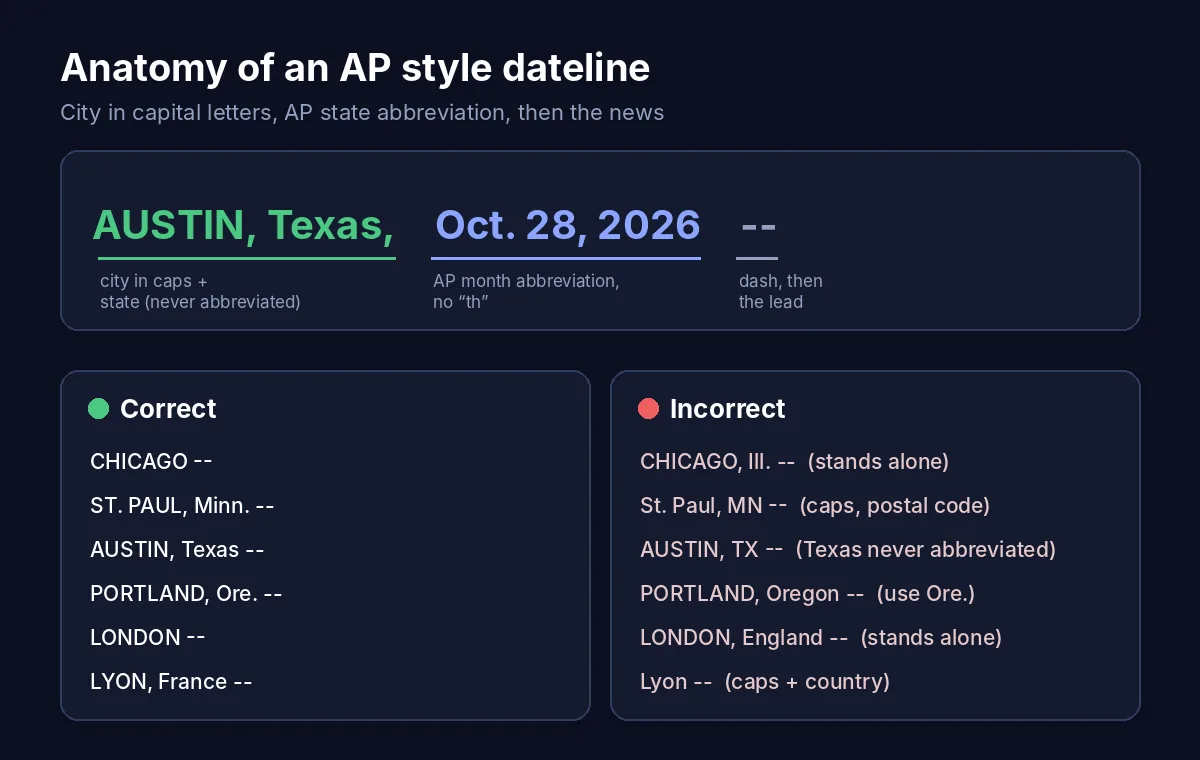
The dateline is the first thing in the body of the release. It tells the reader where the news comes from. AP datelines put the city name in all capital letters, followed in most cases by the state, country or territory where the city is (Cal Poly style guide, which uses AP as its primary reference).
The basic format
In a press release, the dateline usually also carries the release date. These are the common patterns:
CHICAGO, Oct. 28, 2026 -- Lead sentence starts here...

ST. PAUL, Minn. (Oct. 28, 2026) -- Lead sentence starts here...

AUSTIN, Texas, Oct. 28, 2026 /PRNewswire/ -- Lead sentence starts here...
The first two are what you write when you send the release yourself. The third is how wire services such as PR Newswire stamp a release; the wire adds its own tag, so you normally only supply the city and state. AP's own news stories separate the dateline from the text with a long dash; in a press release, two hyphens or the wire's own format are the usual choice. Whichever you pick, use it the same way every time.
Cities that stand alone in a dateline
Some US cities are so well known that AP uses them without a state. These 30 stand alone in datelines (Cal Poly; Writing Explained):
| US cities that need no state in an AP dateline | ||
|---|---|---|
| ATLANTA | HOUSTON | PHILADELPHIA |
| BALTIMORE | INDIANAPOLIS | PHOENIX |
| BOSTON | LAS VEGAS | PITTSBURGH |
| CHICAGO | LOS ANGELES | ST. LOUIS |
| CINCINNATI | MIAMI | SALT LAKE CITY |
| CLEVELAND | MILWAUKEE | SAN ANTONIO |
| DALLAS | MINNEAPOLIS | SAN DIEGO |
| DENVER | NEW ORLEANS | SAN FRANCISCO |
| DETROIT | NEW YORK | SEATTLE |
| HONOLULU | OKLAHOMA CITY | WASHINGTON |
Every other US city takes a state, including well-known ones that are easy to get wrong: KANSAS CITY, Mo. or KANSAS CITY, Kan., ST. PAUL, Minn. and NASHVILLE, Tenn. (Writing Explained).
AP state abbreviations in datelines (not postal codes)
This is the single most common dateline error. In a dateline, AP uses its own state abbreviations, which are not the two-letter postal codes. Postal codes such as CA or IL belong only in a full mailing address with a ZIP code (PGCC on LibreTexts).
| State | AP | State | AP | State | AP |
|---|---|---|---|---|---|
| Alabama | Ala. | Kentucky | Ky. | North Dakota | N.D. |
| Arizona | Ariz. | Louisiana | La. | Oklahoma | Okla. |
| Arkansas | Ark. | Maryland | Md. | Oregon | Ore. |
| California | Calif. | Massachusetts | Mass. | Pennsylvania | Pa. |
| Colorado | Colo. | Michigan | Mich. | Rhode Island | R.I. |
| Connecticut | Conn. | Minnesota | Minn. | South Carolina | S.C. |
| Delaware | Del. | Mississippi | Miss. | South Dakota | S.D. |
| Florida | Fla. | Missouri | Mo. | Tennessee | Tenn. |
| Georgia | Ga. | Montana | Mont. | Vermont | Vt. |
| Illinois | Ill. | Nebraska | Neb. | Virginia | Va. |
| Indiana | Ind. | Nevada | Nev. | Washington | Wash. |
| Kansas | Kan. | New Hampshire | N.H. | West Virginia | W.Va. |
| New Jersey | N.J. | New Mexico | N.M. | Wisconsin | Wis. |
| New York | N.Y. | North Carolina | N.C. | Wyoming | Wyo. |
Never abbreviated: Alaska, Hawaii, Idaho, Iowa, Maine, Ohio, Texas and Utah. So it is AUSTIN, Texas and DES MOINES, Iowa (Cal Poly).
State names in the body of the release
Here is a rule that changed. Since 2014, AP spells out the names of all 50 states in the body of a story, whether the state stands alone or follows a city. The Stylebook's own account confirmed in 2021 that "we made this change away from abbreviations in 2014" (quoted on PR Newswire's Beyond Bylines). The abbreviations above are now for datelines, lists, tables, captions and credit lines.
- Right (body): The company will open stores in Peoria, Illinois, and Macon, Georgia.
- Wrong (body): The company will open stores in Peoria, Ill., and Macon, GA.
Two details: put a comma after the state as well as before it ("Peoria, Illinois, and Macon"), and you do not need a state for a city in the same state as your dateline (Cal Poly).
International datelines
Outside the US, AP datelines use the city in capitals followed by the country spelled out, for example LYON, France. A list of major world cities stands alone, including LONDON, PARIS, TOKYO, BEIJING, BERLIN, DUBLIN, HONG KONG, MADRID, MEXICO CITY, MONTREAL, MOSCOW, NEW DELHI, ROME, SINGAPORE, SYDNEY, TORONTO and ZURICH, among others (Cal Poly's full list). For Canada, cities other than Montreal, Quebec City and Toronto take the province, spelled out and never abbreviated: VANCOUVER, British Columbia (Writing Explained).
| Write | Not | Why |
|---|---|---|
| LONDON -- | LONDON, England -- | London stands alone |
| MUNICH -- | MUNICH, Germany -- | Munich is on the stand-alone list |
| LYON, France -- | Lyon -- | Not on the list: city in caps plus country |
| CALGARY, Alberta -- | CALGARY, AB -- | Canadian provinces are spelled out |
Dates, months and days in AP style
AP month abbreviations
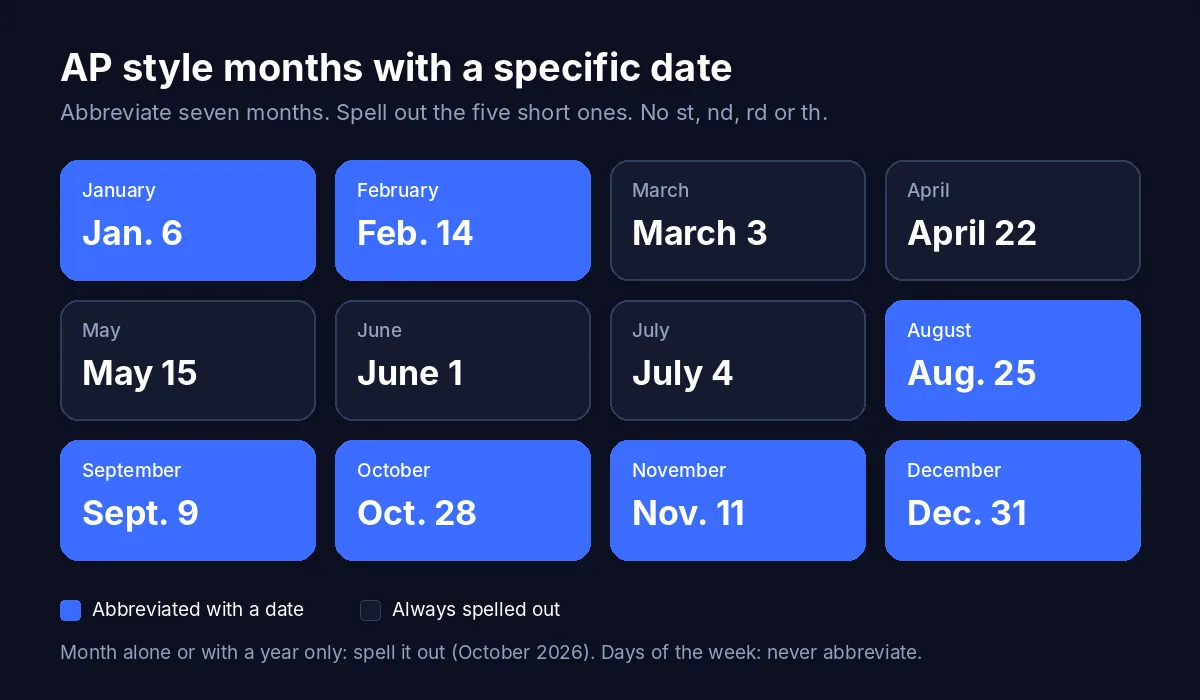
When a month is used with a specific date, abbreviate only Jan., Feb., Aug., Sept., Oct., Nov. and Dec. Always spell out March, April, May, June and July. When a month stands alone or appears with only a year, spell it out (Cal Poly; PGCC).
- The festival runs Sept. 12-14. (month with a date: abbreviate)
- The festival returns in September. (month alone: spell out)
- The store opened in September 2025. (month and year only: spell out, no comma)
- The store opens June 5. (short month: never abbreviated)
Note that September is Sept., not "Sep."
No st, nd, rd or th
Use plain figures for dates: Oct. 28, not "Oct. 28th" or "October 28th" (Cal Poly).
Commas with full dates
When you give month, day and year, set the year off with commas on both sides: "The product ships Feb. 14, 2027, to customers in 12 countries." With only a month and year, use no comma: "January 2027" (Cal Poly).
Days of the week
- Never abbreviate days of the week: Thursday, not Thurs. (Cal Poly).
- For something within the past or coming week, the day name is enough: "on Thursday." For anything further away, use the month and a figure (PGCC).
- The 2018 Stylebook added guidance to use the day of the week rather than "today" or "tomorrow" for when an event happens (Communiqué PR summary of the 2018 changes). This is useful in releases, because a release is often read days after it goes out, so "today" quickly becomes wrong.
Years and decades
Use figures for years, an "s" without an apostrophe for decades (the 1990s), and an apostrophe in place of missing numbers (the '90s). A sentence may start with a year: "2026 was the company's best year" (PGCC).
Times: a.m., p.m., noon and midnight
Event releases and media advisories live or die on times, so get this right:
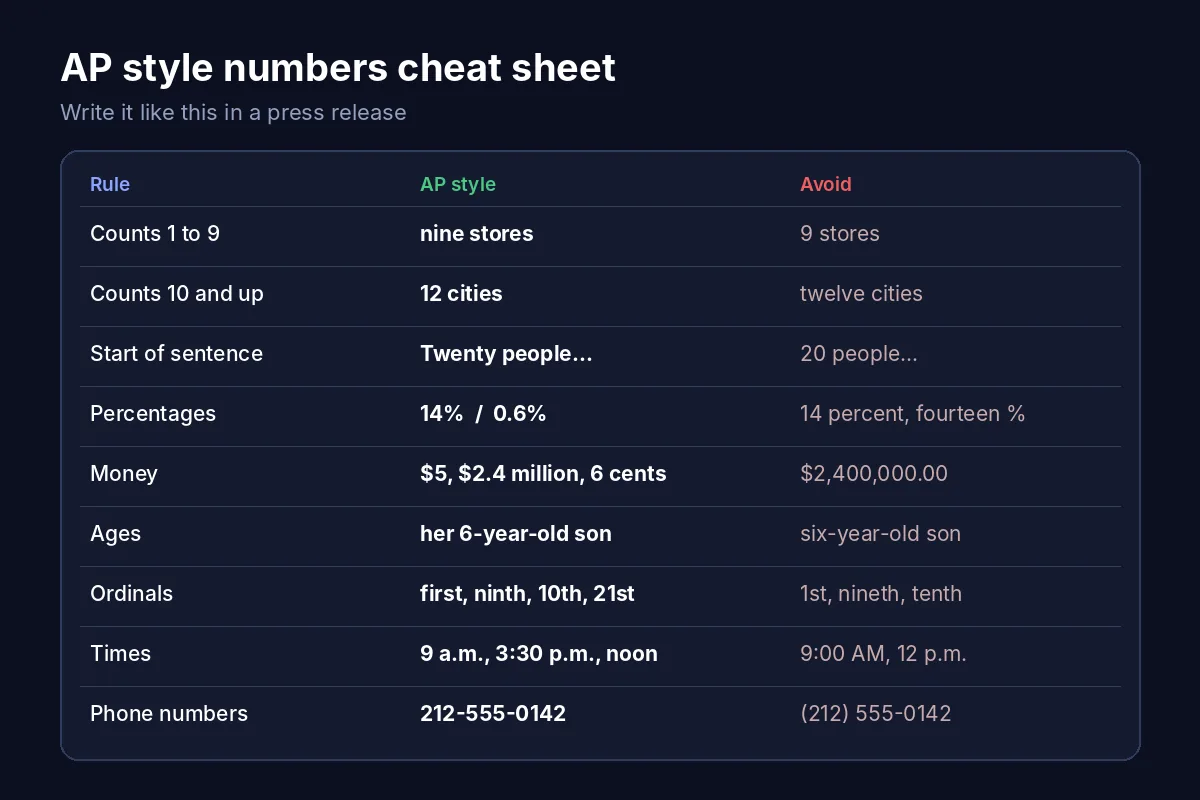
- Use figures with lowercase a.m. and p.m., with periods and no spaces inside: 9 a.m., 3:30 p.m.
- Do not add ":00" to an even hour: 7 p.m., not 7:00 p.m.
- Write noon and midnight, not 12 p.m. or 12 a.m. (Cal Poly).
- For ranges, a hyphen with no spaces is common in AP-based guides: 9-11 a.m. (Cal Poly uses the hyphen for inclusive numbers and times).
A typical order for an event line is time, day, date, place: "The ribbon cutting is at 10 a.m. Saturday, Nov. 14, at 210 Main St." If you are writing an event announcement, our event press release template shows the full format.
Numbers in AP style
One to nine in words, 10 and up in figures
Spell out whole numbers below 10 and use figures for 10 and above: "five new hires and 11 open roles." Use commas in thousands: 2,568 (Cal Poly; PGCC).
Never start a sentence with a figure
Spell the number out, or rewrite the sentence: "Twenty-seven companies signed up," or "The program has 27 companies." The one exception is a year (PGCC).
Percentages: the % sign since 2019
This rule changed. AP now uses the % sign with a figure, with no space: 14%, 0.6%, 4.75%. The change came in 2019; before that, AP wrote "percent" (Cal Poly, which notes the date of the change). Many older guides online, and some university guides that depart from AP, still say "percent," so do not be surprised to see both.
- Use a figure even below 10: 3%, not three percent.
- Put a zero before a decimal under 1: 0.6%.
- If a percentage starts a sentence, spell out both: "Eighty-nine percent of buyers..."
- Use "percentage" without a number: "The percentage of repeat customers grew."
- A rise from 10% to 13% is 3 percentage points, not 3% (Cal Poly).
Money
Use figures and the dollar sign: $5, $26.52. Spell out cents for amounts under a dollar: 6 cents. For $1 million and up, use a figure with the word: $8 million, $2.4 billion (PGCC). In a funding announcement, "raised $12 million" is right; "$12,000,000" is not.
Ages
Always use figures for people's ages, even under 10. Hyphenate when the age comes before a noun or stands in for one: "a 6-year-old daughter," "the contest is for 18-year-olds," but "the student is 21 years old." Decades of age take no apostrophe: "in his 20s" (PGCC; Cal Poly).
Ordinals
Spell out first through ninth and use figures from 10th up when you mean order in time or place: "the company's third location," "its 10th year in a row." Some ordinals use figures in every case, such as political or court districts: 3rd District Court (PGCC).
Large numbers and rank
- Round large numbers and spell out millions where the exact figure does not matter: "about 50 million" rather than 49,850,000 (Cal Poly).
- Use "No." with a figure for rank: No. 1 (Cal Poly).
Titles, names and company names
Job titles: capitalized before the name, lowercase after
Capitalize a formal title when it comes directly before a name. Lowercase it when it follows the name, stands alone or is set off by commas. If a title is long, put it after the name (PGCC).
| Write | Not |
|---|---|
| Maria Lopez, vice president of marketing at Acme | Maria Lopez, Vice President of Marketing at Acme |
| President Maria Lopez | president Maria Lopez |
| the company's chief financial officer | the company's Chief Financial Officer |
| Sen. Jane Doe (formal title before a full name) | Senator Jane Doe, on first reference outside a quote |
In a press release, the simplest habit is name first, title after, lowercase: "said Maria Lopez, vice president of marketing at Acme." It reads naturally and avoids the question of which titles count as formal. Titles such as Gov., Sen., Rep., Dr. and the Rev. are abbreviated before a full name outside a quote (PGCC).
Names on second reference
Use the full name on first reference and only the last name after that. Skip courtesy titles such as Mr., Mrs. and Ms. unless they appear in a quote or are needed to tell two people apart (PGCC). So it is "Lopez said," not "Ms. Lopez said" or "Maria said."
Company names
- Abbreviate Co., Corp., Inc. and Ltd. after a company name, and do not put a comma before Inc. or Ltd.: Ford Motor Co., Acme Widgets Inc. (Cal Poly).
- Do not write a name in all capital letters unless the letters are said one by one: IBM, but not ACME for a company called Acme (Cal Poly). Your logo can be in caps; your release copy should not.
- Use "&" only when it is part of the official name; otherwise write "and" (PGCC).
- Leave trademark symbols out of copy written for reporters.
Abbreviations and acronyms
Very well-known abbreviations such as FBI or NASA can be used on any reference. Less familiar ones should be spelled out on first reference. AP warns against "alphabet soup," and it does not like putting an unfamiliar abbreviation in parentheses after the full name; repeat the name or use a generic term such as "the association" instead (PGCC). That habit of writing "Widget Alliance (WA)" in a release is not AP style.
Titles of books, shows and reports
Put quotation marks around the titles of books, songs, TV shows, games, speeches and works of art. Do not italicize or underline. Names of newspapers and magazines take no quotation marks: The Washington Post (PGCC).
Quotes and attribution: use "said"
AP-based guides recommend "said" as the attribution verb because it is neutral and does not call attention to itself. Words like "exclaimed," "declared," "remarked" or even "noted" put the writer between the reader and the speaker (Missouri State editorial style guide, which follows AP). For a press release, use "said" in the past tense, and give the full name and title on first reference.
Right:  "We built this for teams without a data analyst," said Maria Lopez, vice president of product at Acme.
Right:  "We built this for teams without a data analyst," Lopez said.
Avoid:  "We are thrilled to announce..." exclaimed Maria Lopez, Vice President of Product.
- Periods and commas always go inside the quotation marks (Cal Poly).
- When a quote runs over several paragraphs, leave off the closing quote mark at the end of each paragraph except the last, but open each new paragraph with one (Cal Poly).
- "Said Maria Lopez" (verb first) is common when the title is long; "Lopez said" (name first) is the norm with a short attribution.
Punctuation, phone numbers and web addresses
The Oxford comma
AP does not use a comma before the final "and" or "or" in a simple series: "red, white and blue." It does use one when an item in the series already contains "and," or when the series is made of long phrases: "orange juice, toast, and ham and eggs" (Cal Poly; PGCC).
Spaces, hyphens and lists
- One space after a period, not two (Cal Poly).
- Bulleted lists: AP uses dashes or bullets, capitalizes the first word of each item and ends each item with a period, not a semicolon. It announced this list guidance in its 2018 edition and repeated it on its social account in 2021 (Communiqué PR; Beyond Bylines).
Phone numbers
Use hyphens and no parentheses around the area code: 212-555-0142, not (212) 555-0142 (Cal Poly). Some organizations prefer periods in their own materials, but hyphens are the AP form, and that is what belongs in your media contact block.
Websites, email and internet terms
- Write website, email, internet and smartphone, all lowercase and closed up (Cal Poly).
- When you print a web address in text, many AP-based guides drop "https://" and "www" and the trailing slash: acme.com/launch (Missouri State).
- In an online release, link descriptive words rather than pasting a bare URL or writing "click here."
AP style press release cheat sheet
Copy this table into your release checklist. It covers the rules above in one place.
| Item | AP style | Not |
|---|---|---|
| Dateline, stand-alone city | CHICAGO -- | Chicago, IL -- |
| Dateline, other US city | NAPERVILLE, Ill. -- | NAPERVILLE, IL -- |
| Dateline, never-abbreviated state | AUSTIN, Texas -- | AUSTIN, Tex. -- |
| Dateline, foreign city | LYON, France -- | Lyon, FR -- |
| State in body copy | Macon, Georgia, and Peoria, Illinois | Macon, Ga. and Peoria, IL |
| Date | Oct. 28, 2026, | October 28th, 2026 |
| Short month | June 5 | Jun. 5 |
| Month alone | in October | in Oct. |
| September | Sept. 9 | Sep. 9 |
| Day | Thursday | Thurs. |
| Time | 7 p.m., 9:30 a.m., noon | 7:00 PM, 12 p.m. |
| Small number | nine stores | 9 stores |
| Number 10+ | 12 cities | twelve cities |
| Percent | 14% | 14 percent, 14 % |
| Money | $2.4 million, 6 cents | $2,400,000, $0.06 |
| Age | a 6-year-old girl | a six year old girl |
| Ordinal | third, 10th | 3rd, tenth |
| Title after name | Jane Smith, chief marketing officer | Jane Smith, Chief Marketing Officer |
| Second reference | Smith said | Ms. Smith said, Jane said |
| Attribution | said | stated, exclaimed, shared |
| Company suffix | Acme Widgets Inc. | Acme Widgets, Inc. |
| Series | red, white and blue | red, white, and blue |
| Phone | 312-555-0142 | (312) 555-0142 |
| Web terms | website, email, internet | web site, e-mail, Internet |
Before and after: a release paragraph rewritten in AP style
Here is a made-up opening paragraph with the kind of errors we see every week. Northwind Coffee Co. is an invented company for this example.
Before
Naperville, IL (October 6th, 2026) -- NORTHWIND COFFEE COMPANY, INC. is thrilled to announce the opening of their 4th location on Saturday, Oct. 17th at 8:00 AM. The new 2,400 square foot café will create 15 new jobs and offer a fifteen percent discount for the first 2 weeks. "This is a huge milestone for us!" exclaimed Chief Executive Officer Dana Reyes. "We've grown 300 percent since we opened in Aug. of 2021." For more information, visit https://www.northwindcoffee.com/ or call (630) 555-0108.
After
NAPERVILLE, Ill. (Oct. 6, 2026) -- Northwind Coffee Co. will open its fourth location at 8 a.m. Saturday, Oct. 17, a 2,400-square-foot cafe that will create 15 jobs and offer 15% off for the first two weeks.

"We've grown 300% since we opened in August 2021, and this store lets us serve the north side of town," said Dana Reyes, chief executive officer of Northwind Coffee.

More information is at northwindcoffee.com or 630-555-0108.
What changed and why
- Dateline: city in caps and the AP abbreviation "Ill.," not the postal code "IL."
- Dates: "Oct. 6" and "Oct. 17" with no "th"; "August 2021" spelled out because there is no day.
- Time: "8 a.m.," not "8:00 AM."
- Company name: normal capitals, "Co." abbreviated, no comma before a suffix.
- Numbers: "fourth" (ordinal below 10th), "two weeks" (below 10), "15 jobs" (10 and up), "15%" and "300%" (figure plus % sign).
- Title: moved after the name and lowercased.
- Attribution: "said," not "exclaimed." The quote now says something specific instead of "huge milestone."
- Hype: "is thrilled to announce" is gone. The lead starts with the news.
- Agreement: a company is "its," not "their."
- Contact line: a plain web address and an AP-style phone number.
The "after" version is shorter and every fact survived. For guidance on how long the full release should be, see how long a press release should be, and for the closing "About" paragraph, our press release boilerplate examples.
Common AP style mistakes in press releases
- Postal codes in the dateline. "DENVER, CO" is wrong twice: Denver stands alone, and AP never uses CO in a dateline.
- Adding a state to a stand-alone city. "BOSTON, Mass." is unnecessary.
- Abbreviating Texas, Ohio or the other six. Alaska, Hawaii, Idaho, Iowa, Maine, Ohio, Texas and Utah are always spelled out.
- Ordinal dates. "Nov. 3rd" should be "Nov. 3."
- Abbreviating short months. "Jun. 5" and "Mar. 12" are not AP style.
- "12 p.m." and ":00". Write noon, and 7 p.m.
- "Percent" in new copy. AP has used the % sign since 2019.
- Capitalized titles after a name. "Jane Smith, Director of Sales" should be "Jane Smith, director of sales."
- Fancy attribution verbs. "Shared," "stated," "exclaimed" and "enthused" all become "said."
- Company names in all caps and trademark symbols in body copy.
- Parentheses around area codes. Use 212-555-0142.
- "Today" in a release that will be read next week. Use the day and date.
Send your AP-style release to the right reporters
Clean style gets a release read, but only if it reaches a reporter who covers the topic. A local story belongs with local media: you can find local newspapers by city, or start from a state list such as our New York media list, newspapers in Illinois or the Georgia media list. For a wider campaign, the media list builder filters outlets by country, state and topic, and the media pitch generator helps you write the short email that goes on top of the release.
Media PR Database covers 9,596 news outlets in 195 countries with 16,692 newsroom and journalist emails, including outlets in all 50 US states. Pro ($149, one-time) includes outlet emails and CSV export. Premium ($299, one-time) adds 2,997 podcasts and 123 newsletters as a bonus. There is no subscription. See pricing.
Sources
We checked each rule on October 28, 2026, against these publicly readable guides. Where two guides differ, we followed the one that states it is applying current AP guidance. We paraphrased rules rather than quoting the Stylebook.
- Cal Poly University Communications style guide (AP as primary reference): datelines and stand-alone city lists, state names, dates, times, numbers, percent change in 2019, company names, punctuation, telephone numbers, web terms.
- Prince George's Community College, PRJ 2000: Newswriting for Public Relations, "AP Style" (LibreTexts): AP state abbreviations, ages, money, ordinals, titles, abbreviations, names, composition titles.
- Writing Explained, "AP Style Datelines": domestic, Canadian and international dateline rules.
- PR Newswire Beyond Bylines, "AP Style Rules to Remember for Your Writing" (2021): AP's statement that state names have been spelled out in body copy since 2014; list formatting.
- Communiqué PR, "10 Updates to the 2018 AP Stylebook": days of the week instead of today or tomorrow; bulleted lists.
- Missouri State University editorial style guide (AP as main reference): attribution with "said," web addresses in print.
- The Associated Press Stylebook: the full, paid reference, updated yearly.
The bottom line
AP style for a press release comes down to a short list: city in caps in the dateline, AP state abbreviations there and full state names in the body, Oct. 28 with no "th," 7 p.m. and noon, one to nine in words and 10 and up in figures, the % sign, titles after the name in lowercase, "said" for quotes, no Oxford comma in a simple series, and phone numbers with hyphens. Run your draft against the cheat sheet above before you send it, and the reporter can lift your sentences straight into a story.
FAQ
What is a press release dateline in AP style?
It is the opening of the release body that says where the news comes from: the city in capital letters, followed by the state in AP's abbreviated form (for example NAPERVILLE, Ill.) unless the city is one of the 30 US cities that stand alone, such as CHICAGO or NEW YORK. Press releases usually add the release date, for example CHICAGO, Oct. 28, 2026.
Which cities do not need a state in an AP dateline?
Atlanta, Baltimore, Boston, Chicago, Cincinnati, Cleveland, Dallas, Denver, Detroit, Honolulu, Houston, Indianapolis, Las Vegas, Los Angeles, Miami, Milwaukee, Minneapolis, New Orleans, New York, Oklahoma City, Philadelphia, Phoenix, Pittsburgh, St. Louis, Salt Lake City, San Antonio, San Diego, San Francisco, Seattle and Washington. Major world cities such as London, Paris and Tokyo also stand alone.
Should I use postal codes like CA or IL in a press release?
Not in the dateline or body. AP datelines use AP abbreviations such as Calif. and Ill., and since 2014 AP spells out state names in the body of a story. Postal codes belong only in a full mailing address with a ZIP code.
How do you write dates in AP style?
Abbreviate Jan., Feb., Aug., Sept., Oct., Nov. and Dec. when used with a date, always spell out March, April, May, June and July, and spell out any month used alone or with only a year. Do not add st, nd, rd or th: write Oct. 28, not October 28th.
Does AP style use percent or the % sign?
The % sign. Since 2019, AP uses a figure with the % sign and no space, such as 14% or 0.6%. Spell out the number and the word percent only when a percentage starts a sentence.
Does AP style use the Oxford comma?
Not in a simple series: write red, white and blue. AP does use a comma before the final conjunction when an item in the series contains its own and, or when the series is made of long phrases and the comma prevents confusion.
Build your media list in minutes
Search free, then download any country or state list as CSV in one click.
Keep reading
Media Advisory vs Press Release: Differences and Templates
Media advisory vs press release: what each one is for, when to send it, how long it should be, a real NASA media advisory broken down, and copy-and-paste templates for both.
Press releasesEmbargoed Press Release: How It Works (With Template)
What an embargoed press release is, when to use one, how to write the embargo line, who to send it to, how embargoes work at journals like PLOS and on EurekAlert, and a copy-and-paste template.
Press releasesFree Press Release Distribution: Does It Work in 2026?
An honest look at free press release distribution in 2026: what PRLog, openPR and other free sites really give you, the limits, why Google ignores the links, and the free route that actually gets coverage.