Embargoed Press Release: How It Works (With Template)
What an embargoed press release is, when to use one, how to write the embargo line, who to send it to, how embargoes work at journals like PLOS and on EurekAlert, and a copy-and-paste template.
Short answer: an embargoed press release is news you share with selected reporters before it is public, on the condition that they do not publish until a set date and time. The embargo gives reporters time to interview people and check facts, and it makes coverage land together when the news goes live. You write the embargo at the very top, for example EMBARGOED UNTIL 9:00 a.m. ET, Tuesday, March 3, 2026, and you send it only to reporters who have agreed to honor it.
This guide covers when an embargo is worth using, how science journals and EurekAlert! run theirs, how to send one step by step, what to do when someone breaks it, and a template you can copy. It is written by Media PR Database, a directory of 9,596 news outlets in 195 countries with 16,692 newsroom and journalist emails.
What is a press embargo?
EurekAlert!, the science news service run by the American Association for the Advancement of Science (AAAS), defines a news embargo as "a prohibition against making public, in any way, certain information before a specific date/time" (EurekAlert! FAQ, read Nov. 14, 2026). Wikipedia notes that embargoes are often used by businesses announcing products, by medical journals, and by government officials announcing policy, and that the idea is to let reporters prepare stories so they run at the announcement time (Wikipedia, News embargo).
An embargo is an agreement, not a law. It only works if the reporter agreed to it before receiving the details. Sending news to someone who never agreed and then writing "embargoed" at the top is a request, not a deal.
When to use an embargo (and when not to)
Good reasons
- Complex news that needs explaining: research findings, a big data report, a product with technical details. Reporters need time to read, ask questions and get outside comment.
- A fixed release moment: a journal publication time, a conference keynote, a product launch or a report going live on your site.
- You want several outlets on the same day: trade press, local news and national press all running at once.
Bad reasons
- Small or simple news. A new hire or a minor update does not need preparation time. Just send it.
- Making news look bigger. Reporters notice when an embargo is only theater.
- Sending to people you do not know. If you have no relationship and no agreement, the embargo is easy to ignore.
Embargo vs. exclusive vs. open release
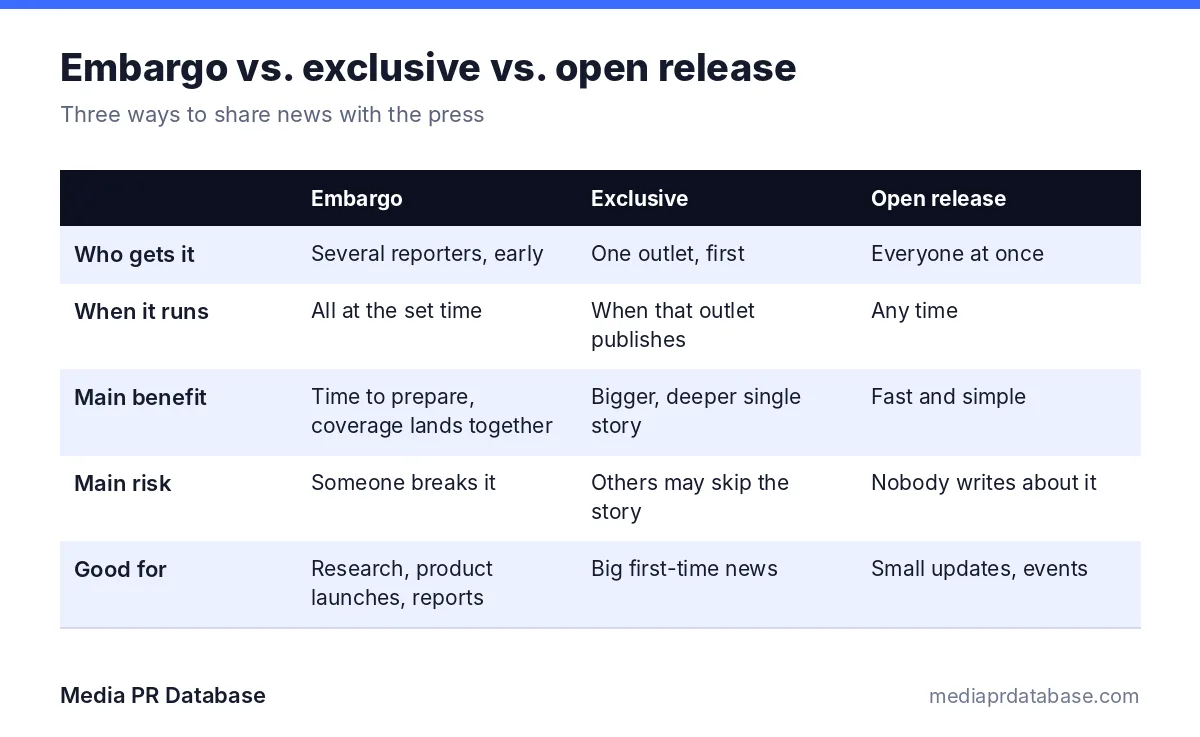
An exclusive gives one outlet the story first. An embargo gives several outlets the story early, with everyone publishing at the same time. Do not mix them up in your emails: offering an "exclusive" to three reporters is the fastest way to lose all three. Whichever you choose, relevance matters more than format: Cision's 2025 State of the Media report found that 86% of journalists immediately reject a pitch that is not aligned with their beat or audience (Cision, 2025 State of the Media).
How the science world runs embargoes
Academic publishing is where embargoes are most formal, and it is a useful model for any company.
Journals set a fixed time
PLOS Biology says its articles "are embargoed until 2 p.m. Eastern Time, USA, on the date of publication," the moment the article goes online. It also says it does not discuss any manuscript with the media until it has been accepted and given a publication date, and that the embargo date and time will be "clearly stated" on everything it sends (PLOS Biology, Press and Media, read Nov. 14, 2026).
Reporters sign up and agree first
On EurekAlert!, reporters must meet eligibility criteria and "digitally sign an embargo agreement" before they get access to the reporter-only section with embargoed releases. Accounts cannot be shared; every journalist registers individually. EurekAlert! also says it only recognizes embargoes set by legitimate content owners, such as journal publishers and scientific meeting organizers (EurekAlert! FAQ).
The lesson for companies: one fixed time, stated clearly, and agreement before access. You do not need a platform to do this. You need a clear email and a yes from each reporter.
How to send an embargoed press release, step by step
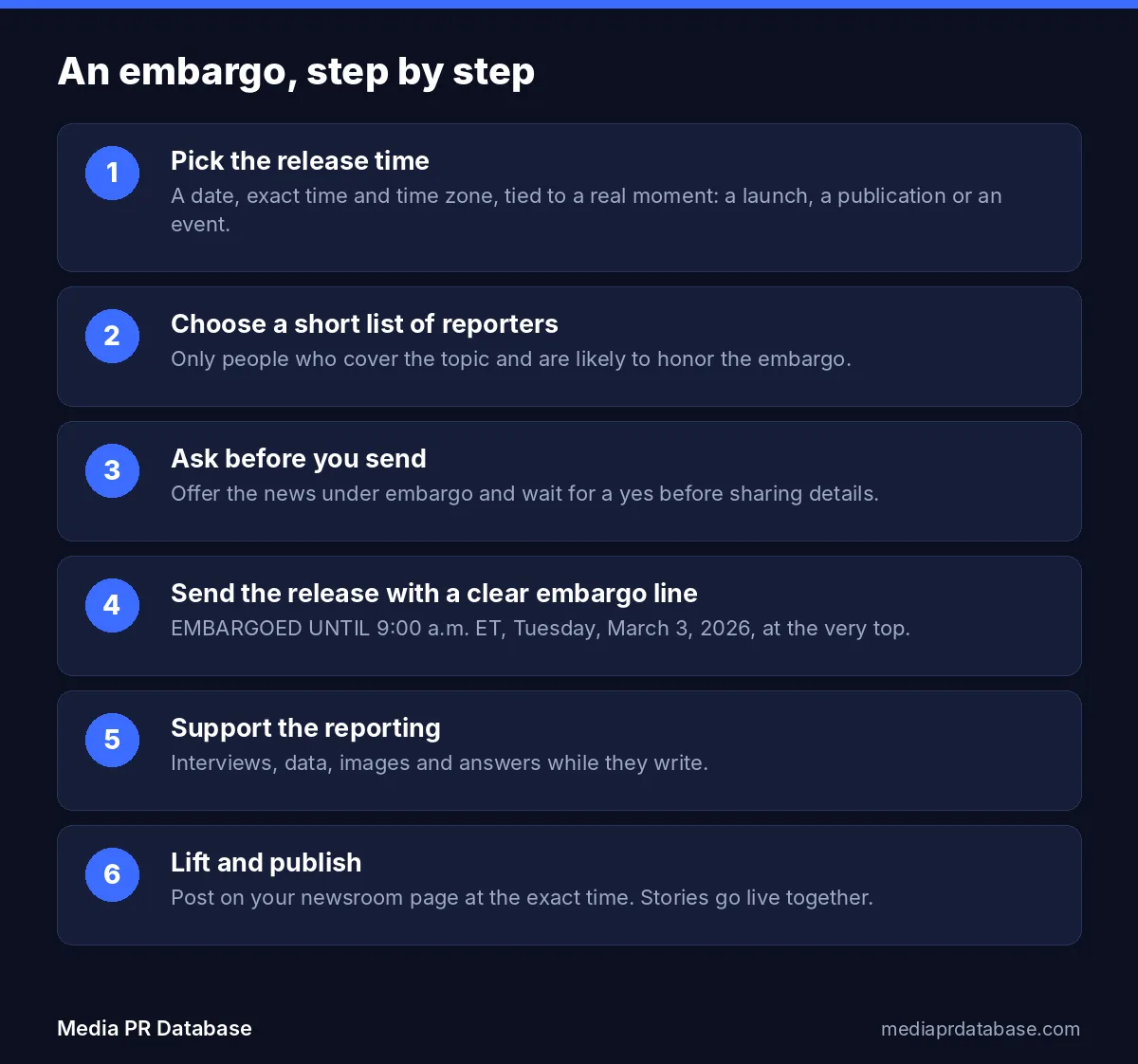
1. Pick the release time
Choose a date, an exact time and a time zone. Tie it to something real: the moment your product page goes live, a journal's publication time or the start of a keynote. Early morning in your main market (for example 6:00 or 9:00 a.m. ET for US news) gives the story a full news day.
2. Choose a short list
Pick reporters who cover your topic and who have a reason to honor the embargo: they have covered you before, or they cover your beat closely. Five to twenty is a normal size. For local news, start with outlets in your area, for example California news outlets or Canadian media. The free Media List Builder helps you shortlist outlets by place and type.
3. Ask before you send
Send a short note: what the news is about in general terms, the embargo time, and a question: "Would you like the details under embargo?" Do not include the actual news yet. Our media pitch email template has wording you can adapt.
4. Send the release with a clear embargo line
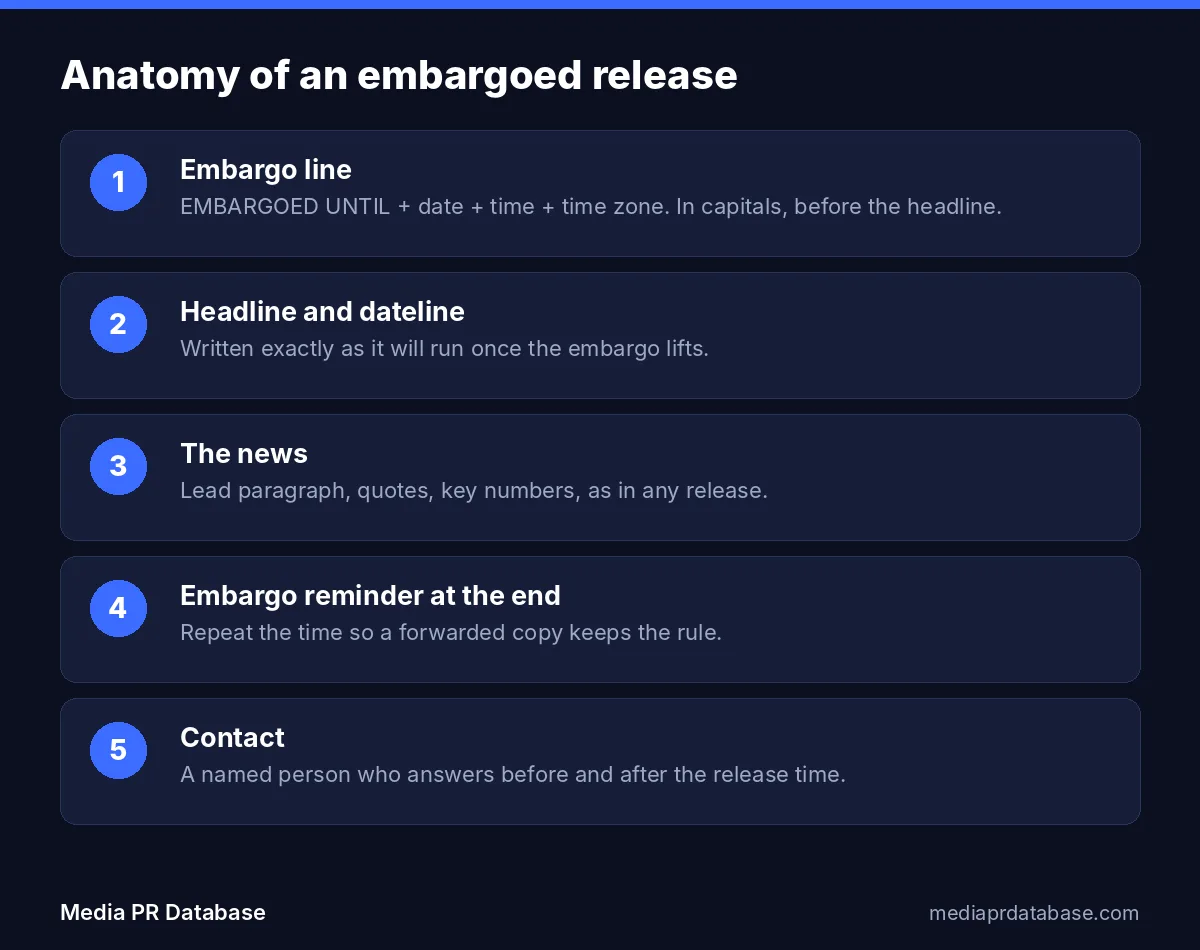
After a yes, send the full release. Put the embargo line above the headline, in capitals, with date, time and time zone. Repeat it in the email subject line and at the end of the release.
5. Support the reporting
Offer interviews, data, high-resolution images and quick answers. The whole point of the embargo is to help reporters write a better story.
6. Lift and publish on time
Publish the release on your own newsroom page at the exact embargo time. If you use a wire, schedule it for the same minute. Then share the coverage.
Writing the embargo line
- Always include a time zone. "9 a.m." means nothing to a reporter in another country. Use ET, PT, GMT or CET, or give the time in UTC as well.
- Use a full date. "Tuesday, March 3, 2026" is clearer than "3/3."
- Use AP style for times and dates if you pitch US media: "9 a.m. ET," "March 3." See our guide to AP style for press releases.
- Say "embargoed until," not "for release on." "For immediate release" means no embargo.
Embargoed press release template
Copy, paste and replace the parts in capitals.
EMBARGOED UNTIL 9:00 A.M. ET, TUESDAY, MARCH 3, 2026

HEADLINE: COMPANY DOES SOMETHING NEW AND WHY IT MATTERS

Subhead: One sentence with the most important number or result.

CITY, State (March 3, 2026) – Lead paragraph: who, what, when, where and why, in two or three sentences.

Second paragraph: the details, the key data and what it means for readers.

"Quote from your spokesperson that adds opinion or context, not a repeat of the facts," said FULL NAME, TITLE at COMPANY.

Third paragraph: background, availability, price or next steps.

About COMPANY
Two to four sentence boilerplate.

Media contact
NAME, TITLE
EMAIL | MOBILE

EMBARGOED UNTIL 9:00 A.M. ET, TUESDAY, MARCH 3, 2026
###
For the "About" paragraph, see our press release boilerplate examples. For length, see how long a press release should be.
What to do if someone breaks the embargo
- Check that it really broke. A teaser tweet without details is not the same as a full story.
- Tell the other reporters right away that the news is out and the embargo is lifted. It is unfair to keep them waiting while one outlet has the story.
- Publish your own release so the official version is online.
- Talk to the reporter or editor later, calmly. Mistakes happen, often a scheduling error.
- Remember it. EurekAlert! can take embargoed access away from reporters who break its rules. You can simply leave someone off your next embargoed list.
Common embargo mistakes
- No time zone or a date that does not match the weekday.
- Sending details before getting agreement.
- Too long an embargo. A few days to a week is plenty for most news. The longer the wait, the higher the chance of a leak.
- Too many people. The bigger the list, the higher the risk of a break.
- Posting the release on your site early, in a public folder, or in a scheduled social post that goes out by mistake.
Finding the right reporters for your embargo list
An embargo only works with the right short list. Media PR Database lists 9,596 news outlets in 195 countries and all 50 US states, with 16,692 newsroom and journalist emails, filterable by place, outlet type, DR and traffic. Search outlets for free; unlock emails with Pro ($149 one-time), or get podcasts and newsletters too with Premium ($299 one-time). See pricing.
Sources
- EurekAlert! (AAAS), Frequently Asked Questions (read Nov. 14, 2026).
- PLOS Biology, Press and Media: Embargo policy (read Nov. 14, 2026).
- Wikipedia, News embargo.
- Cision, 2025 State of the Media report release.
The bottom line
An embargo is a simple deal: early access in exchange for waiting. Use it for news that needs explaining or a fixed launch moment, ask before you share, state the time and time zone clearly, keep the list short, and publish on the minute. Done well, it turns one announcement into several well-reported stories on the same day.
FAQ
What does embargoed mean on a press release?
It means reporters may not publish the information before the stated date and time. The embargo line, such as EMBARGOED UNTIL 9:00 a.m. ET, Tuesday, March 3, 2026, goes at the top of the release.
Is a press embargo legally binding?
Usually not. It is an agreement between you and the reporter. It works when the reporter agreed before getting the details. Services such as EurekAlert! make reporters sign an embargo agreement and can remove access if they break it.
How far in advance should I send an embargoed release?
A few days to a week is typical. Enough time for interviews and fact-checking, not so long that the news leaks.
What is the difference between an embargo and an exclusive?
An embargo gives several reporters the news early, and they all publish at the same set time. An exclusive gives one outlet the story first. Never offer the same exclusive to more than one outlet.
What should I do if a reporter breaks my embargo?
Confirm the story is out, tell the other reporters the embargo is lifted, publish your release, and talk to the reporter later. Leave repeat offenders off future embargoed lists.
Do I need a wire service to send an embargoed release?
No. You can email the release to reporters who agreed to the embargo and publish it on your own site at the set time. If you use a wire, schedule it for the same minute.
Build your media list in minutes
Search free, then download any country or state list as CSV in one click.
Keep reading
Media Advisory vs Press Release: Differences and Templates
Media advisory vs press release: what each one is for, when to send it, how long it should be, a real NASA media advisory broken down, and copy-and-paste templates for both.
Press releasesFree Press Release Distribution: Does It Work in 2026?
An honest look at free press release distribution in 2026: what PRLog, openPR and other free sites really give you, the limits, why Google ignores the links, and the free route that actually gets coverage.
Press releases25 Press Release Examples (and Why They Worked)
25 real press release examples from one news day on PR Newswire, grouped by type: funding, product launch, partnership, data, hires, awards, events, community and sensitive news. Each one has its exact headline, date, link and a short note on why it works, plus the anatomy of a press release, a checklist and a sample press release template.