Free Press Release Distribution: Does It Work in 2026?
An honest look at free press release distribution in 2026: what PRLog, openPR and other free sites really give you, the limits, why Google ignores the links, and the free route that actually gets coverage.
Short answer: free press release distribution works for one thing: putting your news on a public web page that search engines can index. It does not put your story in front of reporters, and it will not help your SEO through links. Free sites such as PRLog and openPR are a fine place to keep a public record of an announcement. If you want actual coverage, the free route that works is sending a short, relevant pitch by email to the reporters who cover your topic.
This guide walks through the main free press release sites, what each one includes according to its own pages (read Nov. 14, 2026), what free distribution can and cannot do, and how to get press for $0 without relying on a wire. It is written by Media PR Database, a directory of 9,596 news outlets in 195 countries with 16,692 newsroom and journalist emails. We sell a contact list, so we have a view on this, and we have tried to be fair about where free sites help.
What "free press release distribution" actually means
A press release distribution service, or wire, takes your release and publishes it in places where it can be seen: its own website, partner news sites, RSS feeds, and in the case of big paid wires, newsroom feeds that some editors watch. A free service does the first part (a page on its own site) and sometimes a little of the second (RSS, search engine indexing).
When people search for "distribute press release free" they usually hope for one of three outcomes:
- Reporters see the news and write about it.
- The release ranks in Google when people search the company or product name.
- Backlinks from the release help the company website rank.
Free distribution can help with the second, rarely with the first, and not with the third. The sections below explain why.
The main free press release sites, checked
PRLog
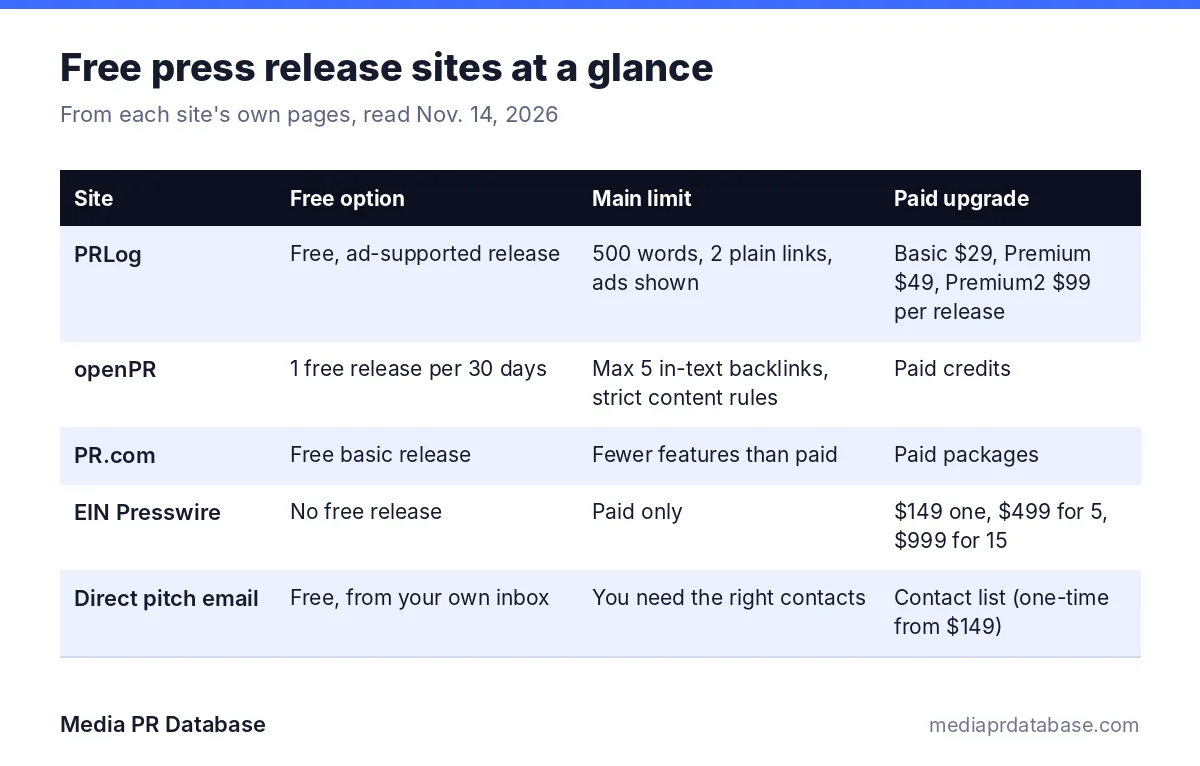
What you get for free: PRLog's comparison page lists a "Free, Ad Supported" package next to three paid ones. The free release gets distribution to search engines, a hosted page on PRLog, pressroom hosting, a company profile and logo, one industry listing with RSS feed, one keyword listing, one location listing, 500 words and two plain (not clickable) links (PRLog press release comparison, read Nov. 14, 2026).
The limit: ads show on your release page, the link count is small, and the wider syndication (to 200+ or 500+ industry and news sites, plus optional PR Newswire and AP add-ons) sits in the paid tiers: Basic $29, Premium $49 and Premium2 $99 per release.
Good for: a clean public page for an announcement you can link to from your own site and pitches.
openPR
What you get for free: openPR's submission page offers "1 free release maximum per 30 days" (openPR submit page, read Nov. 14, 2026).
The limit: the same page says duplicate releases, spam and anything sent by submission software will be deleted, bans adult content and supplements, and allows "no more than 5 backlinks" in the text. Wider reach is sold through paid credits.
Good for: companies with European audiences that want one more public copy of their news each month.
PR.com and similar directories
PR.com, Newswire Today and several other directories have offered free basic releases for years, with paid upgrades for more features. Terms change often, so check each site's own pricing page before you count on it. Third-party reviews also note that many formerly free sites have moved to paid plans.
Paid wires with no free tier
For comparison, EIN Presswire does not offer a free release. Its pricing page lists $149 for one release, $499 for five and $999 for fifteen, usable within a year of purchase (EIN Presswire pricing, read Nov. 14, 2026). Large wires such as PR Newswire and Business Wire cost far more per release; our PR Newswire alternatives guide lists their prices.
What a free release can do, and what it can't
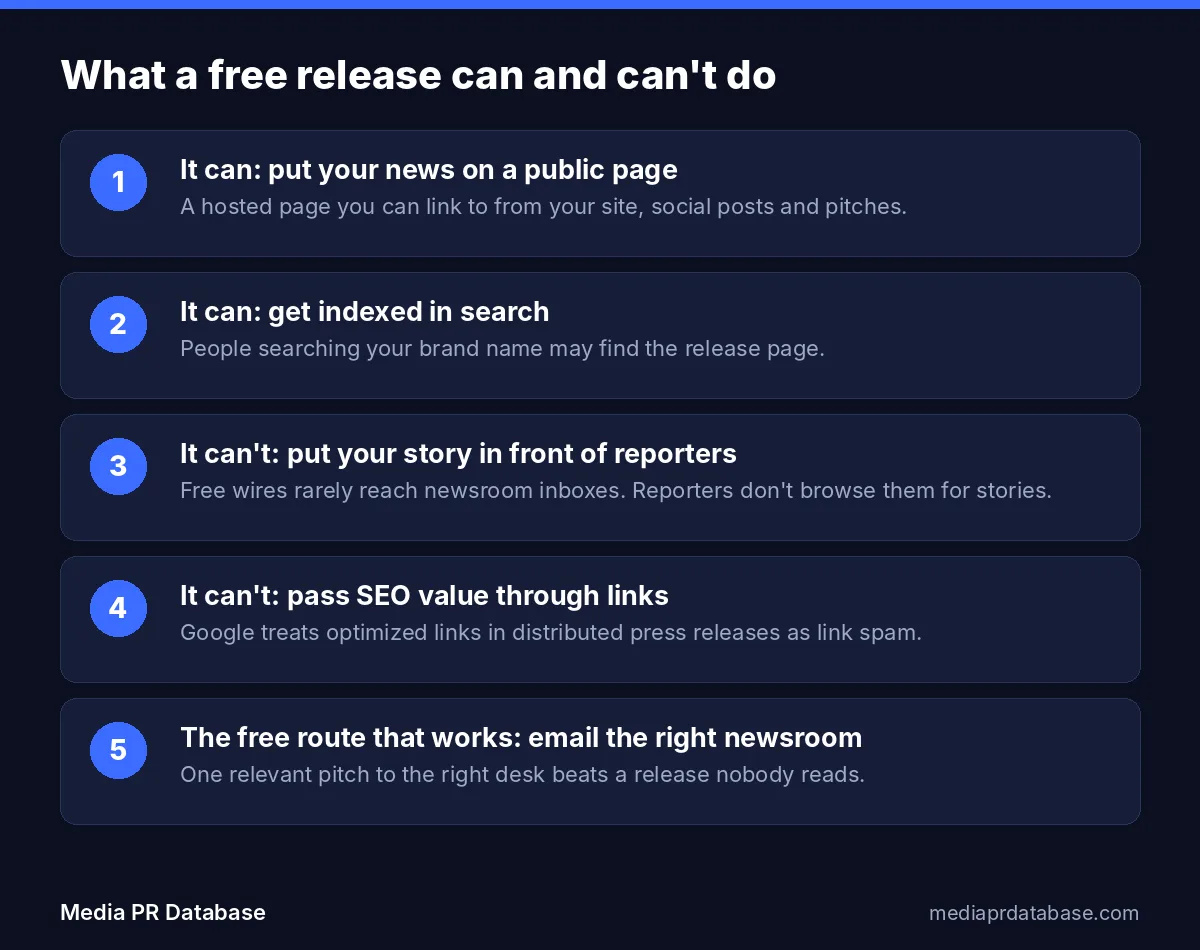
It can give you a public page
A hosted release is a page with a date, a headline and your story. That page is useful to link from your site's news section, from social posts, and from pitches, so a reporter can read the details without an attachment.
It can show up for your brand name
Free release pages are often indexed, so people who search your company or product name may find them. For a new company with few pages online, that is a small but real benefit.
It usually can't reach reporters
Reporters do not browse free release sites looking for stories. Cision's 2025 State of the Media report found that 86% of journalists will immediately reject a pitch that is not aligned with their beat or audience, and 85% say the best way to build a relationship is to introduce yourself by email (Cision, 2025 State of the Media). The same report says 72% of journalists still find press releases the most useful resource PR teams offer. The point is that the release has to arrive in the right inbox. Posting it on a free site is not the same as sending it to someone.
It can't build SEO links
Google's spam policies list as link spam "links with optimized anchor text in articles, guest posts, or press releases distributed on other sites" (Google Search Central, spam policies, read Nov. 14, 2026). In practice, links in distributed releases pass little or no value, and keyword-stuffed anchor text can count against you. Use plain brand or URL links and treat any link in a release as a way for readers to click, not a ranking signal.
Free vs. paid wire vs. direct pitch
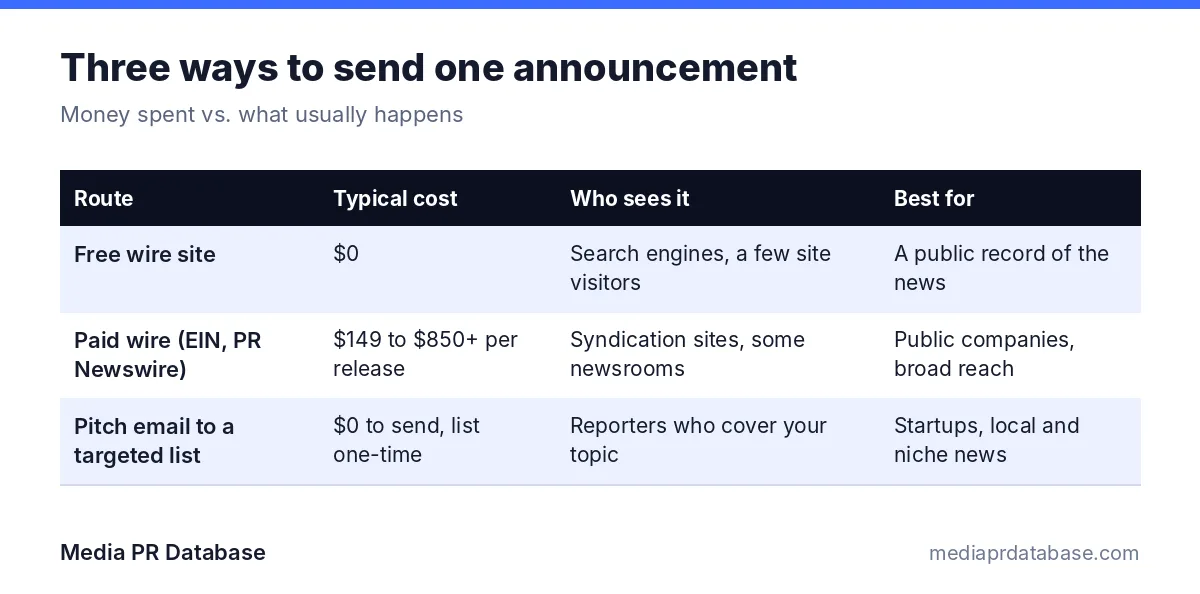
Paid wires make the most sense for public companies with disclosure needs and for brands that want their release copied onto hundreds of finance and news sites. Most of those copies are automatic reposts, not stories written by journalists. For a startup or a local business, a short, targeted pitch to the right reporters usually does more than either wire.
The free route that actually gets coverage
Here is the process we recommend for getting press with no distribution budget.
1. Make sure it is news
A new product, a local first, original data, a big milestone or a strong human story. If you are not sure, our list of news story ideas journalists actually cover shows the angles that work.
2. Write the release anyway
Write a proper release with a headline, dateline, lead, quote and boilerplate. Keep it to the length editors expect; see how long a press release should be and AP style for press releases. Post it on your own site's news page first. A free wire copy is optional.
3. Build a short, relevant list
Ten to fifty reporters and newsrooms that cover your topic or your city. For a local story, start with outlets in your state, for example news outlets in Texas or New York; outside the US, use a country list such as United Kingdom media. The free Local News Finder shows the newspapers, TV and radio stations in a city, and the Media List Builder filters by place and outlet type.
4. Send a pitch, not an attachment
Put a two to four sentence pitch at the top of the email and paste the release below it. No attachments. Our media pitch email template has copy-and-paste versions, and the Media Pitch Generator drafts one for free.
5. Follow up once
One short follow-up three to five days later, with something new: a photo, a data point or an interview offer. Then stop.
When a free wire is still worth it
- You need a public record of an announcement and do not have a newsroom page on your site.
- You want one more indexed page for a new brand name.
- Your pitch needs a link to the full release instead of pasting it in.
In all three cases, the free release supports your outreach. It does not replace it.
Where Media PR Database fits
The hard part of the free route is step 3: finding the right reporters and their emails. Media PR Database covers 9,596 news outlets in 195 countries and all 50 US states, with 16,692 newsroom and journalist emails. You can search outlets for free (emails hidden), then unlock emails with Pro at $149 one-time or get everything, including 2,997 podcasts and 123 newsletters, with Premium at $299 one-time. No subscription. See pricing.
Sources
- PRLog, Press Release Comparison (read Nov. 14, 2026).
- openPR, Free Press Release Submission (read Nov. 14, 2026).
- EIN Presswire, Pricing (read Nov. 14, 2026).
- Google Search Central, Spam policies for Google web search (read Nov. 14, 2026).
- Cision, 2025 State of the Media report release.
The bottom line
Free press release distribution still works as a publishing tool: a public, indexed page for your news. It is not a way to reach reporters or to build links. Post the release on your own site, add a free wire copy if you like, and spend your effort on a short list of the right reporters and a clear pitch. That is where coverage comes from.
FAQ
Does free press release distribution work?
It works for publishing: you get a public page that search engines can index. It rarely gets your story in front of reporters, because journalists do not browse free release sites for stories. For coverage, email a short pitch to reporters who cover your topic.
What is the best free press release site?
PRLog offers a free, ad-supported release with 500 words, two plain links and search engine distribution, and openPR allows one free release every 30 days. Both are fine for a public record of your news. Neither replaces direct outreach to reporters.
Do press release links help SEO?
Not much. Google's spam policies list optimized anchor text links in press releases distributed on other sites as link spam. Use plain brand or URL links so readers can click, and do not count on the release for rankings.
Is EIN Presswire free?
No. EIN Presswire's pricing page lists $149 for one release, $499 for five and $999 for fifteen, usable within a year.
How can I send a press release to journalists for free?
Build a short list of reporters who cover your topic or city, then email each one a two to four sentence pitch with the release pasted below. Free tools such as the Local News Finder help you find outlets; a contact list saves time finding emails.
Should I attach the press release as a PDF?
No. Paste the text into the email body below a short pitch. Many reporters do not open attachments from people they do not know.
Build your media list in minutes
Search free, then download any country or state list as CSV in one click.
Keep reading
Media Advisory vs Press Release: Differences and Templates
Media advisory vs press release: what each one is for, when to send it, how long it should be, a real NASA media advisory broken down, and copy-and-paste templates for both.
Press releasesEmbargoed Press Release: How It Works (With Template)
What an embargoed press release is, when to use one, how to write the embargo line, who to send it to, how embargoes work at journals like PLOS and on EurekAlert, and a copy-and-paste template.
Press releases25 Press Release Examples (and Why They Worked)
25 real press release examples from one news day on PR Newswire, grouped by type: funding, product launch, partnership, data, hires, awards, events, community and sensitive news. Each one has its exact headline, date, link and a short note on why it works, plus the anatomy of a press release, a checklist and a sample press release template.