40 News Story Ideas Journalists Actually Cover
40 news story ideas for startups, small businesses and PR freelancers, grouped by type: data, trends, local firsts, people, reactions, milestones, visuals and seasonal hooks, with real campaign examples and a 60-second test.
Short answer: reporters cover stories that are new, affect real people, fit their beat or area, and come with proof. The ideas that work most often for small companies are original data, local firsts, trends you can show with examples, strong human stories, expert reaction to today's news, milestones, visual stunts and seasonal hooks. Below are 40 concrete ideas in those eight groups, real campaigns that used each angle, and a 60-second test to check any idea before you pitch it.
This list is written by Media PR Database, a directory of 9,596 news outlets in 195 countries with 16,692 newsroom and journalist emails. We see a lot of pitches and stories, and these are the angles that keep showing up in coverage.
First, what makes something news?
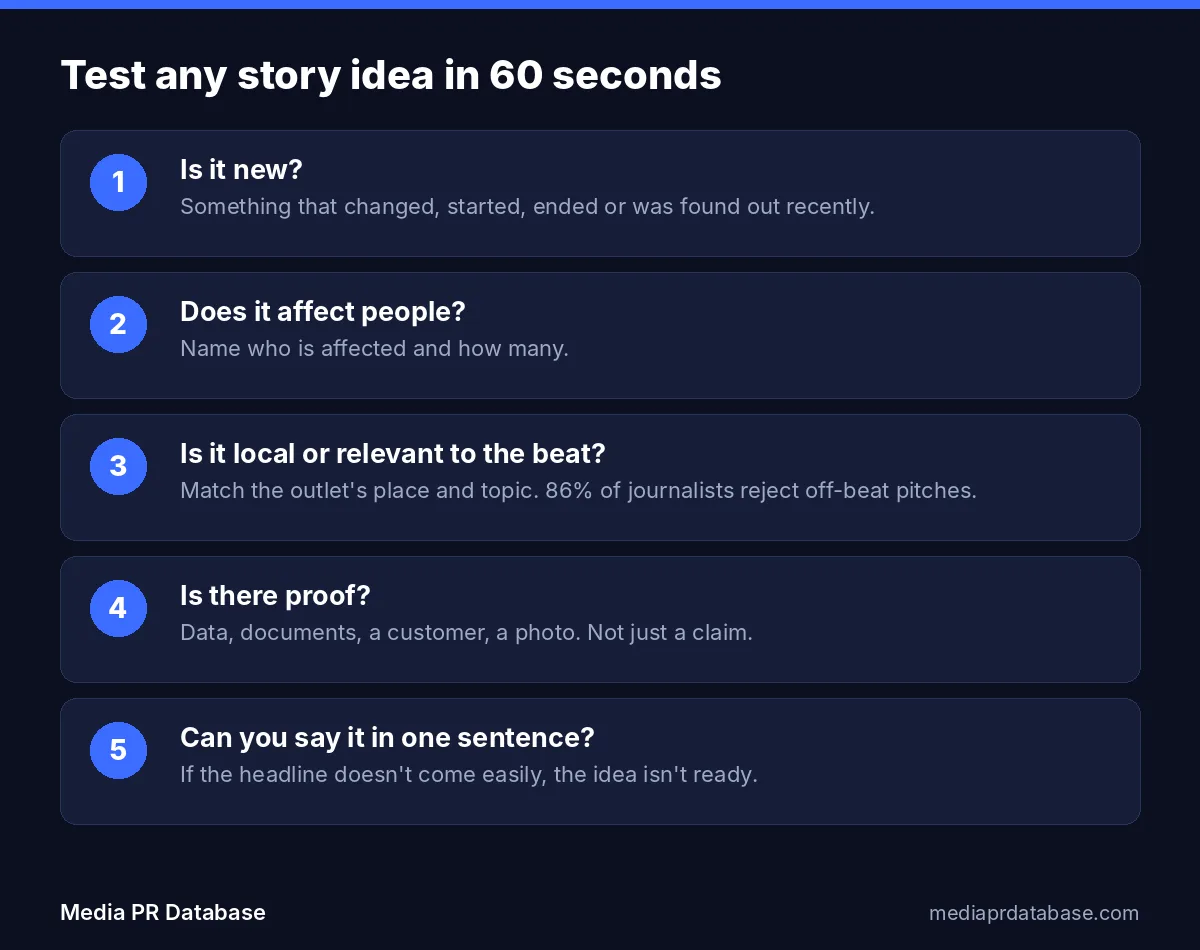
Run every idea through five questions:
- Is it new? Something changed, started, ended or was discovered recently.
- Does it affect people? Say who and how many.
- Does it fit the outlet? Its place and its topic. Cision's 2025 State of the Media report found that 86% of journalists will immediately reject a pitch that is not aligned with their beat or audience (Cision, 2025 State of the Media).
- Is there proof? Data, documents, a customer, a photo.
- Can you say it in one sentence? If the headline is hard to write, the idea is not ready.
An idea that passes all five is worth a pitch. An idea that fails two or more needs more work, not more emails.
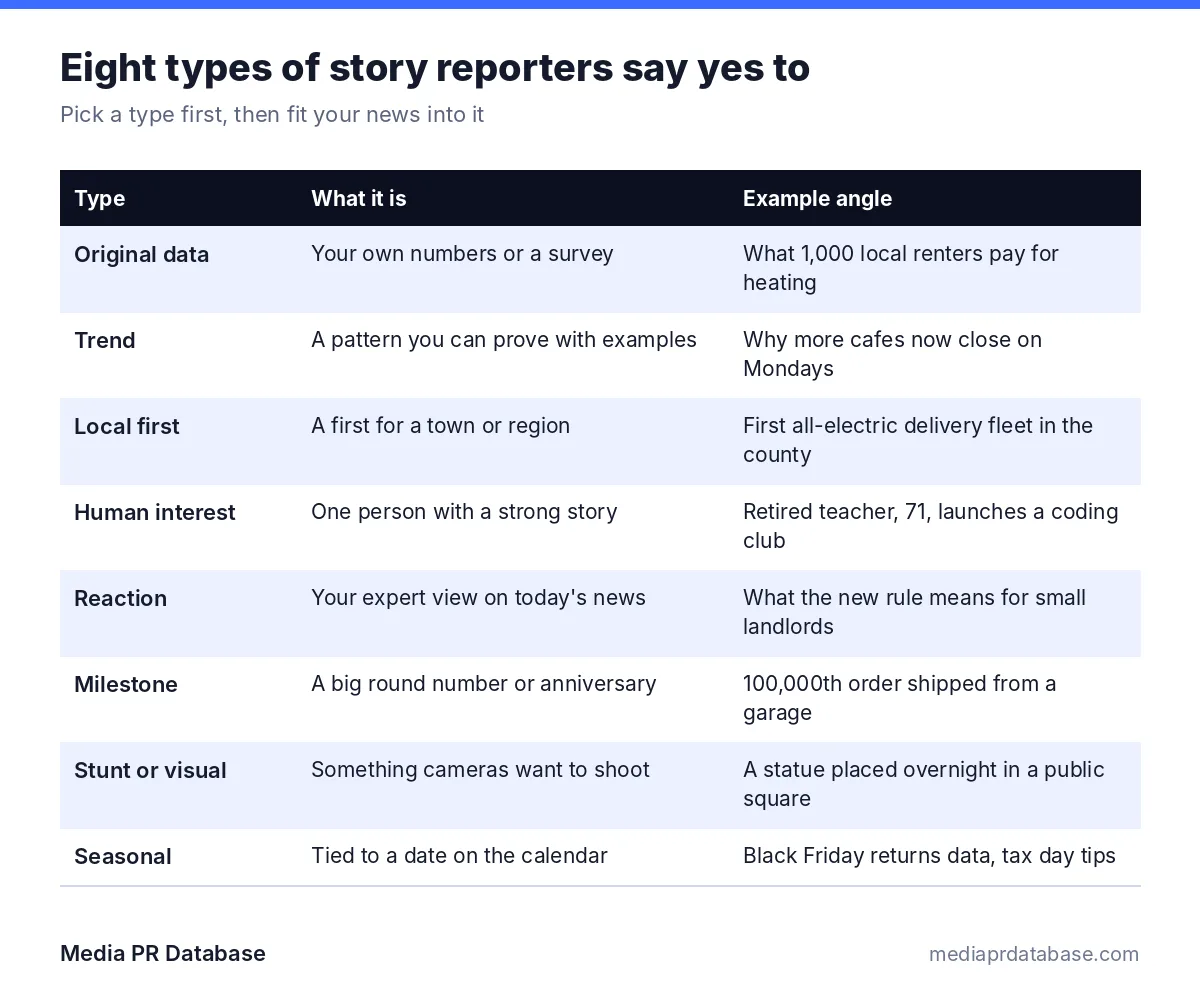
The eight types of story
1. Original data and surveys (ideas 1 to 6)
Numbers nobody else has are the most reusable story type: one dataset can feed national, local and trade stories.
- Customer data trend: what your customers bought, booked or searched more or less of this year, by city or region.
- Price index: what something costs now vs. a year ago, using your own transactions (rent, repairs, flights, lunch).
- Survey of your audience: 500 to 1,000 people on a question your industry argues about. Publish the method.
- Ranking of cities or states: best and worst places for X, using your data plus public data.
- "Year in numbers" report: your own annual roundup.
- Open data analysis: a new look at government data that nobody has summarized for your topic.
Real example: Spotify Wrapped. Every year since 2016, Spotify releases a year-in-review of each user's listening, typically in late November or early December, and Wikipedia describes it as both a year-in-review feature and a viral marketing campaign (Wikipedia, Spotify Wrapped). You do not need Spotify's scale: a small company's "what our 3,000 customers did this year" can work for local and trade press.
2. Trends (ideas 7 to 11)
- "More people are doing X": backed by your data plus three real examples.
- A trend ending: something people stopped doing, and why.
- A new kind of customer: who is buying now who wasn't before.
- Cost pressure: how rising costs are changing small businesses in your trade.
- Tech change on the ground: how AI or a new tool is changing daily work in your field, with names and numbers.
Trend stories need examples beyond your own company. Offer the reporter two or three other people to talk to; it makes the story easier to write and more likely to run.
3. Local firsts and local angles (ideas 12 to 17)
- First in the city, county or state to offer something.
- Local jobs: hiring 20 people in a small town is news there.
- Local reaction to national news: what a national change means for businesses on Main Street.
- Local version of a national survey: cut your data by state or city and pitch each one to local press.
- Return or rescue: reopening a closed building, saving a local brand.
- Community partnership: with a school, food bank or club, with a measurable result.
Local outlets need local stories. Start with a list of outlets in your area, such as Ohio news outlets, Colorado or Australia, or search a city with the free Local News Finder.
4. People and human interest (ideas 18 to 23)
- Founder with an unusual path: career change, late start, a personal reason for the business.
- Customer story: one customer whose life changed in a measurable way (with their permission).
- Employee story: the oldest, youngest, longest-serving or most unusual job.
- Overcoming a setback: fire, flood, closure, illness, and the comeback.
- Family business generations: third generation takes over.
- Volunteer or giving story: with a real number (meals, hours, dollars).
5. Reaction and expert comment (ideas 24 to 28)
- Rapid response: your expert's view within hours of a big announcement in your field.
- "What it means for you": a new law, rate change or rule explained for ordinary people.
- Myth-busting: a common belief in your industry that your data shows is wrong.
- Prediction with reasoning: what will happen next and why, from someone with credentials.
- Answering reporter requests: respond to quote requests on services listed in our HARO alternatives guide.
Reaction pitches live or die on speed. Have a short bio, a headshot and two or three sentences ready to go the same day.
6. Milestones and company news (ideas 29 to 32)
- Round numbers: 1,000th customer, 100,000th order, 10 years in business.
- Funding with a twist: who invested and what the money changes locally.
- Award or certification that is rare in your region or industry.
- Product launch that solves a known problem, with a demo reporters can try.
Plain company news often works better for trade and local outlets than national ones. Write a proper release using our press release examples.
7. Visuals, stunts and events (ideas 33 to 36)
- A public installation that makes a point.
- A record attempt or a "biggest/longest/first" with a clear visual.
- Open day or demo where cameras can film something happening.
- A challenge people join and share.
Real examples: Fearless Girl, a bronze statue commissioned by State Street Global Advisors to promote gender diversity and a related index fund, was installed facing Wall Street's Charging Bull on March 7, 2017, the day before International Women's Day (Wikipedia, Fearless Girl). The ALS Ice Bucket Challenge went viral on social media in July and August 2014 to raise awareness of ALS and encourage donations to research (Wikipedia, Ice Bucket Challenge). Dove's Real Beauty Sketches film, made with Ogilvy & Mather in 2013, was downloaded more than 15 million times within a week of its online release (Wikipedia, Dove Real Beauty Sketches). Each had one simple idea people could understand from a single picture or sentence.
If you invite reporters to something visual, send a media advisory a few days ahead.
8. Seasonal and calendar hooks (ideas 37 to 40)
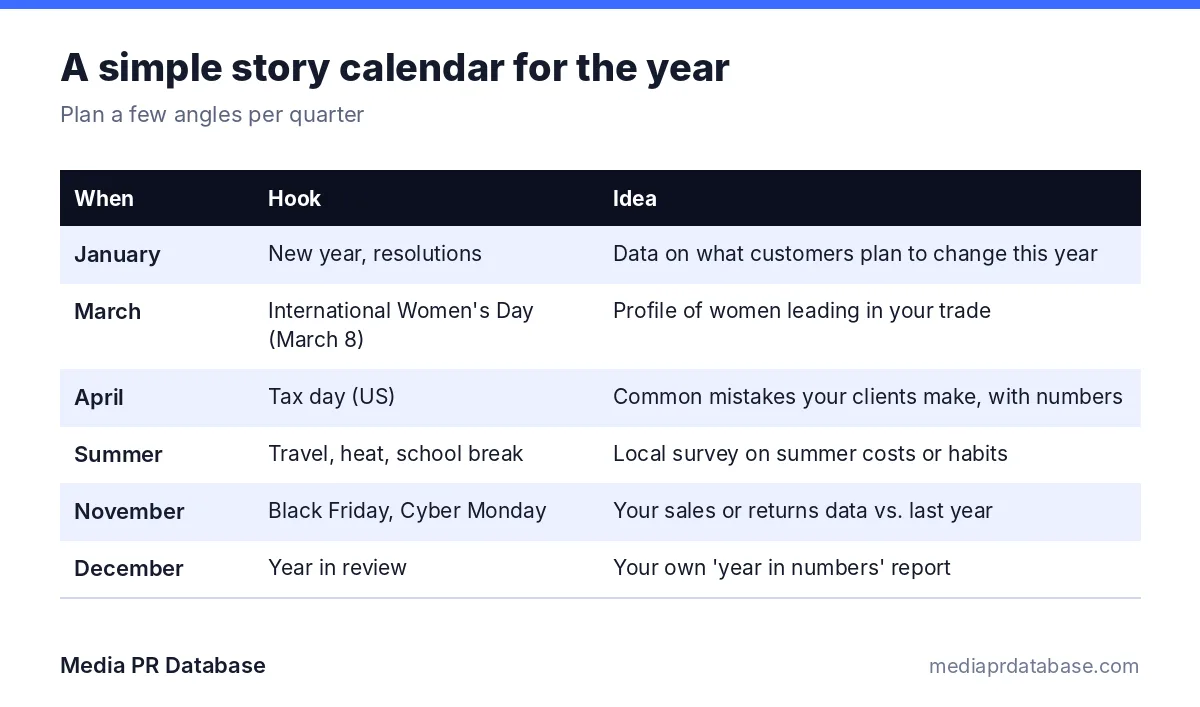
- Holiday shopping data: Black Friday, Cyber Monday, holiday returns.
- Awareness days and months that match your field, with something real to add.
- Back to school, summer travel, tax season: tips with numbers.
- Weather and season: heat, storms, snow, and what your data shows about them.
Seasonal stories are planned weeks ahead. Pitch long-lead magazines months early and newspapers one to three weeks before the date.
How to turn an idea into a pitch
- Write the headline you hope to see. If it is boring, change the angle.
- Pick 10 to 50 reporters who cover that topic or place. The free Media List Builder helps you shortlist outlets.
- Write a short pitch: the news in one sentence, the proof, why it matters to their readers, and what you can offer (data, interview, photos). Our media pitch email template and media pitch samples show how, and the Media Pitch Generator drafts one for free.
- Follow up once with something new.
For a full plan around these ideas, see how to get press coverage without a PR agency and PR strategy for startups.
Find the reporters for your story
A good idea still needs the right inbox. Media PR Database lists 9,596 news outlets in 195 countries and all 50 US states, with 16,692 newsroom and journalist emails, filterable by place, outlet type, DR and traffic. Search for free; unlock emails and one-click CSV with Pro ($149 one-time), or add 2,997 podcasts and 123 newsletters with Premium ($299 one-time). See pricing.
Sources
- Cision, 2025 State of the Media report release.
- Wikipedia, Spotify Wrapped.
- Wikipedia, Fearless Girl.
- Wikipedia, Ice Bucket Challenge.
- Wikipedia, Dove Real Beauty Sketches.
The bottom line
Most good story ideas are one of eight types: data, trend, local first, people, reaction, milestone, visual or seasonal. Pick the type that fits your news, test it with the five questions, then pitch it to a short list of reporters who actually cover it. One strong idea sent to the right 20 people beats ten weak ideas sent to everyone.
FAQ
What makes a good news story idea?
It is new, it affects people, it fits the outlet's area and topic, it comes with proof such as data or a real person, and it can be summed up in one sentence.
What news stories can a small business pitch?
Original customer data, local firsts, hiring, milestones like a 10th anniversary, strong founder or customer stories, and expert reaction to news in your field. Local outlets are usually the best first target.
How do I find a news angle for my company?
Start with what changed recently, then ask who it affects and how many. Look for numbers only you have, a first for your area, or a link to something already in the news this week.
Do journalists still want press releases?
Yes. Cision's 2025 State of the Media report found 72% of journalists still cite press releases as the most useful resource PR teams can offer. The release has to be relevant to their beat, though.
How far ahead should I pitch a seasonal story?
Newspapers and websites: one to three weeks before the date. Monthly magazines: often three to six months ahead.
Where can I find journalists to pitch my story idea?
Read recent coverage of your topic to find bylines, check outlet contact pages, or use a media database. Media PR Database lets you search outlets by country, state and city for free and unlock emails with a one-time plan.
Build your media list in minutes
Search free, then download any country or state list as CSV in one click.
Keep reading
PR Strategy for Startups: A 90-Day Plan
A practical PR strategy for startups in 90 days: build your story, angles, boilerplate and media list in month one, pitch local press, trade press and podcasts in month two, then scale with a data story, launch or funding news and simple measurement. Includes a checklist table and a week-by-week plan.
PitchingHow to Get Press Coverage Without a PR Agency
How to get press coverage without a PR agency: find a real news angle, pick the right outlets and journalists, write a short pitch journalists actually read (Muck Rack 2026 and Cision 2025 data), follow up, and turn one story into steady media coverage. Includes a pitch template and a 30-day plan.
PitchingMedia Pitch Email Template: Copy, Paste and Get Replies (2026)
A media pitch email template broken down line by line, plus 8 copy-paste variants, 30+ subject line examples, follow-up rules and the mistakes journalists hate.