How to Get Press Coverage Without a PR Agency
How to get press coverage without a PR agency: find a real news angle, pick the right outlets and journalists, write a short pitch journalists actually read (Muck Rack 2026 and Cision 2025 data), follow up, and turn one story into steady media coverage. Includes a pitch template and a 30-day plan.
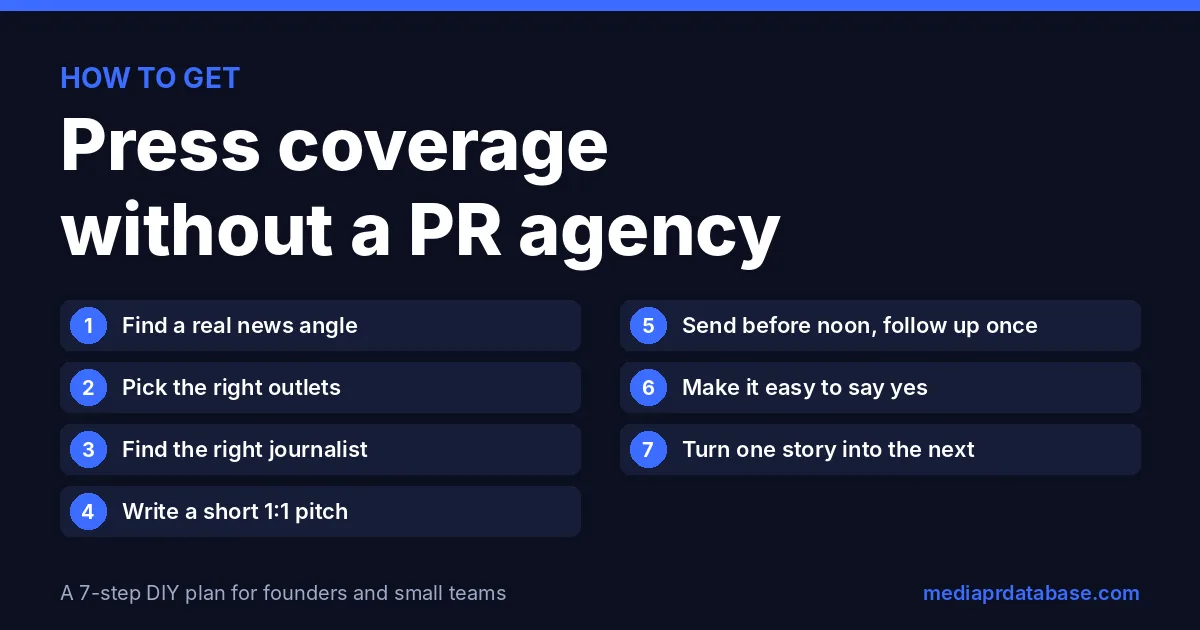
Short answer: to get press coverage without a PR agency, find one angle that is genuinely news to a specific audience, build a short list of outlets that cover that audience, find the one journalist at each outlet who covers your topic, and send that person a personal email of under 200 words before noon. Follow up once, answer fast when a reporter replies, and reuse every piece of coverage to earn the next one.
That is the whole method. The rest of this guide shows how to do each step well, with real survey data on what journalists say they want, a copy-paste pitch template, a list of news angles that work, a 30-day plan and the mistakes that get pitches deleted. It comes from Media PR Database, a directory of 9,596 news outlets in 195 countries with 16,692 newsroom and journalist emails. We built it for founders and small teams who want media coverage but do not want to pay a monthly agency retainer.
Can you really get press coverage without a PR agency?
Yes. A PR agency does not have a secret door into newsrooms. What it mostly sells is time, a contact list and experience with how journalists work. You can supply all three yourself if you are willing to spend a few hours a week on it.
The data backs this up. In Muck Rack's State of Journalism 2026 survey, 86% of journalists said at least some of their work began with a PR pitch (summarized by the University of Minnesota's UMarComm team). Journalists need story ideas. They do not care whether the email came from an agency or from the founder, only whether the idea is useful to their readers.
The same survey has the catch: 43% of journalists said it was rare to get pitches relevant to their beats. Most pitches miss. That is good news for you. If you do the basic research that most senders skip, your pitch is already better than a large share of what lands in a reporter's inbox.
When an agency still makes sense
Doing it yourself is not right for everyone. An agency can be worth the money when:
- You need a large, coordinated launch across many countries on one day.
- You are handling a crisis, where every word matters and mistakes are costly.
- Nobody on your team has even two or three hours a week for outreach.
- You want ongoing coverage in top national titles where an agency already has long relationships.
For a launch, a local story, trade press, podcasts or a steady trickle of mentions, you can usually do it yourself.
What journalists say they want from a pitch
Before you write anything, it helps to know what the people on the other end are asking for. Two large surveys give a clear picture.
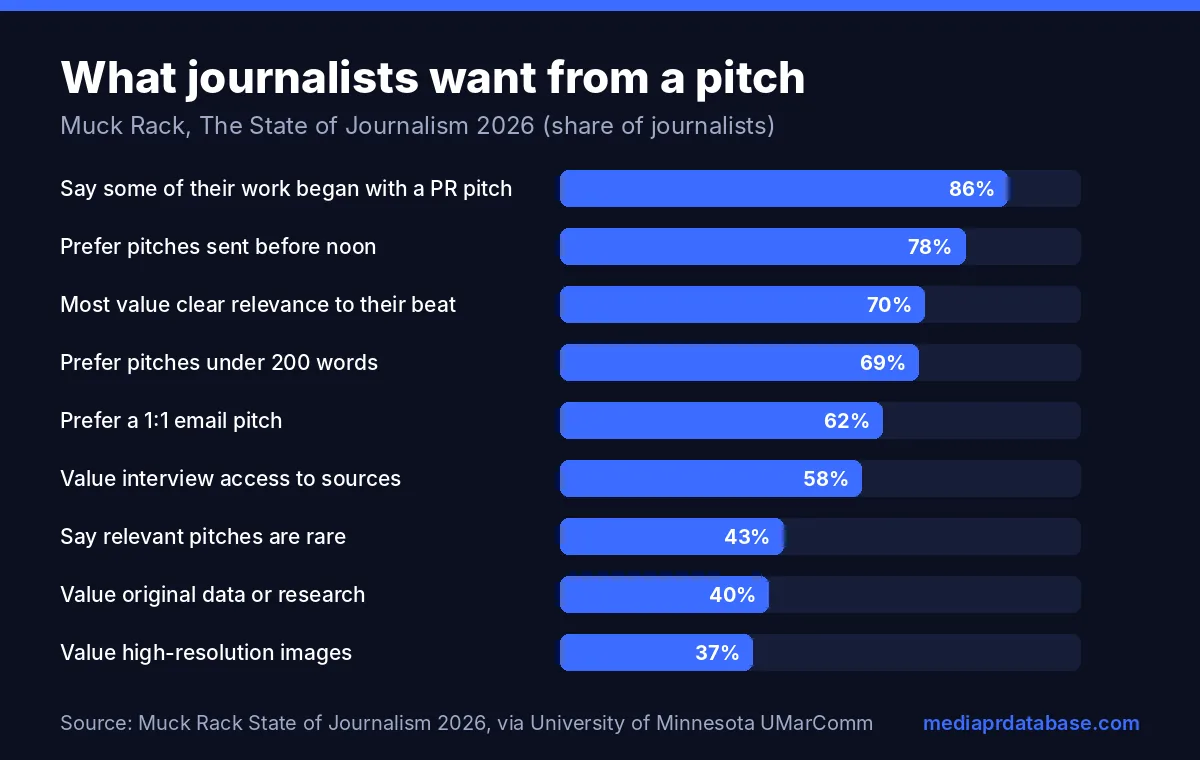
Muck Rack, State of Journalism 2026
- Relevance first: 70% of journalists value clear relevance to their beat most in a pitch.
- Access: 58% value interview access to relevant sources.
- Data: 40% value original data or research.
- Visuals: 37% value high-resolution images.
- Format: 62% prefer to be pitched in a one-to-one email, and 69% prefer pitches under 200 words.
- Timing: 78% prefer pitches sent before noon. Half do not care about the day of the week; of those who do, 18% prefer Monday.
Cision, State of the Media 2025
Cision's 16th annual report surveyed more than 3,000 journalists in 19 markets (Cision press release, May 7, 2025). Its main findings line up with Muck Rack's:
- 86% of journalists say they will immediately reject a pitch that is not aligned with their beat or audience.
- 72% still cite press releases as the most useful resource PR teams can offer.
- 85% say the best way to build a relationship is to introduce yourself by email, even without a story to pitch.
- 72% worry about factual errors in AI-generated PR content.
Put together, the message is simple: send the right story to the right person, keep it short, back it with facts and make it easy to report. Everything below is built around those points.
Step 1: find an angle that is actually news
The most common reason a pitch fails is that there is no story in it. "We launched a new feature" or "We are a great company" is news to you, not to a reader. Ask one question before you go further: why would this outlet's readers care, this week?
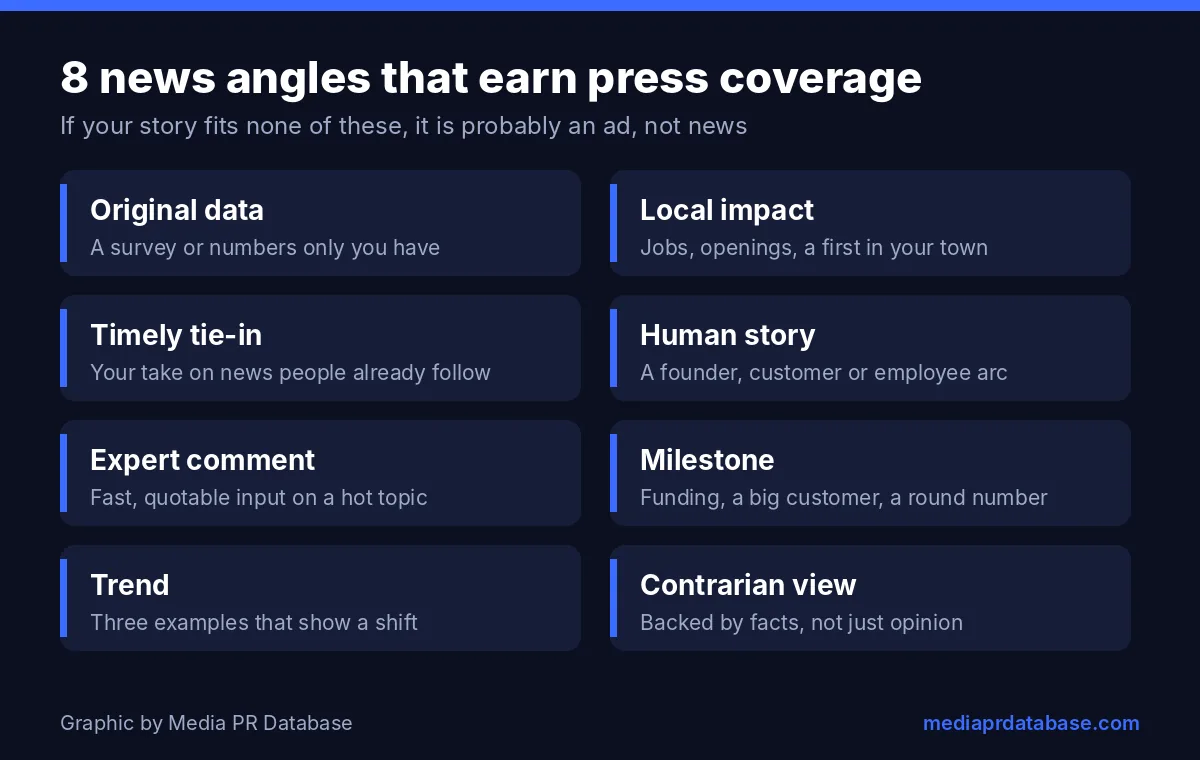
Eight angles that tend to work
- Original data. A small survey of your customers, numbers from your own product or a public dataset you analyzed. Journalists rank original data among the things they value most in a pitch, and few small companies bother to create it.
- Local impact. New jobs, a new location, a first in your town, a local founder. Local and regional outlets need local stories every day.
- Timely tie-in. Your expert view on something people are already reading about: a new law, a price change, a seasonal event.
- Human story. How a founder, customer or employee overcame something. Concrete people beat abstract companies.
- Expert comment. Fast, quotable input for a reporter who is already writing a story. This is the easiest way in for most small businesses.
- Milestone. Funding, a well-known customer, a round number of users, an award. Best for trade and local press.
- Trend. Three or more examples that show something is changing. You can be one of the examples.
- Contrarian view. A view that goes against the usual advice, backed by facts rather than opinion alone.
The one-sentence test
Write your story in one sentence, as if it were a headline on the outlet you are pitching. If you cannot, the angle is not ready. Compare:
- Weak: "Acme launches innovative scheduling software."
- Better: "Small clinics in Austin lose [X] hours a week to no-shows, Acme's data on [N] clinics shows." (Fill in your own real numbers, never invented ones.)
Prepare your assets before you pitch
Reporters work on deadlines. Have these ready before the first email goes out:
- A one-page fact sheet: who you are, the key facts, the numbers and how you got them.
- Two or three high-resolution photos (people, product, location) with credit lines.
- One or two short quotes a reporter could use.
- A spokesperson with time free in the next few days.
- If the news is formal, a short press release. See our guides on how long a press release should be and writing a press release boilerplate.
Step 2: pick the right outlets
"Getting press" is not one thing. A mention in a trade newsletter, a story in a local paper and a segment on national TV are very different targets. Start where your story fits naturally and where your buyers actually read.
Four types of outlets to consider
| Outlet type | Best for | How hard |
|---|---|---|
| Local and regional news | Openings, hires, local data, community stories | Easiest for most businesses |
| Trade and industry press | B2B launches, customer wins, expert comment | Moderate, very targeted readers |
| Podcasts and newsletters | Expert interviews, founder stories | Moderate, many shows need guests |
| National and international news | Big data stories, trends, strong human stories | Hardest, needs a strong angle |
Start local
Local news is the most underrated route to media coverage. Local outlets have a clear need for local stories, and fewer people are competing for their attention than at national titles. The local newsroom is also shrinking. Northwestern University's Medill State of Local News 2025 report found that almost 40% of local US newspapers have vanished since 2005, that newspaper industry jobs fell 7% in the past year, and that 39 states now have fewer than 1,000 journalists. Fewer reporters covering a town means each one has less time to find stories, so a well-prepared, genuinely local pitch is often welcome.
The same report tracks about 8,000 local outlets, including more than 5,400 newspapers, close to 700 stand-alone digital sites and more than 340 public broadcasters. To find the ones near you, try our free local news finder, or browse outlets by place, for example Texas media outlets, California media outlets or UK media outlets.
How many outlets?
For a first campaign, 25 to 50 well-matched outlets is a good size. That is enough to get a few replies and small enough that you can personalize every email. A list of 500 random outlets sent the same email will do worse, and Cision's 86% instant-rejection figure explains why. If you have never built one, read what a media list is and how to build one, or use the free media list builder.
Step 3: find the right journalist
Sending your pitch to a general inbox is better than nothing, but sending it to the one reporter who covers your topic is much better. Relevance to the beat was the top thing journalists said they value in a pitch.
How to find who covers your topic
- Search the outlet's site for your topic and note who wrote the last three related stories.
- Read the author page. Many outlets list the reporter's beat and sometimes a contact email or a tips address.
- Check the masthead or contact page for section editors (business, tech, health, features) and the newsroom email.
- Check the reporter's public social profiles, which often state the beat and a preferred contact method.
- Use a media database to skip the hunting. Ours lists newsroom and journalist emails by outlet, country and US state.
Write down one recent story
For each journalist on your list, note one recent story and one sentence on why your idea fits it. This takes a few minutes per person and is the single most effective thing you can add to a pitch. It proves you are not mass-mailing.
Keep a simple tracking sheet
Use a spreadsheet with these columns: outlet, journalist, email, beat, recent story, angle, date sent, follow-up date, reply, result. It stops you from emailing the same person twice and shows you which angles work.
Step 4: write a pitch journalists will read
A pitch is not a press release. It is a short, personal email that tells one journalist why one story fits their readers. Keep it under 200 words, since that is what 69% of journalists in the Muck Rack survey prefer.
The structure
- Subject line: the story in plain words, under about 10 words. No "PRESS RELEASE" or "URGENT."
- Line 1: the reporter's name and the recent story you read.
- Lines 2 to 3: the news, with your strongest number or fact.
- Line 4: why it matters to their readers now.
- Line 5: what you can offer: an interview, data, photos, a customer to talk to.
- Close: one simple question, your name, title and phone number.
Copy-paste press coverage pitch template
Subject: [Local/industry] [finding or news in under 10 words]

Hi [First name],

I read your piece on [recent story] last week. [One sentence on why it connects.]

[Company] just [the news], and [strongest fact, e.g. our data from X customers shows Y].

That matters for [outlet]'s readers because [why now, in one sentence].

I can offer [an interview with our founder / the full dataset / a customer who saw this firsthand / high-res photos], and I am free [days] this week.

Would this be useful for a story?

[Name]
[Title], [Company]
[Phone] | name@example.com
Want a draft tailored to your story? Our free media pitch generator builds a first version from a few inputs. For more finished examples, see media pitch samples and our media pitch email template.
Pitch writing rules
- One email, one journalist. No visible CC lists. 62% of journalists prefer a one-to-one email.
- Plain text, no attachments. Link to photos or a fact sheet instead.
- Facts, not adjectives. Cut "innovative," "revolutionary" and "leading." Replace them with a number.
- Check every fact. If you use AI to draft, check every claim yourself. Cision found that 72% of journalists worry about factual errors in AI-generated PR content.
- Read it on your phone. If it needs scrolling, it is too long.
Step 5: send at the right time and follow up once
When to send
Send in the morning of the journalist's time zone. In the Muck Rack 2026 survey, 78% of journalists preferred pitches before noon. The day of the week matters less: half said they do not care, and among those who do, 18% prefer Monday. If your news has a fixed date, pitch a few days ahead and offer it under embargo, stating the date and time clearly in the first line.
How to follow up
- Wait about five working days.
- Reply in the same email thread, so the original pitch is right there.
- Add something new: a fresh number, a new customer, a link to a related news story.
- Follow up once. After that, move on and come back later with a different idea.
A sample follow-up:
Subject: Re: [original subject]

Hi [First name],

Quick follow-up with one new detail: [new fact or development].

Happy to send the full data or set up a 15-minute call if useful. If it is not a fit, no problem at all.

[Name]
Step 6: make it easy for the reporter to say yes
When a journalist replies, the story is not done. Many stories are lost at this stage because the source is slow or hard to work with.
- Answer within hours, not days. Reporters often file the same day.
- Send what they ask for, in the format they ask for. Photos as links, data as a simple table, quotes as plain text.
- Be available. Give two or three call times, or offer to call whenever suits them.
- Give them interview access. 58% of journalists in the Muck Rack survey value access to relevant sources. A customer, an expert or a local resident who can speak on the record makes a story stronger.
- Do not ask to approve the story. You can offer to fact-check numbers, but editorial control belongs to the outlet.
- Say thank you. A short note after the story runs costs nothing and is remembered.
Other ways to get media coverage
Cold pitching is the core of DIY PR, but it is not the only route. These channels work well alongside it.
Journalist request services
Services that collect requests from reporters looking for sources let you answer questions that journalists have already asked. You reply with a short, quotable answer and your credentials. Speed and specifics win. Our list of HARO alternatives compares the main options.
Podcasts
Podcasts need a steady stream of guests and are often easier to land than a news story. An interview also gives you a long piece of content to share. Read our guide on how to get on podcasts as a guest.
Introduce yourself before you need anything
Cision's survey found that 85% of journalists say the best way to build a relationship is a simple email introduction, even without a story. Send a short note to the few reporters who matter most in your field: who you are, what you know about, and that you are happy to help with data or comment when they need it. Then, when you do have news, you are a familiar name.
Press releases
A press release on its own rarely creates coverage, but it is still useful. In the Cision survey, 72% of journalists named press releases as the most useful resource PR teams can offer. Put the release on your own site, link to it in your pitch, and use a wire service only when the news is big enough to justify the cost. Our PR Newswire alternatives guide covers cheaper options.
A 30-day DIY press coverage plan
Here is a realistic plan for a founder or small team spending three to five hours a week.
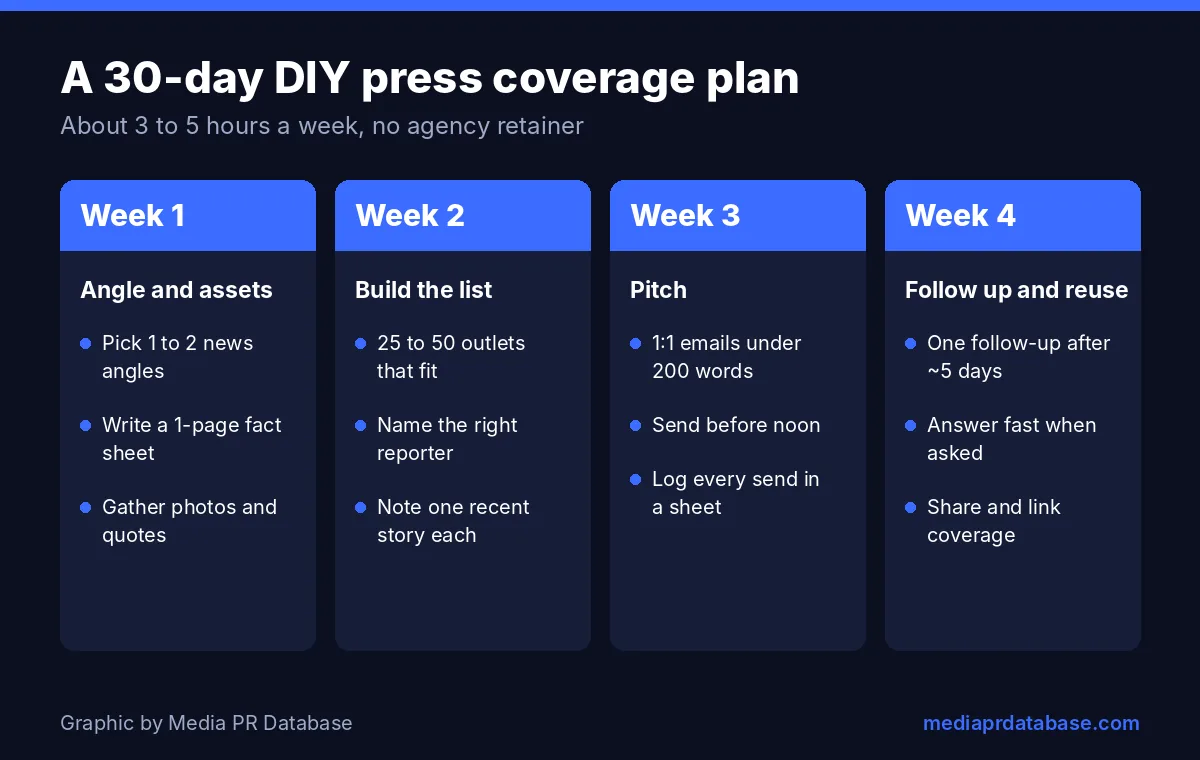
Week 1: angle and assets
- Choose one or two news angles and pass the one-sentence test.
- Write a one-page fact sheet and collect real numbers.
- Gather photos, a short bio and two usable quotes.
Week 2: build the list
- List 25 to 50 outlets: local first, then trade, then podcasts.
- Find the right journalist at each and note one recent story.
- Set up your tracking sheet.
Week 3: pitch
- Send personal emails of under 200 words, in the morning, in small batches.
- Answer journalist requests related to your field each day.
- Log every send.
Week 4: follow up and reuse
- Follow up once with something new, about five working days after each pitch.
- Respond to replies the same day.
- When coverage runs, share it, add it to your site and mention it in the next pitch.
How to turn one story into steady coverage
The first piece of press coverage is the hardest. After that, each story makes the next one easier.
- Add an "As seen in" section to your site with links to the stories.
- Mention past coverage in new pitches, in one line. It tells the reporter you are a reliable source.
- Pitch follow-up angles to the same reporter. If they wrote about your launch, offer them your six-month data.
- Repeat the data story. If a survey worked once, run it again next year and compare.
- Keep a monthly rhythm. A couple of hours a month on outreach beats one big push a year.
Common mistakes that kill press coverage
- Mass-mailing one generic email. Cision's data says 86% of journalists will reject an off-beat pitch on sight.
- Burying the news. If the story is not in the first two lines, it is not read.
- Writing 600 words. Most journalists want under 200.
- Attachments and heavy formatting. Links and plain text are safer.
- Following up again and again. Once is enough.
- Pitching an ad. If your story only says how good your product is, it belongs in a paid placement.
- Inventing or inflating numbers. One wrong number can end a relationship with a reporter for good.
- Going quiet after the reply. Be ready to talk the same day.
Where Media PR Database fits
Media PR Database is a one-time-payment media database built for exactly this kind of DIY outreach. The free plan lets you search every outlet and see its type, category and number of contacts, with emails hidden. Pro ($149, one-time) unlocks every newsroom and journalist email for 9,596 outlets in 195 countries and all 50 US states, with CSV download. Premium ($299, one-time) adds bonus databases of 2,997 podcasts and 123 newsletters with their contact emails. There is no monthly fee, unlike the subscription tools in our Cision alternatives guide. See pricing, or start free with the local news finder and the media pitch generator.
Sources
We read each source on November 4, 2026.
- University of Minnesota UMarComm, "Pitching journalists with Muck Rack's The State of Journalism 2026" (April 13, 2026): 86% of journalists say some of their work began with a PR pitch; 43% say relevant pitches are rare; pitch values (70% relevance, 58% interview access, 40% original data, 37% high-resolution images); 62% prefer a 1:1 email; 78% prefer pitches before noon; 69% prefer under 200 words; 18% prefer Monday.
- Cision, 2025 State of the Media Report press release (May 7, 2025): survey of more than 3,000 journalists in 19 markets; 86% reject off-beat pitches; 72% find press releases most useful; 85% prefer an email introduction; 72% worry about AI factual errors.
- Northwestern Medill Local News Initiative, The State of Local News 2025: almost 40% of local newspapers vanished since 2005; 7% decline in newspaper jobs in the past year; fewer than 1,000 journalists in 39 states; about 8,000 local outlets tracked.
The bottom line
You do not need a PR agency to get press coverage. You need a real news angle, a short list of outlets that fit it, the right journalist at each, and a personal pitch of under 200 words sent in the morning. Follow up once, answer fast, and reuse every story to earn the next. Do that for a month and you will know which angles work for your business, which is more than many agency retainers deliver.
FAQ
How do I get press coverage for my small business?
Find one angle that is genuinely news to a specific audience, such as local impact, original data or a timely expert view. Build a list of 25 to 50 outlets that cover that audience, starting with local and trade press, find the journalist who covers your topic at each, and send a personal email of under 200 words before noon. Follow up once after about five working days.
Can I get media coverage without a PR agency?
Yes. Journalists judge pitches on relevance, not on who sent them. In Muck Rack's State of Journalism 2026 survey, 86% of journalists said at least some of their work began with a PR pitch, and 43% said relevant pitches are rare. A well-researched pitch from a founder can beat a generic agency email.
How long should a pitch to a journalist be?
Under 200 words. In the Muck Rack 2026 survey, 69% of journalists said they prefer pitches under 200 words. Put the news in the first two lines, include your strongest fact, say why it matters to the outlet's readers and offer an interview, data or photos.
When is the best time to pitch journalists?
In the morning of the journalist's time zone. 78% of journalists in the Muck Rack 2026 survey prefer pitches before noon. The day matters less: half do not care, and among those who do, 18% prefer Monday.
How many times should I follow up with a journalist?
Once. Wait about five working days, reply in the same thread and add something new, such as a fresh number or a related news story. If there is still no answer, move on and come back later with a different angle.
How do I find journalists' email addresses?
Check the outlet's author pages, contact page and masthead, and the journalist's public social profiles. A media database saves time: Media PR Database lists 16,692 newsroom and journalist emails for 9,596 outlets in 195 countries, with a one-time Pro plan at $149.
Build your media list in minutes
Search free, then download any country or state list as CSV in one click.
Keep reading
40 News Story Ideas Journalists Actually Cover
40 news story ideas for startups, small businesses and PR freelancers, grouped by type: data, trends, local firsts, people, reactions, milestones, visuals and seasonal hooks, with real campaign examples and a 60-second test.
PitchingPR Strategy for Startups: A 90-Day Plan
A practical PR strategy for startups in 90 days: build your story, angles, boilerplate and media list in month one, pitch local press, trade press and podcasts in month two, then scale with a data story, launch or funding news and simple measurement. Includes a checklist table and a week-by-week plan.
PitchingMedia Pitch Email Template: Copy, Paste and Get Replies (2026)
A media pitch email template broken down line by line, plus 8 copy-paste variants, 30+ subject line examples, follow-up rules and the mistakes journalists hate.