PR Strategy for Startups: A 90-Day Plan
A practical PR strategy for startups in 90 days: build your story, angles, boilerplate and media list in month one, pitch local press, trade press and podcasts in month two, then scale with a data story, launch or funding news and simple measurement. Includes a checklist table and a week-by-week plan.
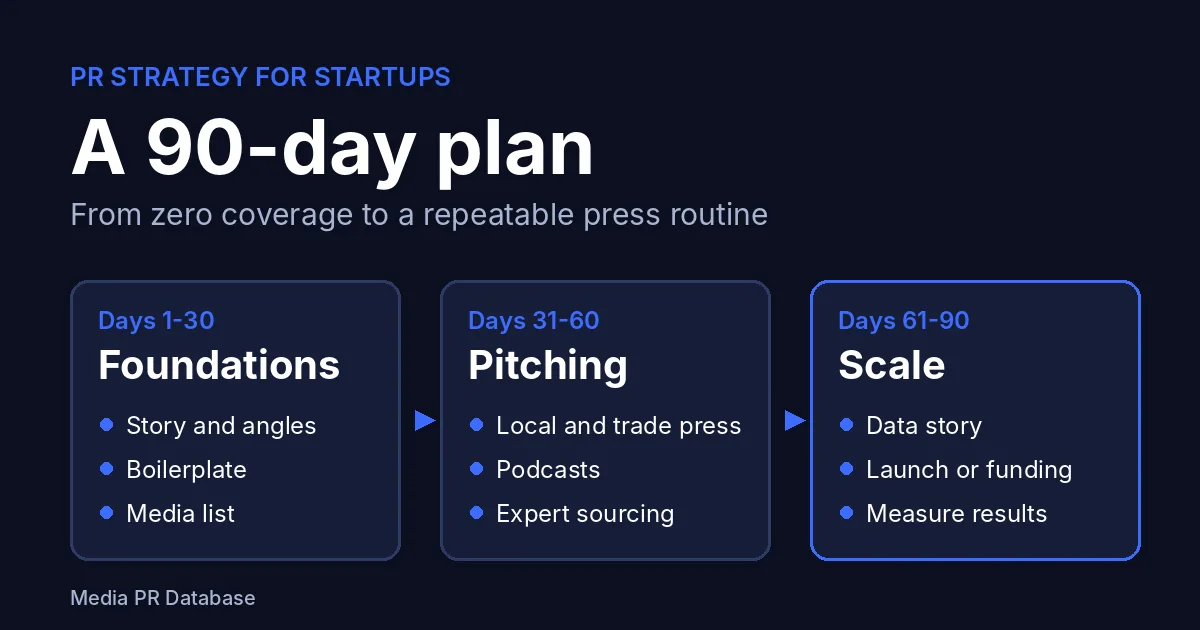
Short answer: a good PR strategy for startups is a 90-day routine, not a single launch announcement. Spend days 1 to 30 on foundations: one clear story, three to five news angles, a boilerplate and a targeted media list. Spend days 31 to 60 pitching the outlets most likely to say yes: local press, trade publications, podcasts and journalists looking for expert sources. Use days 61 to 90 to scale: publish a small data story, time your launch or funding news, and measure what worked so you can repeat it.
This guide turns that into a plan you can follow with a founder's calendar and no agency retainer. You get a checklist table, a week-by-week view, pitch examples and the numbers to track at day 90. It comes from Media PR Database, a directory of 9,596 news outlets in 195 countries with 16,692 newsroom and journalist emails, so most of what follows is about finding the right people and giving them something worth covering.
Why startups need a PR strategy, not just a launch
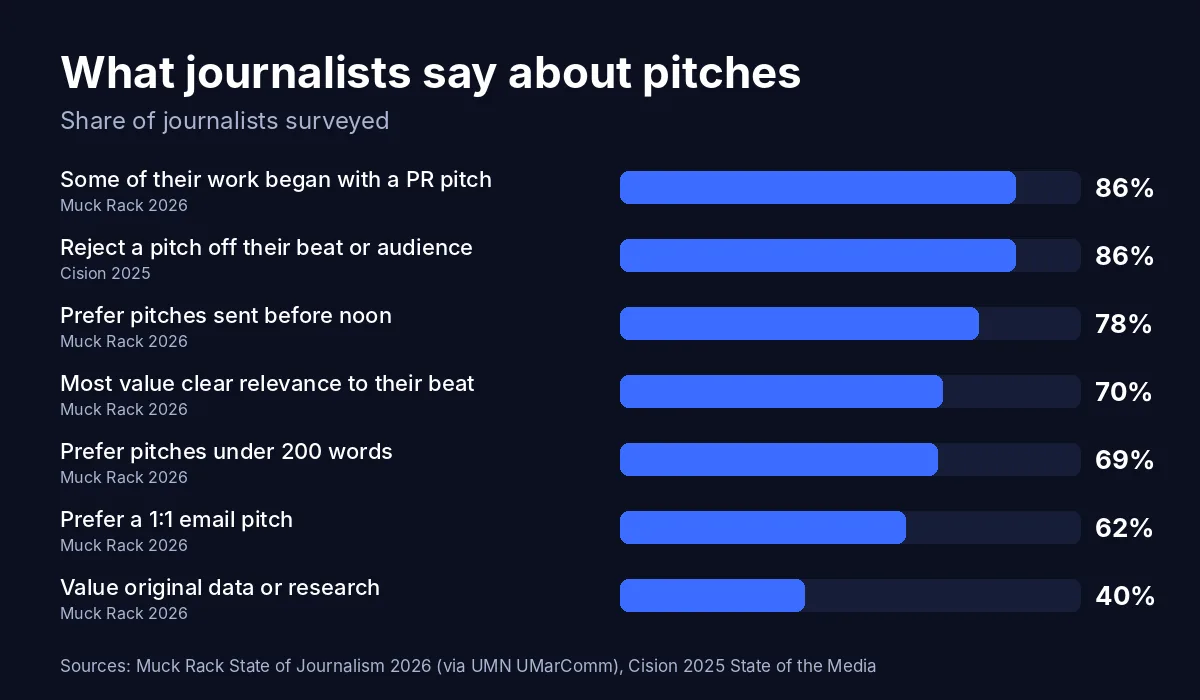
Most startup PR fails the same way: a press release written the night before launch, sent to a few big tech outlets, followed by silence. One email to the most crowded inboxes in media is not a strategy. Startup PR works when you treat it like any growth channel: pick an audience, test messages, track replies and repeat what works. And journalists still need what startups offer. In Muck Rack's State of Journalism 2026 survey, 86% of journalists said at least some of their work began with a PR pitch, while 43% said it was rare to receive pitches relevant to their beat (summarized by the University of Minnesota's UMarComm team). In other words, reporters use pitches, but most pitches miss. A startup that sends fewer, better targeted pitches has a real opening.
Relevance is also where pitches get rejected. Cision's 2025 State of the Media report, a survey of more than 3,000 journalists across 19 markets, found that 86% of journalists will immediately reject a pitch that is not aligned with their beat or audience (Cision press release, May 7, 2025). That is why the first month of this plan is spent on targeting, not sending.
What a realistic startup PR goal looks like
Before day one, write down what you want from the 90 days. Good startup PR goals are specific and small enough to measure:
- Coverage in a few local or trade outlets your customers actually read.
- Appearances on several niche podcasts where the founder can explain the problem you solve.
- Quotes in other people's stories, which build credibility over time.
- A list of journalists who know your name and have replied at least once.
- Referral traffic, sign-ups or backlinks you can trace back to coverage.
"Get into a top national tech outlet" is a poor 90-day goal, because you control almost none of it. The plan below builds the assets and relationships that make it possible later.
The 90-day PR plan at a glance: checklist table
Here is the whole plan as a checklist. Each row is a task you can finish in a week or less, with the output you should have when it is done.
| Phase | Task | Output when done | Done? |
|---|---|---|---|
| Days 1 to 30 | Write the core story | One paragraph: problem, who has it, what you do, why now | ☐ |
| Days 1 to 30 | Pick news angles | Three to five angles, each matched to a type of outlet | ☐ |
| Days 1 to 30 | Write a boilerplate and fact sheet | About section, founder bios, key facts, logo and photos in one folder | ☐ |
| Days 1 to 30 | Build a media list | 50 to 150 named contacts, each tagged by angle and outlet type | ☐ |
| Days 31 to 60 | Pitch local press | Personal pitches to local newsrooms and business journals | ☐ |
| Days 31 to 60 | Pitch trade press | Pitches to industry publications and newsletters | ☐ |
| Days 31 to 60 | Pitch podcasts | Ten or more tailored guest pitches | ☐ |
| Days 31 to 60 | Answer expert source requests | Short, quotable replies sent fast | ☐ |
| Days 31 to 60 | Follow up and adjust | One follow-up per pitch, subject lines rewritten where replies were low | ☐ |
| Days 61 to 90 | Create a data story | One small piece of original data with a headline finding | ☐ |
| Days 61 to 90 | Announce launch or funding | Press release plus personal pitches to warm contacts | ☐ |
| Days 61 to 90 | Measure and repeat | One sheet with outreach, coverage and results, plus next quarter's plan | ☐ |
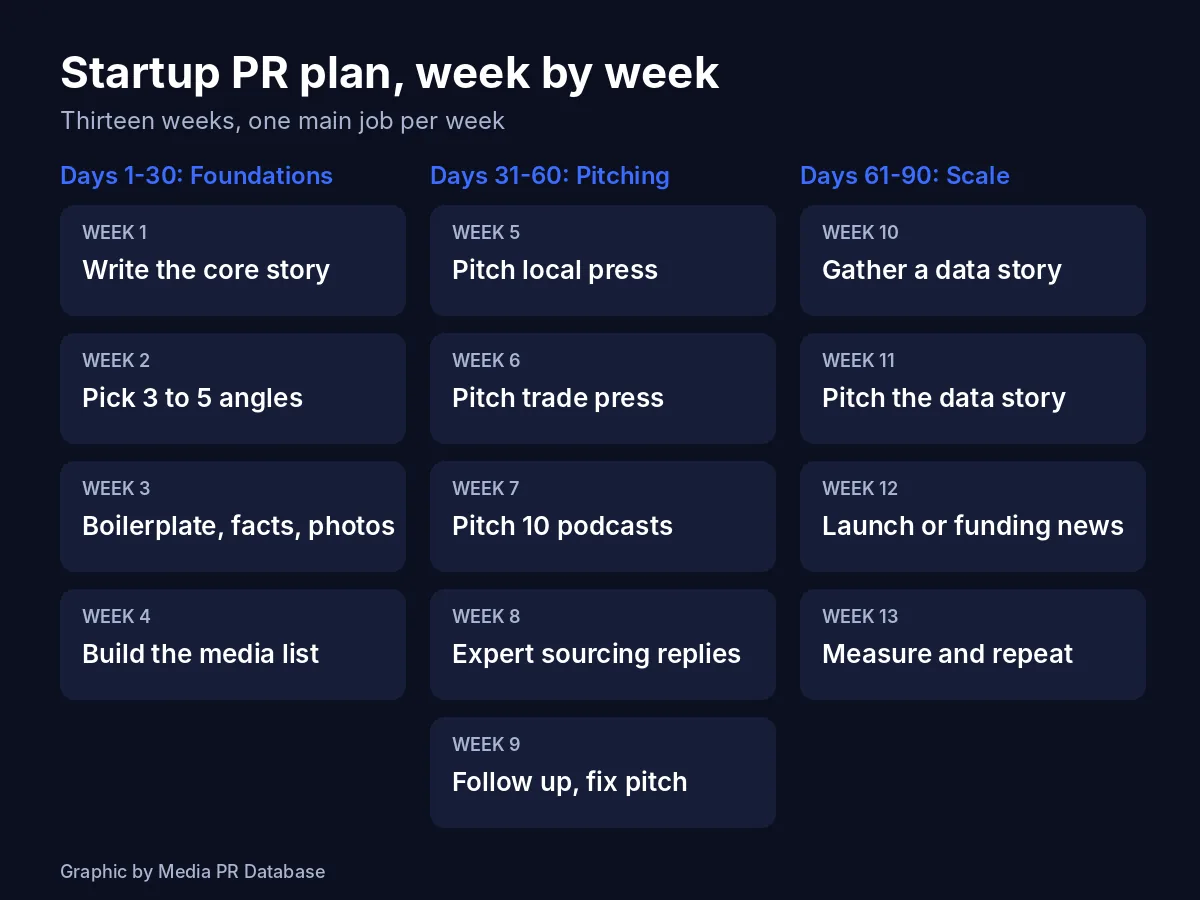
Days 1 to 30: build your PR foundations
The first month produces no coverage, and that is fine. It produces what every later pitch depends on: a story, angles, press materials and a list of people to contact.
Week 1: write your core story
Your core story is not your pitch deck. Investors want market size and returns. Journalists want to know why their readers should care. Write one paragraph that answers four questions:
- What problem exists? Describe it in plain words, ideally with a fact you can source.
- Who has it? A specific group of people, not "businesses" or "everyone."
- What do you do about it? One sentence, no jargon, no "AI-powered platform" unless that is genuinely the news.
- Why now? A change in law, technology, prices or behavior that makes this timely.
Test it on someone outside your industry. If they cannot repeat it back, simplify it.
Week 2: choose three to five news angles
A startup with one story still has many angles. An angle is the reason a particular outlet would run something about you. The same company can be a local business story, a trade story about how an industry is changing and a podcast conversation about the founder's experience. Common angles that work for early-stage companies:
- Local angle: a company founded, hiring or solving a problem in a specific city.
- Industry trend angle: what your customers are doing differently and what it means for the sector.
- Founder angle: why you started this, what you got wrong, what you learned.
- Data angle: a number you can measure that nobody else has published.
- Expert angle: a topic where the founder can explain something clearly to a general audience.
Write each angle as a possible headline and note which kind of outlet would run it.
Week 3: write your boilerplate, fact sheet and press kit
Reporters on deadline want facts they can copy. Create one public press page with:
- Boilerplate: the short "About" paragraph that ends every release. Our guide to the press release boilerplate has templates for early-stage companies.
- Fact sheet: founding year, location, founders, number of customers or users if you share them, funding if public, and a short product description.
- Images: logo files, product screenshots and high-resolution founder photos. In the Muck Rack survey summary, 37% of journalists said they value high-resolution images in a pitch.
- Contact: one named person and a direct email, such as press@example.com, that someone actually reads.
Week 4: build your media list
This is the most important task of the first month. A media list is a spreadsheet of the specific journalists, editors, producers and podcast hosts you will pitch, with notes on what each one covers. If the term is new, read what a media list is and how to structure one first.
For a startup's first 90 days, aim for 50 to 150 contacts split across the angles you chose in week 2. Tag each row with its angle so you never send the trade story to the local reporter. A good starting mix:
- Local outlets in the city or region where you are based or where your first customers are. Browse by location, for example California media outlets, New York media outlets or, outside the US, media outlets in Germany.
- Trade publications and newsletters for your customers' industry.
- Podcasts that interview founders or practitioners in your field.
- Individual reporters who have written about your problem space in the past year.
You can start for free with our media list builder and the local news finder, which shows newsrooms near any city. Before adding a reporter, read two or three of their recent articles. It takes a few minutes per name and it is the difference between a relevant pitch and the 86% that get rejected.
Days 31 to 60: start pitching where startups win
In month two you start sending. The order matters: begin with outlets where a young company has a strong chance, collect early coverage and replies, and use what you learn to sharpen the pitch before the bigger moments in month three.
Week 5: pitch local press
Local news is the easiest door for most startups because your location is, by definition, an angle nobody else has. It is also a newsroom under pressure. Northwestern University's Medill State of Local News 2025 report found that almost 40% of local US newspapers have vanished since 2005, and that more than 130 papers shut down in the past year alone. Fewer reporters covering a region means each one has less time to find stories, so a well-prepared local pitch with the facts already gathered is often welcome.
Good local angles include local hiring, a partnership with a local business or school, a founder from the community, or a problem residents face. If you sell nationally, treat the two or three cities with the most customers as local stories.
Week 6: pitch trade press and newsletters
Trade publications rarely make a founder famous, but they are often where your buyers read. Trade editors want news about how the industry works: new approaches, practical results, regulation and expert commentary.
Write the trade pitch around your customers, not your product. "How independent clinics are cutting no-shows" is a trade story. "Our scheduling app launches version 2" usually is not, unless the version contains something the industry has never seen.
Week 7: pitch podcasts
Podcasts suit early-stage founders: hosts need guests, episodes are long enough to explain a product, and niche shows reach exactly your audience. Pick ten shows whose recent episodes fit your founder or expert angle, listen to at least part of one episode each, and send a short pitch that names a specific topic you could cover.
Our guide on how to get on podcasts as a guest walks through finding shows and includes a pitch template. Media PR Database Premium adds 2,997 podcasts and 123 newsletters as a bonus, which saves time if podcasts become a main channel.
Week 8: answer expert source requests
Journalists regularly look for expert sources, and answering those requests gets you quoted without needing your own news. Keep replies short: one or two quotable sentences, a line about why you are qualified, and your contact details. Reply quickly, because many requests close within hours.
Our roundup of HARO alternatives compares the services that publish these requests. Give it a fixed daily slot so it does not take over your week.
Week 9: follow up, then fix what is not working
Send one polite follow-up per unanswered pitch, three to five working days later, adding something new if you can. Then check which angles and outlet types replied, rewrite the weakest pitch and keep the strongest.
How to write a startup pitch journalists read
All of month two depends on the pitch itself. The survey data gives clear guidance. In the Muck Rack summary, 62% of journalists prefer to be pitched in a one-to-one email, 69% prefer pitches under 200 words and 78% prefer pitches sent before noon. Cision found that 85% of journalists say the best way to build a relationship is to introduce yourself by email, even without a story to pitch.
The structure
- Subject line: the news or angle in plain words, under about ten words.
- First sentence: why this matters to their readers, ideally tied to something they have covered.
- Two or three sentences: the facts, including one number if you have it.
- The offer: what you can provide, such as an interview, data, a customer or images.
- Sign-off: name, role, phone number and a link to your press page.
A short example
Subject: Local clinic startup hiring 12 in [City] after first year

Hi [First name],

I saw your piece on [recent article topic] and thought this might fit your
coverage of local employers.

[Company] started in [City] last year to help small clinics reduce missed
appointments. We now work with [number] clinics in the region and are hiring
12 people locally this quarter.

I can share our numbers on missed appointments across the clinics we work with,
and our founder and one clinic owner are both available for an interview this week.

Best,
[Name], [Role]
[Phone] | press@example.com | [link to press page]
Fill the brackets with real details only. For more structures, see our media pitch email templates, or draft a first version with the free media pitch generator and then personalize it by hand.
Days 61 to 90: scale what works
By day 60 you should have a tested pitch, some replies and maybe some coverage. Month three uses that base for bigger moments.
Weeks 10 and 11: create and pitch a data story
Original data is one of the few things a small company can offer that larger competitors cannot easily copy. In the Muck Rack summary, 40% of journalists said they value original data or research in a pitch. You do not need a large research budget. Useful sources of data for a startup include:
- Anonymized product data: trends across your customers, such as busiest days, average savings or common requests. Get consent where needed and never share anything that identifies a customer.
- A short survey: ten questions to your users or to people in your industry, with a clear sample size and dates.
- Public data analysis: government or open datasets combined in a way nobody has published.
Pick the most surprising finding, write it as a headline and publish a short report page with the method explained. In week 11, pitch it to the contacts who replied in month two plus a few new reporters on the topic.
Week 12: announce your launch or funding news
If you have a launch, a new product line or a funding round, this is the time to announce it, because you now have warm contacts instead of a cold list. Cision's survey found that 72% of journalists still cite press releases as the most useful resource PR teams can offer, so write a proper release with a clear headline, dateline, quote and boilerplate.
A few rules for startup announcements:
- Pitch before you distribute. Send personal pitches to your best contacts a few days early, with a clear embargo time if you offer one, and only to reporters who agree to it.
- Lead with what changes for customers. Funding is news to investors and other founders. For a wider audience, explain what the money lets you do.
- Do not overstate. Claims you cannot back up damage trust with a reporter you may need again.
If you do not have launch or funding news in this window, do not invent it. Use week 12 for a second data story, a customer milestone or a founder op-ed pitched to a trade outlet.
Week 13: measure the 90 days and plan the next quarter
Measurement is what turns a burst of PR into a strategy. Keep one sheet updated every week and review it at day 90.
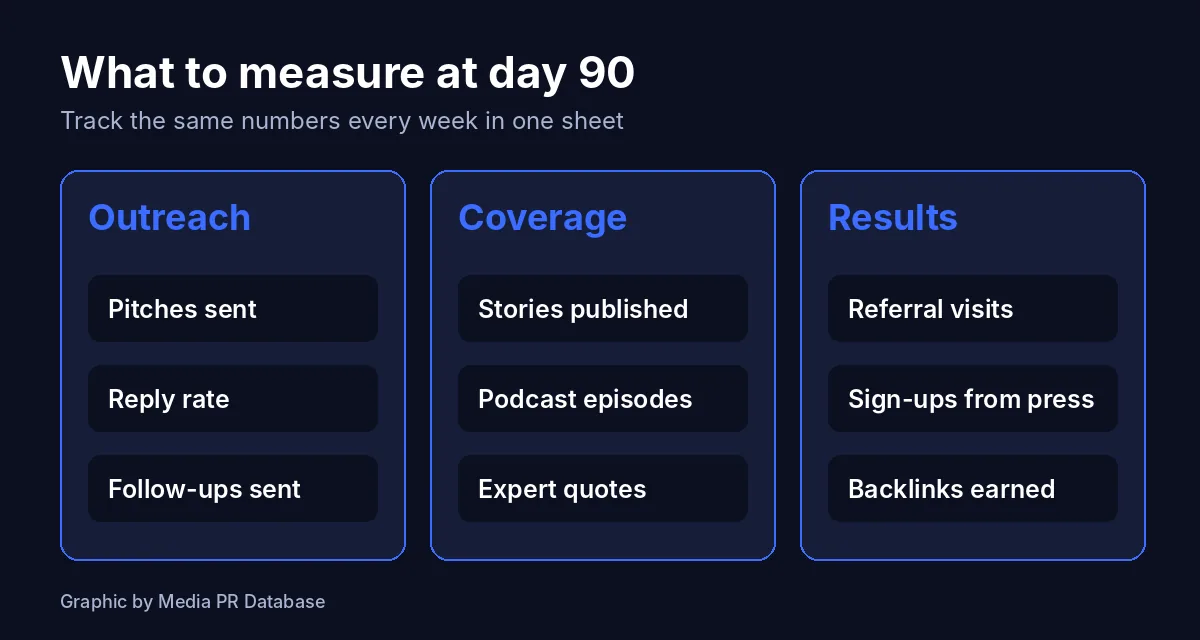
Track pitches sent and reply rate by angle, then coverage (articles, episodes, quotes), then results: referral visits in your analytics, sign-ups tagged with UTM links from your press page, and backlinks earned. The most valuable output is often the list of warm contacts, the journalists and hosts who replied at least once.
Then keep the best angles, drop outlet types that never answered, add contacts and write the next 90-day plan.
Common startup PR mistakes
Pitching only the biggest outlets
Starting with large national and tech outlets means competing with every other startup at once. Build local, trade and podcast clips first, then use them to show traction.
Mass emailing a purchased list
Cision's finding that 86% of journalists reject off-beat pitches is the best argument against blasting the same email to hundreds of addresses. A database is for finding the right people. The pitch still has to be written for each one.
Making the product the story
Features are rarely news. The story is the problem, the people affected, the trend or the data. Your product appears as the reason you know about it.
Leaning on AI-written pitches
Cision found that over half of journalists globally now use generative AI tools, yet 72% worry about factual errors in AI-generated PR content. Use AI to draft if it helps, but check every fact and rewrite the pitch in your own voice before it goes out.
Tools for a lean startup PR stack
A lean stack is a spreadsheet, your email account, free analytics and a contact source. Our list of the best PR tools for small teams compares options at different budgets.
For the contact source, Media PR Database covers 9,596 news outlets in 195 countries and all 50 US states, with 16,692 newsroom and journalist emails. You can browse outlets by location for free, and use the media list builder, local news finder and media pitch generator without paying. Pro ($149, one-time) includes outlet emails and CSV export. Premium ($299, one-time) adds 2,997 podcasts and 123 newsletters as a bonus. There is no subscription, which suits a startup that wants to run PR in quarterly bursts. See pricing.
If you want a deeper look at earning coverage without outside help, read our guide on how to get press coverage without a PR agency.
Sources
We checked these sources on November 9, 2026.
- University of Minnesota UMarComm, "Pitching journalists with Muck Rack's The State of Journalism 2026" (April 13, 2026): pitch origins, relevance, format and timing preferences.
- Cision, 2025 State of the Media Report press release (May 7, 2025): pitch rejection, press releases, email introductions and AI concerns among more than 3,000 journalists.
- Northwestern Medill Local News Initiative, The State of Local News 2025: newspaper losses since 2005 and in the past year.
The bottom line
A PR strategy for startups is a repeatable 90-day cycle. Build the story, angles, press materials and media list first. Pitch local press, trade publications, podcasts and expert requests next, where a small company has the best odds. Then scale with original data and your biggest news, measure everything in one sheet, and start the next quarter with warmer contacts and a sharper pitch.
FAQ
What is a PR strategy for startups?
It is a plan for earning media coverage that matches a startup's size and goals: a clear core story, a few news angles matched to specific outlets, a targeted media list, regular pitching and simple measurement. Instead of one big launch announcement, a startup PR strategy runs in repeatable cycles, such as 90 days, so the team learns what works and builds relationships with journalists over time.
How long does it take for startup PR to work?
Expect the first month to produce no coverage, because it is spent building your story, press materials and media list. Most startups see first replies and local, trade or podcast coverage in the second month if they pitch consistently. Bigger results usually come in later quarters, once you have warm contacts and earlier coverage to point to.
Can a startup do PR without an agency?
Yes. Founders often make the best spokespeople, and the core work of startup PR, finding the right journalists and writing relevant one-to-one pitches, does not require an agency. What it does require is a few focused hours every week, a well-researched media list and the discipline to follow up and measure results.
Which outlets should a startup pitch first?
Start where a young company has the best odds: local news outlets and business journals in your city, trade publications your customers read, niche podcasts that interview founders, and journalists looking for expert sources. Use that coverage to build credibility before pitching large national or tech outlets.
How much does startup PR cost?
A do-it-yourself plan can cost very little: your time, an email account, a spreadsheet and a source of media contacts. Media PR Database offers free location browsing and free tools, with Pro at $149 one-time and Premium at $299 one-time, no subscription.
How do you measure startup PR results?
Track three groups of numbers every week: outreach (pitches sent, reply rate, follow-ups), coverage (articles, podcast episodes, expert quotes) and results (referral visits, sign-ups or leads from press, and backlinks). Review them at day 90 to keep the angles that got replies and drop the ones that did not.
Build your media list in minutes
Search free, then download any country or state list as CSV in one click.
Keep reading
40 News Story Ideas Journalists Actually Cover
40 news story ideas for startups, small businesses and PR freelancers, grouped by type: data, trends, local firsts, people, reactions, milestones, visuals and seasonal hooks, with real campaign examples and a 60-second test.
PitchingHow to Get Press Coverage Without a PR Agency
How to get press coverage without a PR agency: find a real news angle, pick the right outlets and journalists, write a short pitch journalists actually read (Muck Rack 2026 and Cision 2025 data), follow up, and turn one story into steady media coverage. Includes a pitch template and a 30-day plan.
PitchingMedia Pitch Email Template: Copy, Paste and Get Replies (2026)
A media pitch email template broken down line by line, plus 8 copy-paste variants, 30+ subject line examples, follow-up rules and the mistakes journalists hate.