15 Best PR Tools for Small Teams in 2026
The 15 best PR tools for small teams in 2026: media databases, monitoring, press release distribution, outreach, journalist request services and design helpers, with real published prices, a comparison table and a lean starter stack.
Short answer: the best PR tools for a small team are the ones that cover the five jobs of PR without locking you into a big annual contract: find the right journalists, pitch them, answer reporters who need sources, track your mentions and announce big news. For most small businesses that means one media database, one monitoring tool, a free journalist request feed and a press release wire only when the news is big enough to justify it.
This guide ranks 15 PR tools across six categories. We start with our own product, Media PR Database, then cover 14 other tools we think a small team should know. For every tool you get what it does, who it suits and its price. We only list a price when we read it on the vendor's own pricing page on November 6, 2026; where a vendor does not publish prices, we say so. The sources are linked at the end.
Quick comparison: the 15 best PR tools at a glance
| # | Tool | Category | Best for | Published starting price |
|---|---|---|---|---|
| 1 | Media PR Database | Media database | Worldwide media lists and emails on a small budget | $149 one-time |
| 2 | Muck Rack | Media database and monitoring | Teams that want database, pitching and reports in one suite | Pricing on request |
| 3 | Cision (CisionOne) | Media database and monitoring | Larger teams that also want a newswire | Pricing on request |
| 4 | Semrush AI PR Toolkit | Media database and pitching | Pitching with AI search visibility in mind | $149/month |
| 5 | Brand24 | Monitoring | Affordable web, news and social monitoring | $199/month billed annually, $249 monthly |
| 6 | Meltwater | Monitoring | Media plus social listening at scale | Pricing on request |
| 7 | Google Alerts | Monitoring | Basic email alerts for your brand name | Check their site |
| 8 | EIN Presswire | Press release distribution | Low-cost wire distribution | $149 per release |
| 9 | PR Newswire | Press release distribution | Major corporate and investor news | Check their site |
| 10 | Prezly | Newsroom and PR CRM | A branded online newsroom with email campaigns | 100 EUR/month billed annually |
| 11 | BuzzStream | Outreach CRM | Tracking pitches and follow-ups | $49/month |
| 12 | Qwoted | Journalist requests | Paid access to reporter requests | $1,188/year (Pro) |
| 13 | Source of Sources | Journalist requests | Free daily reporter queries | Free |
| 14 | Canva | Design | Press kit graphics and social images | Check their site |
| 15 | Grammarly | AI writing helper | Cleaner pitches and releases | Check their site |
Prices were read on November 6, 2026, from each vendor's pricing page and can change at any time. Check the vendor's site before you buy.
What PR tools does a small team actually need?
Big agencies buy one large suite and give every account manager a seat. A team of one to five people rarely needs that. You need a tool for each step that actually costs you time, and nothing else. PR tools fall into six groups:
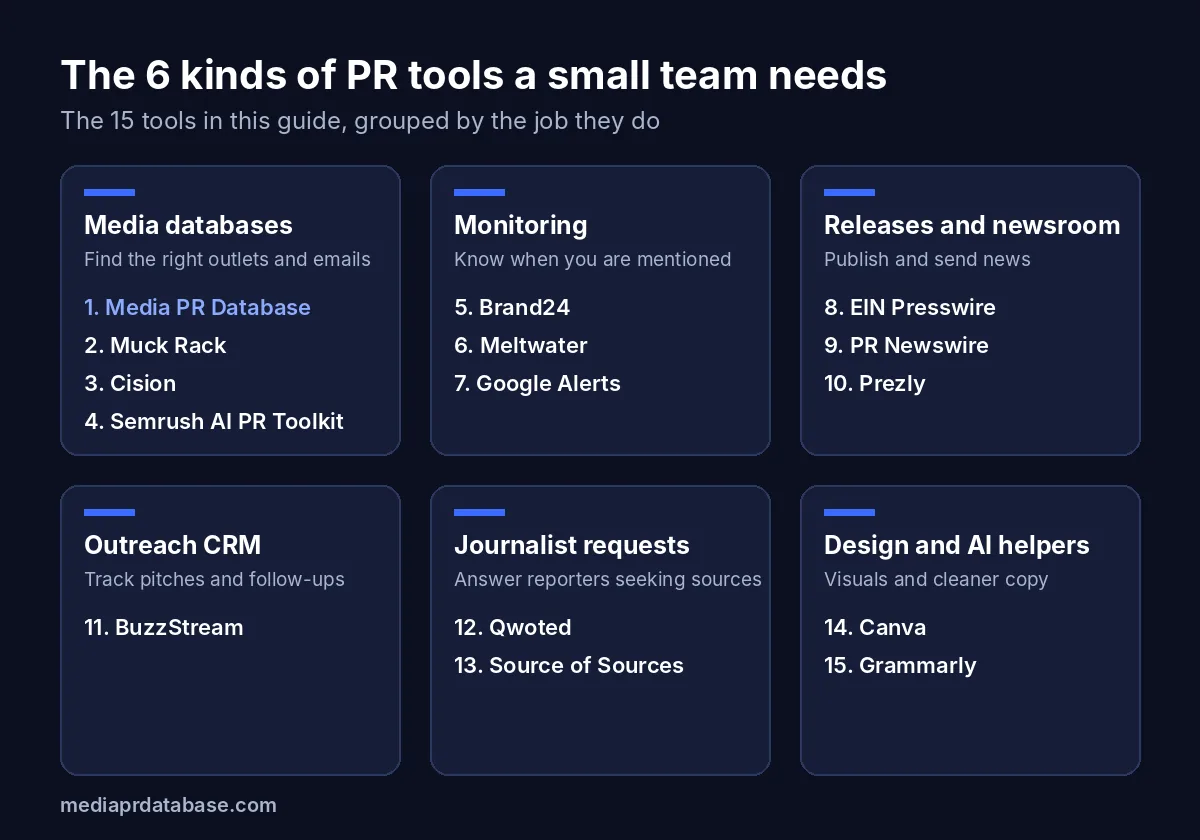
- Media databases tell you which outlets and journalists cover your topic and how to reach them. This is where coverage starts. If you are new to the idea, read what a media database is.
- Monitoring tools tell you when your brand, your competitors or your topic is mentioned online.
- Press release distribution (wires) and newsrooms publish your announcement and push it to news sites and aggregators.
- Outreach CRMs track who you pitched, who replied and who needs a follow-up.
- Journalist request services send you queries from reporters looking for expert sources.
- Design and AI helpers make your visuals and your copy look professional.
The order matters. A small team that buys monitoring before it has a media list ends up watching for coverage that never comes. Start with the list, then the pitch, then everything else.
How we picked these PR tools
We chose tools that a team of one to five people can start using without a long sales process, plus a few well-known suites so you can see what the big options offer. We judged each one on four things:
- The job it does. Does it solve one of the six problems above well?
- Price transparency. Can you see the price before you talk to sales?
- Commitment. One-time, monthly, per release or annual contract?
- Fit for small teams. Can one person set it up and get value in the first week?
We did not log in to any tool for this review. Feature notes come from the vendors' public pages, and we only quote numbers we read there.
Media databases and pitching tools
1. Media PR Database: best for affordable worldwide media lists
Media PR Database is our own product, so judge it by the facts below. It is a searchable directory of 9,596 news outlets in 195 countries with 16,692 newsroom and journalist emails, and it covers outlets in all 50 US states. Every state and country has its own page, such as the New York media list, the California media list or the Canada media list.
What it does: you search by country, state, city or outlet type, build a list of the outlets that cover your story, and export it to send pitches from your own inbox or email tool. There is no seat licence and no monthly fee.
Who it suits: founders, small businesses, freelancers and small agencies who need media contacts in one or many countries without a five-figure contract.
Pricing (see plans):
- Pro, $149 one-time: news outlet and journalist emails with CSV export.
- Premium, $299 one-time: everything in Pro, plus 2,997 podcasts and 123 newsletters as a bonus.
Where it falls short: it does not monitor mentions, send press releases over a wire or track replies. Pair it with a monitoring tool from the list below and your own inbox or an outreach CRM.
Free tools to try first: the media list builder filters outlets by country, state and topic, the local news finder shows newspapers and stations near any city, and the media pitch generator drafts the short email that goes to each reporter.
2. Muck Rack: best all-in-one suite for growing teams
What it does: Muck Rack combines a searchable database of journalists with pitching, media monitoring and coverage reports in one platform. Journalists also keep public profiles there.
Who it suits: in-house teams and agencies that pitch every week, need reporting for leadership or clients, and want one login for most PR work.
Pricing: pricing on request. Muck Rack does not publish a price list, so you get a quote after a demo.
Watch out for: a suite is more than a small team usually needs. If you mostly need contacts, see our list of Muck Rack alternatives.
3. Cision (CisionOne): best for larger teams that also want a wire
What it does: Cision offers a media contact database, monitoring and analytics, and it owns the PR Newswire distribution service, so one company can cover the list, the release and the reporting.
Who it suits: mid-size and enterprise communications teams with a steady flow of announcements and a budget for an annual platform.
Pricing: pricing on request. Cision quotes each customer after a sales call.
Watch out for: annual contracts and pricing you cannot see in advance are hard to justify for a team of two. Our guide to Cision alternatives compares cheaper options.
4. Semrush AI PR Toolkit: best for pitching with AI search in mind
What it does: the AI PR Toolkit (formerly Prowly) helps you find media outlets that large language models cite, find relevant journalists, build lists and send targeted pitches. According to Semrush, the Pro plan adds follow-ups, result analysis, weekly updates on AI-cited media and media coverage monitoring, and the Business plan adds competitor coverage tracking and share of voice benchmarks.
Who it suits: marketers who already use Semrush and want PR outreach tied to visibility in ChatGPT, Gemini and Google. Semrush says the toolkit is designed for users with little or no prior experience with PR tools.
Pricing: Base $149/month, Pro $279/month, Business $499/month, with a free 7-day trial. During the trial, sending emails, viewing and exporting contacts and email statistics are limited or unavailable.
Media monitoring tools
5. Brand24: best affordable monitoring for small businesses
What it does: Brand24 tracks keywords such as your brand or product name across sources it lists as news, blogs, podcasts, newsletters, Reddit, YouTube, TikTok, LinkedIn, X, Facebook, Instagram and review sites. It adds AI sentiment analysis, reach estimates and reports.
Who it suits: small teams that want to see press and social mentions in one dashboard and send simple coverage reports.
Pricing: Individual $199/month billed annually or $249 month to month (3 keywords, 2,000 mentions a month, 1 user); Team $299/month billed annually or $349 monthly (7 keywords, 10,000 mentions, unlimited users). Pro, Business and Enterprise plans cost more. There is a free 14-day trial with no credit card, and Brand24 says you can cancel at any time. Note that mentions above your plan's limit can carry overage fees.
6. Meltwater: best for media plus social listening at scale
What it does: Meltwater is a large media intelligence platform: news and broadcast monitoring, social listening, media contacts and analytics.
Who it suits: brands and agencies that need broad global monitoring, many users and detailed analytics.
Pricing: pricing on request. Meltwater quotes after a demo.
Watch out for: a platform of this size is built for big programs. If you mainly need contacts or basic alerts, read our Meltwater alternatives.
7. Google Alerts: best basic option to start today
What it does: Google Alerts emails you when new results for a topic show up in Google Search, for example news about your company or mentions of your founder's name. Google's help page says you can choose how often you get notifications, the types of sites, the language, the region and how many results you see.
Who it suits: anyone who needs a simple, set-and-forget way to catch new coverage. It is a good first step before you pay for a monitoring tool.
Pricing: check their site. You create alerts while signed in to a Google account.
Watch out for: it only covers what Google Search picks up and gives you no sentiment, reach or reports.
Press release distribution and newsroom tools
8. EIN Presswire: best low-cost press release wire
What it does: EIN Presswire publishes and distributes press releases. Its pricing page says all packages include distribution to AP News, Nexstar Media Group and the USA TODAY Network, plus news aggregators such as Google News and Bloomberg Terminals, with placement based on relevance. Each release comes with a distribution report.
Who it suits: small businesses that issue a few releases a year and want wire distribution and search visibility without a large per-release bill.
Pricing: Basic $149 for one release (700-word limit), Pro+ $499 for five releases (EIN advertised a sixth release free as a limited-time offer), Corporate $999 for 15 releases. Releases must be used within one year of purchase.
Watch out for: a wire puts your release online; it does not guarantee a journalist writes a story. Pitch the reporters who matter directly as well.
9. PR Newswire: best for major corporate and investor news
What it does: PR Newswire, part of Cision, is one of the best-known press release wires, used widely for corporate, financial and investor announcements.
Who it suits: companies with news that has to reach financial media and investors, or that must meet disclosure needs.
Pricing: check their site. For cheaper options and how they compare, see our PR Newswire alternatives.
10. Prezly: best for a branded online newsroom
What it does: Prezly gives you a hosted newsroom for your stories and press releases, a contact database and email campaigns to journalists, with analytics on every send.
Who it suits: brands that want a professional press page and want to pitch from the same place they publish.
Pricing: Essential 100 EUR/month billed annually (1 site, 1 user, up to 5,000 contacts); Standard 250 EUR/month billed annually (2 users, up to 10,000 contacts, white-label sites, sending from your own domain); Enterprise is custom. There is a 14-day free trial with no credit card.
Pitching and outreach tools
11. BuzzStream: best outreach CRM for tracking pitches
What it does: BuzzStream is an outreach CRM. It finds contact information, tracks opens, clicks and replies, stores email templates, and on higher plans adds bulk sending, scheduling and automated follow-ups.
Who it suits: digital PR and link building teams who send many personalized pitches and need to know who replied and who needs a nudge.
Pricing: Starter $49/month (1 user, 500 contacts), Growth $174/month (3 users, 25,000 contacts), Professional $424/month (6 users, 100,000 contacts), Custom from $999/month. BuzzStream says plans are monthly with no minimum term, and there is a free trial.
Tip: BuzzStream tracks outreach but you still need the contacts. Build the list first with a media database, then import it.
Journalist request services
Request services flip pitching around: reporters post what they need and you reply if you are a genuine expert. They are useful alongside pitching, not instead of it. Our HARO alternatives guide covers more of them.
12. Qwoted: best paid marketplace for reporter requests
What it does: Qwoted connects journalists with expert sources. You see reporter requests and send pitches through the platform.
Who it suits: founders, executives and agencies with genuine expertise who want a steady flow of quote opportunities.
Pricing: the Pro plan is listed at $1,188/year (shown reduced from $1,788) with 35 pitches a month. The Team plan for agencies and PR teams and the managed Qwoted Amplify service are priced on request.
13. Source of Sources: best free journalist request feed
What it does: Source of Sources (SOS) was started by Peter Shankman, who founded HARO. Subscribers get an email with journalist queries up to three times a day and reply directly to the reporter.
Who it suits: experts and small businesses that want free media opportunities and will only answer when they have something useful to add. SOS warns that anyone who pitches off topic is removed with no appeal.
Pricing: free. The site says the list does not cost anything and suggests donating to an animal charity instead.
Design and AI writing helpers
14. Canva: best for press kit and release visuals
What it does: Canva is an online design tool for social images, one-page fact sheets, press kit PDFs and simple charts.
Who it suits: teams without a designer who need clean visuals to attach to a pitch or embed in a release.
Pricing: check their site.
15. Grammarly: best for cleaner pitches and releases
What it does: Grammarly is a writing assistant that checks grammar, clarity and tone in your drafts.
Who it suits: anyone who writes pitches and releases under time pressure and wants a second pair of eyes. It will not fix AP style for you, so keep our AP style cheat sheet close.
Pricing: check their site.
How PR tools charge: one-time, per release, monthly or free
The biggest difference between PR tools is not the features. It is how you pay. Four models show up in this list:
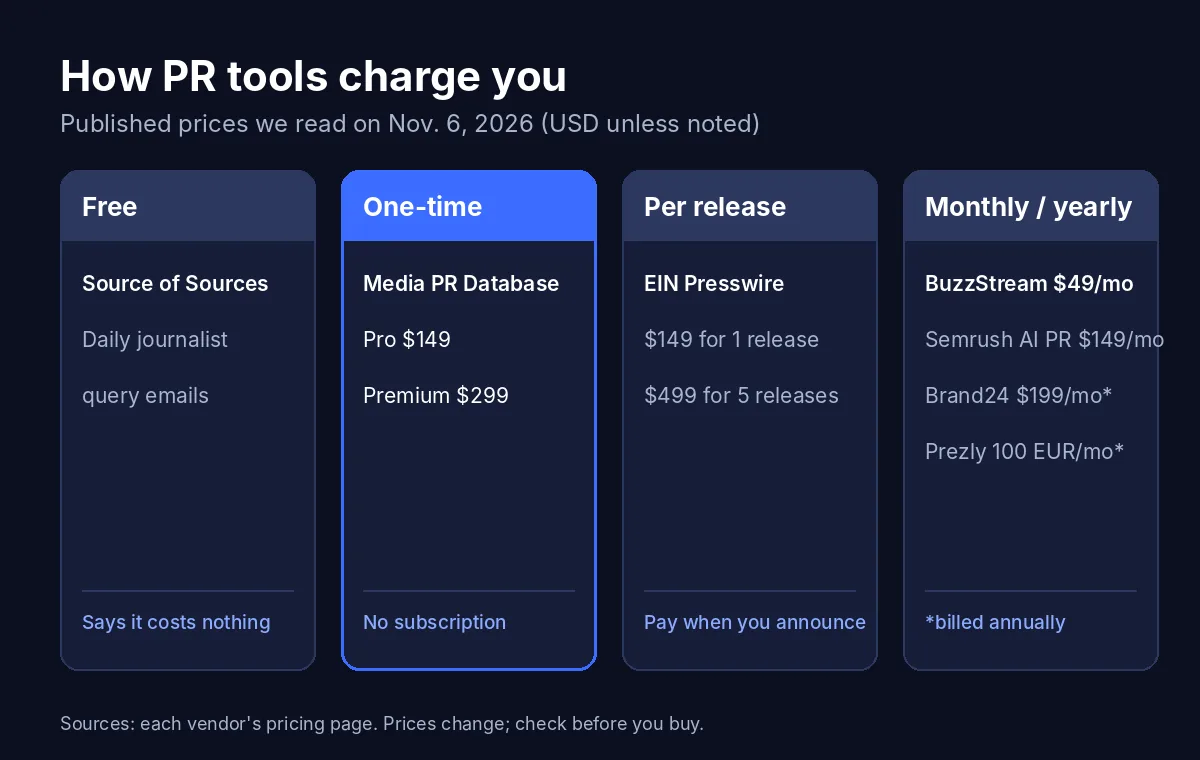
Free
Source of Sources costs nothing, and Google Alerts is a quick start for tracking mentions. Free tools are worth using from day one, but they will not build your media list for you.
One-time
Media PR Database is paid once: $149 for Pro or $299 for Premium. That suits teams that pitch in bursts, such as around a launch, rather than every day of the year.
Per release
Wires such as EIN Presswire charge for each release or a bundle of releases. You only pay when you have news, which keeps costs tied to real announcements.
Monthly or annual subscription
Monitoring, outreach CRMs and PR suites usually bill monthly or yearly. They make sense when you use them every week. Before you sign, check the contract term, whether annual billing is required for the advertised price, and what happens if you go over your plan's limits.
A lean PR tool stack for a small team
If you are starting from zero, you do not need 15 tools. You need one per step:
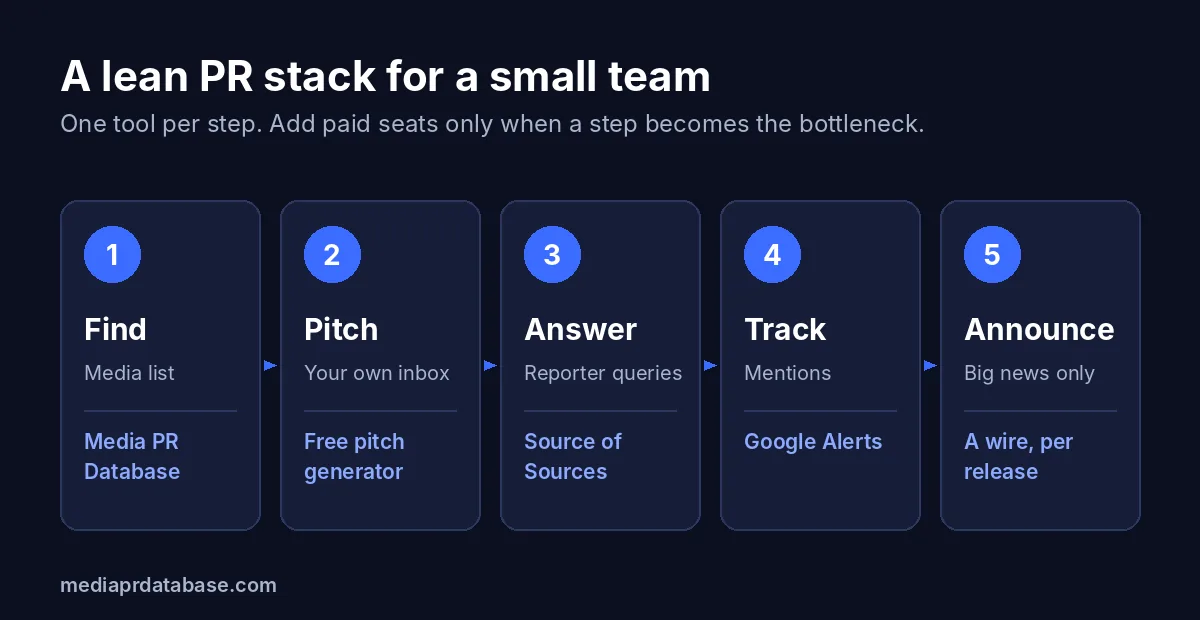
- Find: build a targeted list of 20 to 50 outlets. Start with the media list builder or a location page such as the Texas media list or the UK media list, then unlock emails with Media PR Database.
- Pitch: write a short, personal email for each reporter. The media pitch generator gives you a first draft. Send from your own inbox so replies come straight to you.
- Answer: subscribe to Source of Sources and reply only to queries that match your expertise.
- Track: set up Google Alerts for your brand, your founder and your product. Move to Brand24 or a similar tool when alerts are no longer enough.
- Announce: use a wire such as EIN Presswire only for news that deserves it, like a launch, funding or a major partnership.
For the full process, from angle to follow-up, read how to get press coverage without a PR agency.
Example: a two-person team launching a product
Here is how the stack fits together for a small software company launching in the US and Canada. The founder builds a list of trade and local outlets in a weekend, filtered by state and by the Canada media list. The marketer drafts one pitch, personalizes the first line for each reporter, and sends 10 to 15 emails a day from a normal inbox. Replies are tracked in a simple spreadsheet. On launch day they publish one wire release for search visibility, and Google Alerts catches the coverage. A pitch might end with a contact line like press@example.com and a phone number, nothing more.
When the team starts pitching every week, they add an outreach CRM. When a client or a board asks for coverage reports, they add a monitoring tool. Each tool is bought because a step became the bottleneck, not because a suite bundled it.
Which PR tool should you choose?
If you need media contacts
Start with Media PR Database for a one-time price, or Semrush AI PR Toolkit if you want pitching and AI-cited media inside one subscription. Choose Muck Rack or Cision when you also need monitoring and reporting for a larger team.
If you need to know who mentions you
Start with Google Alerts. Move to Brand24 when you need social, news and podcast coverage in one dashboard with reports. Look at Meltwater when you need global monitoring at enterprise scale.
If you need to publish an announcement
EIN Presswire is the low-cost wire in this list. PR Newswire fits financial and investor news. Prezly fits brands that want their own newsroom page.
If you need quotes in stories
Subscribe to Source of Sources for free. Pay for Qwoted when you want a bigger flow of requests and a profile journalists can find.
If you need better visuals and copy
Canva for graphics and Grammarly for a final proofread. Neither replaces a good story, but both make a good story easier to read.
Mistakes small teams make when buying PR software
- Buying a suite before you have a list. The expensive part of PR is not the software. It is finding the 30 reporters who actually cover your topic.
- Paying for distribution instead of pitching. A wire release can help search visibility, but reporters write stories from pitches that fit their beat.
- Ignoring the contract term. Many advertised prices assume annual billing. Read the small print before you commit.
- Mass-sending one pitch. Request services like SOS remove people who pitch off topic, and journalists do the same with their inbox. Personalize every email.
- Forgetting local media. Local news is often the easiest first coverage. The local news finder shows outlets near any city.
Sources
We read each page below on November 6, 2026. Prices are as published on that date and can change.
- Semrush Knowledge Base, "AI PR Toolkit Pricing and Plans": Base $149, Pro $279 and Business $499 a month; 7-day trial and its limits; what each plan includes.
- Brand24 pricing: Individual, Team, Pro, Business and Enterprise prices and limits; monitored sources; 14-day free trial; overage fees.
- Google Search Help, "Create an alert": how Google Alerts works and which settings you can change.
- EIN Presswire pricing: Basic, Pro+ and Corporate packages; one-year use window; AP News, Nexstar and USA TODAY Network distribution; word limits.
- Prezly pricing: Essential and Standard prices, users, contact limits and 14-day trial.
- BuzzStream plans and pricing: Starter, Growth, Professional and Custom prices, users and contacts; no minimum term.
- Qwoted pricing: Pro plan price and pitch allowance; Team and Amplify on request.
- Source of Sources: founder, up to three query emails a day, off-topic rule, no cost.
The bottom line
The best PR tools for a small team are the ones that match the step you are stuck on. Most teams are stuck on the first one: knowing who to pitch. Start there with a media list, pitch from your own inbox, add free tools like Source of Sources and Google Alerts, and buy monitoring, an outreach CRM or a wire only when you outgrow the free options.
Media PR Database gives you 9,596 news outlets in 195 countries and 16,692 emails for $149 one-time (Pro), or adds 2,997 podcasts and 123 newsletters for $299 one-time (Premium). There is no subscription. See pricing.
FAQ
What are PR tools?
PR tools are software that help you get and measure media coverage. They fall into six groups: media databases for finding journalists and outlets, monitoring tools for tracking mentions, press release wires and newsrooms for publishing announcements, outreach CRMs for tracking pitches, journalist request services for answering reporters who need sources, and design or writing helpers.
What is the best PR tool for a small business?
For most small businesses, the best first tool is a media database, because finding the right journalists is the step that blocks coverage. Media PR Database costs $149 one-time for Pro. Pair it with free tools such as Google Alerts for tracking mentions and Source of Sources for journalist requests, and add paid monitoring or a wire later.
Are there free PR tools?
Yes. Source of Sources sends free journalist queries up to three times a day, and Google Alerts emails you when new results for a topic appear in Google Search. Media PR Database also has free tools, including a media list builder, a local news finder and a media pitch generator.
How much does PR software cost?
It depends on the pricing model. On November 6, 2026, published prices included $149 one-time for Media PR Database Pro, $149 per release for EIN Presswire Basic, $49 a month for BuzzStream Starter, $149 a month for Semrush AI PR Toolkit Base and $199 a month billed annually for Brand24 Individual. Suites such as Muck Rack, Cision and Meltwater quote on request.
Do I need a press release distribution service?
Not for every announcement. A wire helps search visibility and puts a release on news aggregators, but it does not guarantee a story. Reporters usually write from pitches that fit their beat, so build a media list and pitch directly, and use a wire for major news such as a launch or funding.
What is the difference between a media database and media monitoring?
A media database helps you before coverage: it tells you which outlets and journalists cover your topic and how to contact them. Media monitoring helps you after: it tracks where your brand, competitors or topic are mentioned in news, blogs and social media.
Build your media list in minutes
Search free, then download any country or state list as CSV in one click.
Keep reading
PR Database Software: One-Time vs Subscription
PR database software compared by pricing model: subscriptions with annual contracts and quote-only pricing, one-time plans from $149, pay-per-use wire packages and free options, with a 12 and 24 month cost table built from published prices.
NewslettersNewsletter Advertising: How to Find and Pitch Newsletters
A practical guide to newsletter advertising and sponsorships: pricing models (flat fee, CPM, CPC), how ad networks like beehiiv's work, how to find and vet newsletters, what to ask for, and how to get free earned mentions with a pitch.
Pitching40 News Story Ideas Journalists Actually Cover
40 news story ideas for startups, small businesses and PR freelancers, grouped by type: data, trends, local firsts, people, reactions, milestones, visuals and seasonal hooks, with real campaign examples and a 60-second test.