PR Database Software: One-Time vs Subscription
PR database software compared by pricing model: subscriptions with annual contracts and quote-only pricing, one-time plans from $149, pay-per-use wire packages and free options, with a 12 and 24 month cost table built from published prices.
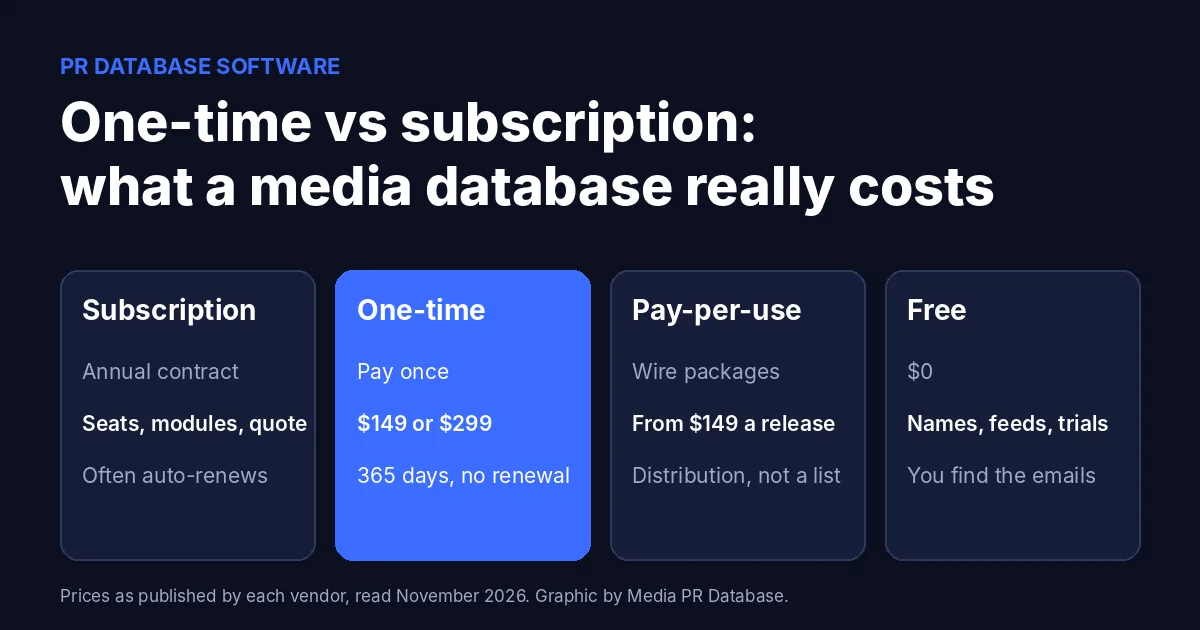
Short answer: PR database software is sold in four ways. Subscriptions (Muck Rack, Cision, Meltwater) are usually annual contracts priced by seats and modules, and none of the three publishes a price. Monthly self-serve plans such as the Semrush AI PR Toolkit publish prices from $149 a month. One-time plans such as Media PR Database Pro ($149) and Premium ($299) are paid once for 365 days of access with no auto-renewal. Pay-per-use wire packages charge per press release, and free options give you outlet names and journalist request feeds but rarely exportable emails. If you pitch in campaigns rather than every day, a one-time plan is usually the cheapest way to get a working media list.
This guide explains what PR database software does, how each pricing model works, and what one user really pays over 12 and 24 months, using only prices published on the vendors' own pages. Where a vendor only quotes on request, we say so and do not guess. It comes from Media PR Database, which sells a one-time plan, so we have a side in this comparison. We have tried to keep the numbers checkable: every price links to its source, with the date we read it. You can compare our own plans on the pricing page.
What is PR database software?
PR database software (also called a PR database, media database or media contact database) is a searchable directory of news outlets, journalists, and often podcasts and newsletters, with the contact details you need to pitch them. You filter by country, state, city, topic or outlet type, save the results as a media list, and then email or export it. If you are new to the idea, our guide to what a media database is covers the basics, and what a media list is explains what you build with one.
The category is broad. Some products are only a database. Others bundle the database with media monitoring, social listening, press release distribution, reporting and AI features. That bundling is the main reason prices range from free to five figures a year, and it is why "media database software" from two vendors may not be the same thing at all.
What you are actually paying for
- The contact data: outlet names, newsroom and journalist emails, and beats.
- Search and filters: by location, topic, outlet type and language.
- Export: a CSV or a push into your email tool.
- Extras: monitoring, pitching inside the app, analytics, release distribution, support and onboarding.
A founder sending one launch pitch needs the first three. An in-house team reporting coverage every month may need all four.
The four pricing models at a glance
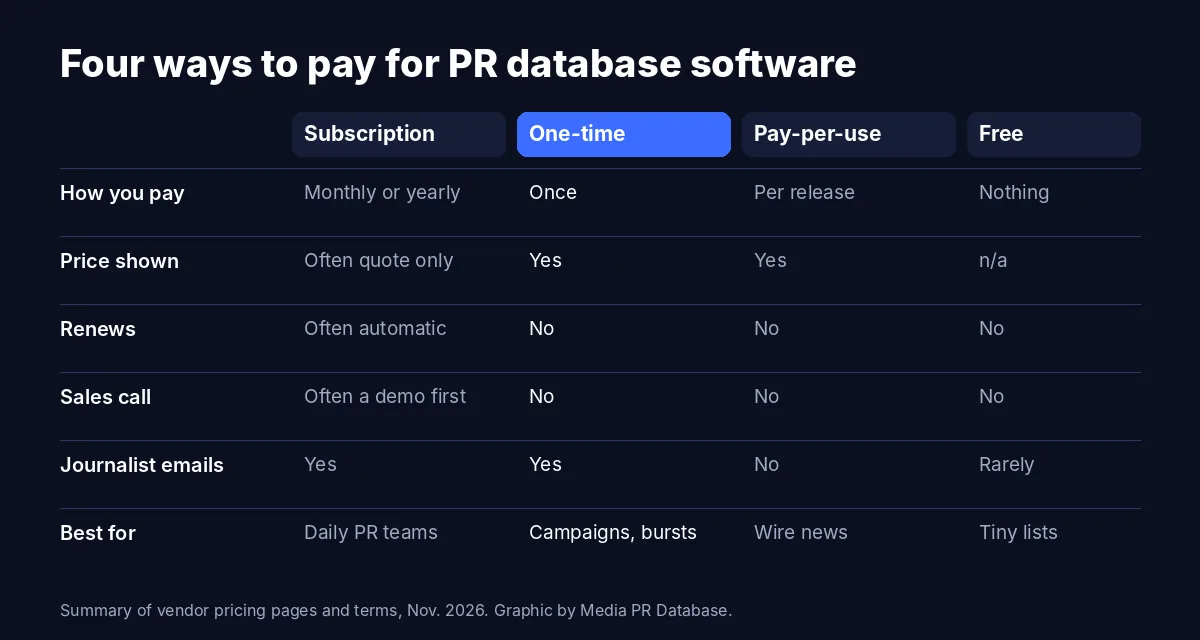
| Model | How you pay | Typical examples | Main catch |
|---|---|---|---|
| Annual subscription (enterprise) | Yearly contract, priced by users and modules | Muck Rack, Cision, Meltwater | No public price; demo first; usually 12 months |
| Monthly subscription (self-serve) | Card, month to month | Semrush AI PR Toolkit, BuzzStream (outreach CRM) | Costs add up every month you keep it |
| One-time | Pay once for a fixed access period | Media PR Database Pro and Premium | Fewer extras such as monitoring |
| Pay-per-use | Per press release or bundle | EIN Presswire packages | Distribution, not a contact list |
| Free | $0 | Request feeds, public lists, free tools | You find most emails yourself |
The subscription model
Most of the best-known PR database software is sold as a subscription. There are two quite different kinds.
Enterprise suites: annual contracts and quote-only pricing
Muck Rack, Cision and Meltwater sell suites that combine a media database with monitoring, analytics and more. None of them publishes a price list.
- Muck Rack says its PR platform "requires a paid subscription with custom pricing," that pricing depends on factors "including the number of users," and that it offers three plans for brands and three for agencies. Every tier on its pricing page says "Contact us," the Starter tier shows media list exports as "Limited," and print and broadcast monitoring, social listening and press release distribution are add-ons. A demo "typically lasts 30-45 minutes" (Muck Rack pricing, read Nov. 16, 2026).
- Meltwater says it "uses tailored pricing rather than a one-size-fits-all list," with the quote based on modules, sources, regions, number of users, onboarding and contract terms. It does not offer a self-serve free trial. On contract length, it says most partnerships are annual "with a minimum contract length of 12 months," and complex setups may carry a one-time onboarding charge (Meltwater pricing, read Nov. 16, 2026).
- Cision prices through a request form after a sales conversation (Cision, Request Pricing, read Nov. 13, 2026).
Because these prices are quote-only, we do not put a number on them in our cost table. If you want a sense of scale, third-party buyer data from Vendr, which we cited in our October 2026 guides, reported a median Muck Rack contract of $13,000 a year, a median Cision contract of $12,625 a year and a median Meltwater contract of $25,800 a year (Vendr, Muck Rack; Vendr, Cision; Vendr, Meltwater). Those are reported deals, not list prices, and your quote can be higher or lower. Our Muck Rack alternatives, Cision alternatives and Meltwater alternatives guides go through each one in detail.
How annual contracts work in practice
The four terms that shape what you really pay on an enterprise subscription are:
- Term length. Meltwater states a 12-month minimum for most contracts. You commit to a year whether you pitch every week or twice.
- Seats. Both Muck Rack and Meltwater list the number of users as a pricing factor. Adding a colleague or an intern usually means a bigger contract.
- Modules and add-ons. Monitoring, broadcast, social listening, distribution and API access are often priced separately, so two teams on the "same" plan can pay very different amounts.
- Auto-renewal. Vendr's buyer data, as cited in our Muck Rack and Cision guides, reports that auto-renewal is common on these contracts and that Cision contracts often need 30 to 60 days' cancellation notice. Put the notice date in your calendar the day you sign.
Monthly self-serve subscriptions
A newer group of tools publishes prices and lets you pay by card. The Semrush AI PR Toolkit lists Base at $149 a month, Pro at $279 and Business at $499, with a free 7-day trial. During the trial you cannot send emails or view and export contact information, and canceling a paid plan ends your access (Semrush Knowledge Base, read Nov. 16, 2026).
BuzzStream is an outreach CRM rather than a media database, but many PR teams use it to manage pitches. Its Starter plan is $49 a month for one user and 500 contacts, Growth is $174 a month for three users, plans are monthly with "no minimum term," and paying 12 months in advance gets you one month free (BuzzStream pricing, read Nov. 16, 2026).
Monthly plans are flexible: you can stop when a campaign ends. The catch is the same as any subscription. If you keep it running "just in case," the yearly cost climbs fast, and when you cancel, the tool and often your saved lists go with it. BuzzStream, for example, says it keeps your data for 14 days after cancellation and then deletes it.
The one-time model
A one-time plan means you pay once and get access for a fixed period, with nothing renewing in the background. This is how Media PR Database is sold:
- Pro, $149 one-time: all news outlet and journalist emails, one-click CSV download of any list, download of the whole news database, pitch templates and API access.
- Premium, $299 one-time: everything in Pro, plus a bonus of 2,997 podcasts and 123 newsletters with contacts, one-click downloads formatted for Instantly, Smartlead and Lemlist, and pushing contacts straight into a campaign.
Both plans give 365 days of access from payment. In the words of our pricing page: "No subscription, no auto-renewal, no sales call." There is no annual contract to cancel and no notice period. Searching is free and needs no credit card, so you can check whether the outlets you care about are in the database before you pay. The database covers 9,596 news outlets in 195 countries with 16,692 emails, including all 50 US states. See the full plan details on the pricing page.
Why one-time pricing suits most small teams
Most small teams pitch around a launch, a funding round or an event, then go quiet for weeks. A subscription charges for the quiet weeks too. A one-time plan lets you download the lists you need and work from your own inbox. Our PR strategy for startups lays out a 90-day plan that works this way.
What a one-time plan does not include
To be fair about the trade-off: Media PR Database is a contact database, not a monitoring suite. It does not track your coverage, run social listening or build board reports. If you need those daily, an enterprise suite or a dedicated monitoring tool is the better fit, and you can still use a one-time list for outreach next to it. Our best PR tools for small teams roundup covers monitoring options, including free ones such as Google Alerts.
Pay-per-use: wire distribution packages
Press release wires are often mixed up with PR databases, but they do a different job. A wire publishes your release and syndicates it to news sites and aggregators. It does not give you a list of journalists to pitch.
Wires are usually sold per release or in bundles. EIN Presswire lists $149 for one release, $499 for five (with a sixth free as a limited-time offer when we checked) and $999 for 15, and the releases can be used within 365 days of purchase. All packages include distribution to AP News, Nexstar Media Group and the USA TODAY Network, among others (EIN Presswire pricing, read Nov. 16, 2026). Larger wires cost more per release: our PR Newswire alternatives guide compares published wire prices.
Pay-per-use suits a few big announcements a year. It does not replace direct pitching to reporters on the right beat.
Free options
You can build a small media list for $0. Our guide to free media databases tests the options in detail; in short, free gets you:
- Outlet names: free tools such as our Local News Finder and media list builder, plus public lists such as Wikipedia's state newspaper lists.
- Journalist request feeds: Source of Sources, HARO and Qwoted's free Basic plan send you reporters' requests for expert sources.
- Free trials of paid tools: often with contact data hidden. Semrush's trial, for example, blocks viewing and exporting contact information.
- Free search in paid databases: Media PR Database lets you search every outlet for free, with emails hidden until you buy.
What free rarely gives you is a large, exportable list of checked emails. You find those one at a time on mastheads, contact pages and bylines. For 10 local outlets that is fine. For 200 outlets across several states, the hours usually cost more than a one-time plan.
Cost over 12 and 24 months: the comparison table
The table below uses only list prices published on each vendor's own page, read on the dates shown. It assumes one user, no add-ons and no discounts. For one-time plans, the 24-month figure assumes you buy a second year; if you only need one campaign, your 24-month cost stays at the 12-month figure.
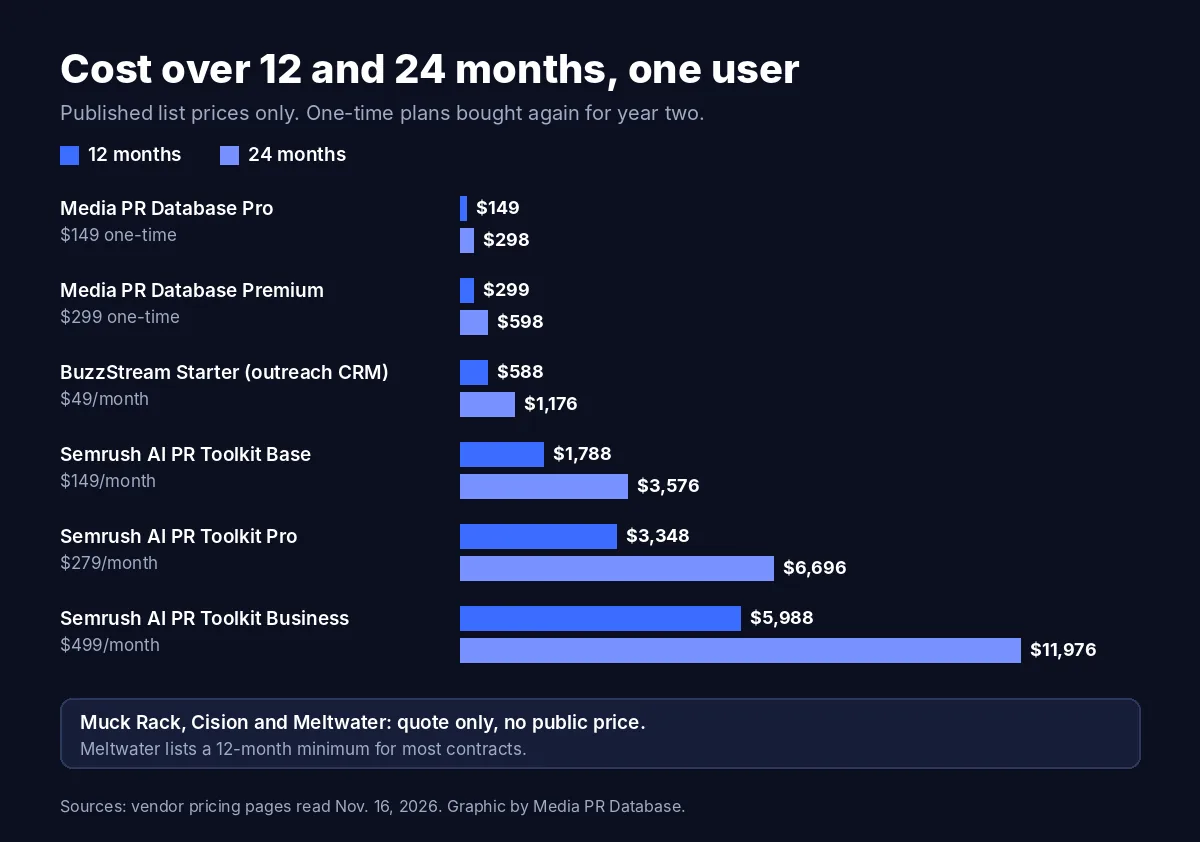
| Tool and plan | Model | Published price | 12 months | 24 months | Read on |
|---|---|---|---|---|---|
| Media PR Database Pro | One-time | $149 for 365 days | $149 | $298 (if renewed by hand) | Nov. 16, 2026 |
| Media PR Database Premium | One-time | $299 for 365 days | $299 | $598 (if renewed by hand) | Nov. 16, 2026 |
| BuzzStream Starter (outreach CRM) | Monthly | $49/month | $588 | $1,176 | Nov. 16, 2026 |
| Semrush AI PR Toolkit Base | Monthly | $149/month | $1,788 | $3,576 | Nov. 16, 2026 |
| Semrush AI PR Toolkit Pro | Monthly | $279/month | $3,348 | $6,696 | Nov. 16, 2026 |
| Semrush AI PR Toolkit Business | Monthly | $499/month | $5,988 | $11,976 | Nov. 16, 2026 |
| EIN Presswire | Pay-per-use | $149 for 1 release; $999 for 15 | Depends on releases sent; packages valid 365 days | Nov. 16, 2026 | |
| Muck Rack | Annual subscription | Quote only | Quote only | Quote only | Nov. 16, 2026 |
| Cision | Annual subscription | Quote only | Quote only | Quote only | Nov. 13, 2026 |
| Meltwater | Annual subscription (12-month minimum for most) | Quote only | Quote only | Quote only | Nov. 16, 2026 |
| Free options | Free | $0 | $0 plus your time | $0 plus your time | Nov. 13, 2026 |
BuzzStream manages outreach but is not a contact database, so it sits here only as a common monthly cost in a PR stack. Prices change, so check each vendor's page on the day you buy.
What the numbers say
Over 12 months, the cheapest published monthly database plan in the table (Semrush Base) costs $1,788, which is 12 times the price of a one-time Pro plan. Over 24 months the gap widens, because subscriptions charge every month by default while a one-time plan only costs more if you choose to buy again. The enterprise suites cannot be compared on list price at all: if you need a sales call to learn the price, budget time for the process too.
Which pricing model should you choose? A decision checklist
Choose a one-time plan if
- You pitch in campaigns (launches, events, funding news) rather than every day.
- You want journalist and outlet emails you can export and use in your own inbox or cold email tool.
- You are a founder, freelancer, small agency or nonprofit with no PR software budget line.
- You want to know the full price before you start, with nothing renewing.
- You need lists for specific places, such as a Washington media list, Massachusetts journalists or a media list for France.
Choose a monthly subscription if
- You run outreach every week and want sending, follow-ups and analytics in one app.
- You value features such as AI-cited media discovery and will use them every month.
- You are disciplined about canceling when a project ends.
Choose an enterprise annual contract if
- You are an in-house team or agency doing PR full time, with several users.
- You need monitoring, broadcast clips, social listening and reporting as much as contacts.
- You have budget for a yearly contract and someone to manage renewals and seats.
Choose pay-per-use or free if
Pick a wire package for a few formal announcements a year, alongside direct pitching. Stay free if your list is about a dozen local outlets you can research by hand, or your main goal is expert quotes through request feeds.
What to check before buying PR database software
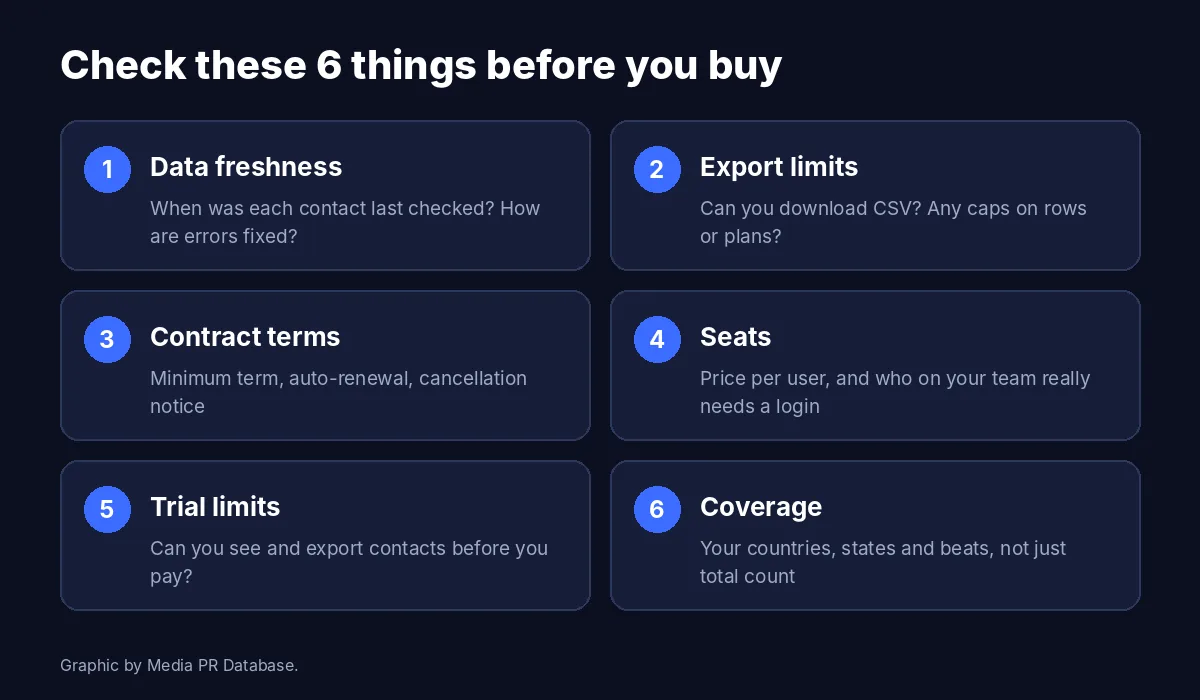
1. Data freshness
Journalists change beats and outlets close, so every database goes stale. Ask how contacts are checked and how errors are fixed. Muck Rack, for example, says journalists maintain their own profiles there. We say plainly in our terms that contact details change and that we fix reported errors but cannot guarantee every address. Whatever you buy, check addresses before a big send, because bounces hurt your sending domain.
2. Export limits
Find out whether you can download your lists as CSV, and how much. Muck Rack's pricing page shows media list exports as "Limited" on its Starter tier. Semrush says each AI PR Toolkit plan has usage limits for exporting contacts. Media PR Database Pro includes one-click CSV download of any list and of the whole news database. If you plan to send from Instantly, Smartlead or Lemlist, check that the export fits those tools without reformatting.
3. Contract terms
Read four things in the contract: the minimum term, whether it renews automatically, the cancellation notice period and the yearly price increase. Ask what happens to your saved lists and notes when the contract ends, and export them before it does.
4. Seats
If price depends on users, count who really needs a login. Often one person builds the list and everyone else only needs the exported file. BuzzStream, for example, publishes a fee per additional user on its Growth plan ($58 a month), which makes the cost of each seat visible.
5. Trial limits
A trial that hides emails cannot tell you whether the emails are good. Look for a way to see real coverage before paying: free search, a sample list, or a short paid plan with a published price.
6. Coverage for your market
A big total number means little if your state, country or beat is thin. Search for your own target outlets by name. With Media PR Database you can do that for free across 195 countries and every US state, then build a list with the media list builder.
Media contact database pricing: questions to ask any vendor
Copy these into your next sales email. Any vendor should be able to answer them in writing:
1. What is the total price for year one, including onboarding and add-ons?
2. Is the price per user? What does each extra seat cost?
3. What is the minimum term? Does it renew automatically?
4. How many days' notice do I need to cancel?
5. Can I export contacts to CSV? Are there limits on exports?
6. When were the contacts in my target market last checked?
7. What happens to my lists and data if I cancel?
Try it before you buy
You can search all 9,596 outlets in Media PR Database for free, including all 50 US states and 195 countries, and see exactly what you would get. When the list looks right, unlock emails and CSV export with Pro ($149, one-time), or add 2,997 podcasts, 123 newsletters and cold email exports with Premium ($299, one-time). Both last 365 days, with no subscription, no auto-renewal and no sales call. See pricing.
Sources
- Muck Rack, Pricing (read Nov. 16, 2026).
- Meltwater, Pricing (read Nov. 16, 2026).
- Cision, Request Pricing (read Nov. 13, 2026).
- Semrush Knowledge Base, AI PR Toolkit Pricing and Plans (read Nov. 16, 2026).
- BuzzStream, Plans and Pricing (read Nov. 16, 2026).
- EIN Presswire, Pricing (read Nov. 16, 2026).
- Vendr buyer data for Muck Rack, Cision and Meltwater: median contract values and renewal terms, as cited in our October 2026 alternatives guides.
- Media PR Database pricing: Pro and Premium plans, 365 days of access, no auto-renewal.
The bottom line
PR database software is not one product with one price. Enterprise suites bundle a database with monitoring and analytics on annual, quote-only contracts. Monthly tools publish prices but charge every month you keep them. Wires charge per release and do not give you a list. Free options cost time. And a one-time plan gives you the contacts and the export for a fixed price with nothing renewing. Work out how often you really pitch, check exports, contract terms and seats, and pick the model that matches. For most small teams that pitch in bursts, that is a one-time plan.
FAQ
What is PR database software?
PR database software is a searchable directory of news outlets, journalists and often podcasts and newsletters, with contact details you can use to pitch them. You filter by location, topic or outlet type, save a media list and email or export it. Some products add monitoring, analytics and press release distribution.
How much does PR database software cost?
It depends on the pricing model. On Nov. 16, 2026, published prices included $149 one-time for Media PR Database Pro, $299 one-time for Premium, and $149, $279 or $499 a month for the Semrush AI PR Toolkit. Muck Rack, Cision and Meltwater do not publish prices and quote after a sales conversation.
Is a one-time PR database cheaper than a subscription?
For teams that pitch in campaigns, usually yes. Media PR Database Pro costs $149 for 365 days of access, while the cheapest Semrush AI PR Toolkit plan costs $1,788 over 12 months at its published monthly price. Enterprise suites are quote-only, so you need a proposal to compare.
Does Media PR Database renew automatically?
No. You pay once, $149 for Pro or $299 for Premium, and get 365 days of access. Nothing renews automatically, there is no annual contract and no sales call. If you want another year, you buy again.
Do Muck Rack, Cision and Meltwater publish their prices?
No. Muck Rack says pricing is custom and depends on factors including the number of users, Meltwater says it uses tailored pricing and that most contracts have a 12-month minimum, and Cision prices through a request form. Ask for the full year-one total in writing.
What should I check before buying a media contact database?
Check how fresh the data is and how errors are fixed, whether you can export to CSV and how much, the minimum term, auto-renewal and cancellation notice, the price per seat, whether the trial shows real contacts, and whether your own countries, states and beats are well covered.
Build your media list in minutes
Search free, then download any country or state list as CSV in one click.
Keep reading
15 Best PR Tools for Small Teams in 2026
The 15 best PR tools for small teams in 2026: media databases, monitoring, press release distribution, outreach, journalist request services and design helpers, with real published prices, a comparison table and a lean starter stack.
NewslettersNewsletter Advertising: How to Find and Pitch Newsletters
A practical guide to newsletter advertising and sponsorships: pricing models (flat fee, CPM, CPC), how ad networks like beehiiv's work, how to find and vet newsletters, what to ask for, and how to get free earned mentions with a pitch.
Pitching40 News Story Ideas Journalists Actually Cover
40 news story ideas for startups, small businesses and PR freelancers, grouped by type: data, trends, local firsts, people, reactions, milestones, visuals and seasonal hooks, with real campaign examples and a 60-second test.