Free Media Databases: What You Really Get for $0
An honest guide to every free media database option: free trials of paid PR tools, free journalist request services, DIY sources like Google News and mastheads, and free media list tools. What you get, the limits, the time cost, and when paying makes sense.
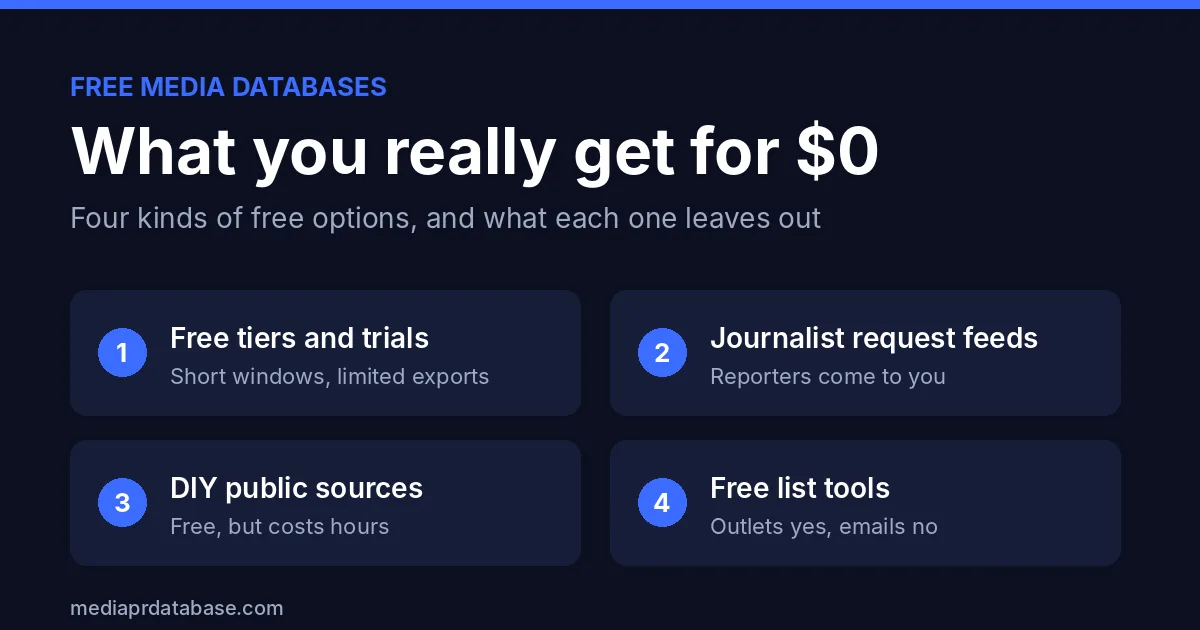
Short answer: there is no fully free media database that gives you a large, current list of journalist emails you can export. What you can get for $0 falls into four groups: free trials of paid tools (short, with exports and contact views limited), free journalist request services such as Source of Sources and HARO (reporters come to you, but only for stories they already want to write), DIY public sources such as Google News, outlet mastheads and Wikipedia lists (free in money, expensive in hours), and free list tools that show outlet names but keep emails behind a paywall. Used together, they are enough for a small, local campaign. For anything bigger, a one-time purchase usually costs less than the time you would spend.
This guide goes through each free option and answers three questions: what you actually get, what the limits are, and how much of your time it costs. Prices and free tiers below come from the vendors' own pages, with the date we read them. It is written by Media PR Database, a directory of 9,596 news outlets in 195 countries with 16,692 newsroom and journalist emails. We sell a paid plan too, so we have tried to be fair about where free is good enough.
What "free media database" usually means
A media database is a searchable directory of news outlets and the people who work there, with contact details and beats, so you can build a list of the right reporters for a story. If the idea is new to you, our guide what is a media database explains the parts, and what is a media list covers the list you build from it.
When people search for a "free media database," a "free journalist database" or a "free PR database," they usually want one of three things:
- Outlet names for a place or topic: which newspapers, TV stations and news sites cover Ohio, or tech in Ireland.
- Contact emails for those outlets or for specific reporters.
- An export, so the list can go into a spreadsheet or an email tool.
Free options are generous with the first, stingy with the second and almost never give you the third, because contact data is what costs money to collect and keep current.
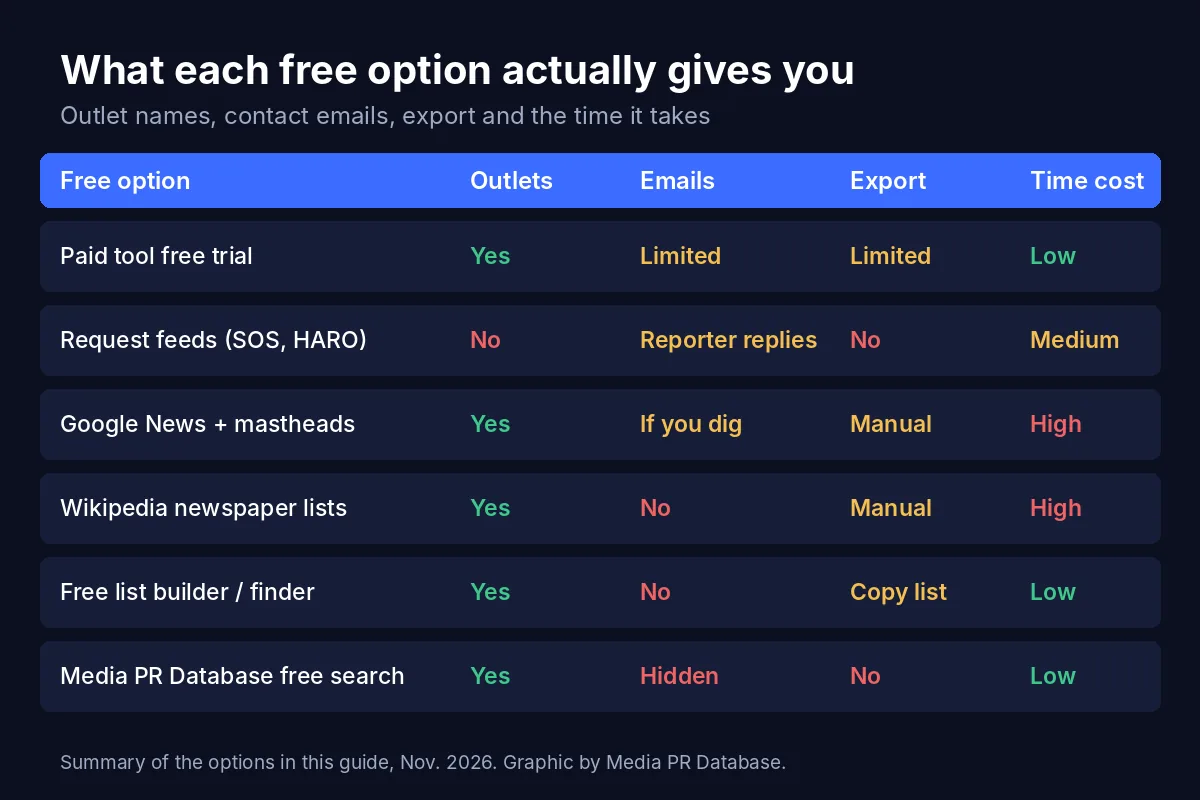
1. Free trials and free tiers of paid media databases
The big PR platforms are the closest thing to a full media database. Here is what each one offers for free, based on their own pricing pages.
Muck Rack
What you get for free: nothing on the PR side. Muck Rack's pricing page says it offers free tools only for journalists (profiles, verification and trends), and that its PR platform "requires a paid subscription with custom pricing." It lists Starter, Standard and Premier plans, each marked "Contact us," and says pricing depends on factors such as the number of users. Media list exports on the Starter plan are marked "Limited" (Muck Rack pricing, read Nov. 13, 2026).
The limit: you cannot try the database without talking to sales. Muck Rack offers a demo, which it says typically lasts 30 to 45 minutes.
Time cost: a demo call, then a proposal. Fine for a team that will use it every week; overkill for one launch. Our Muck Rack alternatives guide compares cheaper tools.
Cision (CisionOne)
What you get for free: no public free tier. Cision's pricing link leads to a "Request Pricing" form that asks for your company, job title and phone number so an expert can contact you (Cision request pricing, read Nov. 13, 2026). If you want to know whether a trial is available, check their site or ask on the call.
The limit: no self-serve way to see the database or the price.
Time cost: a sales process. See Cision alternatives if that is more than you need.
Semrush AI PR Toolkit (formerly Prowly)
What you get for free: a 7-day free trial. Paid plans are Base $149/month, Pro $279/month and Business $499/month (Semrush pricing and plans, read Nov. 6, 2026).
The limit: Semrush says that during the trial, sending emails, viewing and exporting contacts and email statistics are limited or unavailable. So the trial shows you how the tool works, not a list you can take away.
Time cost: low to try. But a week is short, and the part you probably came for (contacts) is the part that is restricted.
Prezly
What you get for free: a 14-day free trial with no credit card. After that, Essential is 100 EUR/month billed annually (1 site, 1 user, up to 5,000 contacts) and Standard is 250 EUR/month billed annually (Prezly pricing, read Nov. 6, 2026).
The limit: Prezly is mainly a newsroom and a contact manager for journalists you already know. Whether a journalist directory is included on the trial is not stated on the pricing page, so check their site.
Time cost: low to set up, and useful if you want a hosted press page. Less useful if your problem is finding reporters in the first place.
The honest verdict on free trials
Trials help you decide whether to buy. They are not a way to get a media list for free: every option we checked either has no self-serve access or limits contact data.
2. Free journalist request services
Request services turn pitching around: reporters post what they need and you reply if you fit. You need speed and real expertise, not a database. Our HARO alternatives guide covers the full list; here are the free ones.
Source of Sources
What you get: an email with journalist queries up to three times a day. It was started by Peter Shankman, who founded HARO. The site says the list costs nothing and suggests donating to an animal charity instead (Source of Sources).
The limit: strict rules. SOS says anyone who pitches a reporter off topic is removed with no appeal.
Time cost: medium. You need to read every email quickly and answer only the ones where you are a real fit.
HARO (now run by Featured.com)
What you get: the original Help a Reporter Out is back under Featured.com as a free email for journalists and sources, supported by newsletter ads (HARO). Featured.com itself has a Free plan, with Lite at $29/month and Pro at $79/month (Featured pricing, read Oct. 2026).
The limit: popular queries attract a lot of replies, so the fastest relevant answer usually wins.
Time cost: medium, for the same reason as SOS.
Qwoted (free Basic plan)
What you get: a free Basic plan for seeing reporter requests and pitching through the platform. The Pro plan is $1,188 a year with 35 pitches a month (Qwoted pricing, read Oct. 2026).
The limit: the useful volume of pitches sits in the paid plan. Check their site for the current limits on Basic.
Time cost: low to medium. A source profile takes a while to set up, then you check requests as they come in.
Help a B2B Writer (now MentionMatch)
What you get: helpab2bwriter.com now redirects to MentionMatch, which connects B2B writers with expert sources in areas such as marketing, SaaS, SEO and ecommerce. Sources register, choose their expertise and get matching requests by email. The homepage says it is trusted by 9,000+ B2B sources and that it is "launching soon" (MentionMatch, read Nov. 13, 2026).
The limit: the homepage lists "Is MentionMatch free?" as an FAQ but we could not read the answer, so check their site. It is mostly B2B blogs, not newsrooms.
Time cost: low, since you only get requests that match your areas.
Where request services fit
Request feeds are excellent for expert commentary. They are useless for your own news. If you are launching a product, opening a location or releasing a report, nobody will post a request asking for it. For that, you need to pitch first, which means you need a list.
3. DIY free sources: build your own journalist database
Every contact in a paid database started as public information. You can collect it yourself. It works, and it costs nothing but time. Here are the best free sources and what each one gives you.
Google News
What you get: a search for your topic plus a place ("bakery Columbus Ohio") shows which outlets covered similar stories recently, and the bylines on those stories tell you who wrote them. That is the most valuable research you can do, because it finds reporters who actually cover your beat.
The limit: no emails, no export, and results lean toward bigger outlets.
Time cost: high. Expect to read several stories per outlet to be sure you have the right person.
Outlet "Contact us" and masthead pages
What you get: most newspapers and stations publish a newsroom email, a news tip form or a staff page. Smaller outlets often list each reporter's address. This is where many of the emails in any media database come from.
The limit: every site is laid out differently, some only offer a form, and the pages are not always kept up to date.
Time cost: high, one site at a time.
X and LinkedIn bios
What you get: many reporters list their beat, and sometimes their work email or a "DMs open" note, in their profile. It is also the quickest way to check whether someone still works at the outlet.
The limit: not every journalist is active, and a social profile is not an invitation to pitch by DM. Use it to confirm details, then email.
Time cost: medium.
Wikipedia lists of newspapers
What you get: Wikipedia keeps lists of newspapers by state and country. The list of newspapers in Ohio, for example, groups papers into major, daily, nondaily and student newspapers by city, from the Akron Beacon Journal to the Yellow Springs News.
The limit: no contacts at all, and the lists are not complete. The Ohio page itself carries a notice that it "is incomplete," dated August 2008, and it lists The Athens News as defunct (1977 to 2026). Treat any list like this as a starting point that you need to check.
Time cost: low to get names, high to turn them into contacts.
The Medill local news data
What you get: the Medill Local News Initiative at Northwestern University tracks about 8,000 US local news outlets, including more than 5,400 newspapers, close to 700 stand-alone digital sites, more than 850 network digital sites and more than 340 public broadcasters (The State of Local News: 2025 Report). Its report and maps are free to read and show which counties still have local news.
The limit: it is research, not a contact list. Its main value for PR is telling you where local media is thin before you plan a local campaign.
Why it matters for your list: the same report says 148 newspapers vanished in the past year through closures or mergers, and 212 US counties now have no local news source, up from 206. That churn is why a hand-built list goes stale, and why any list, free or paid, needs checking before you send.
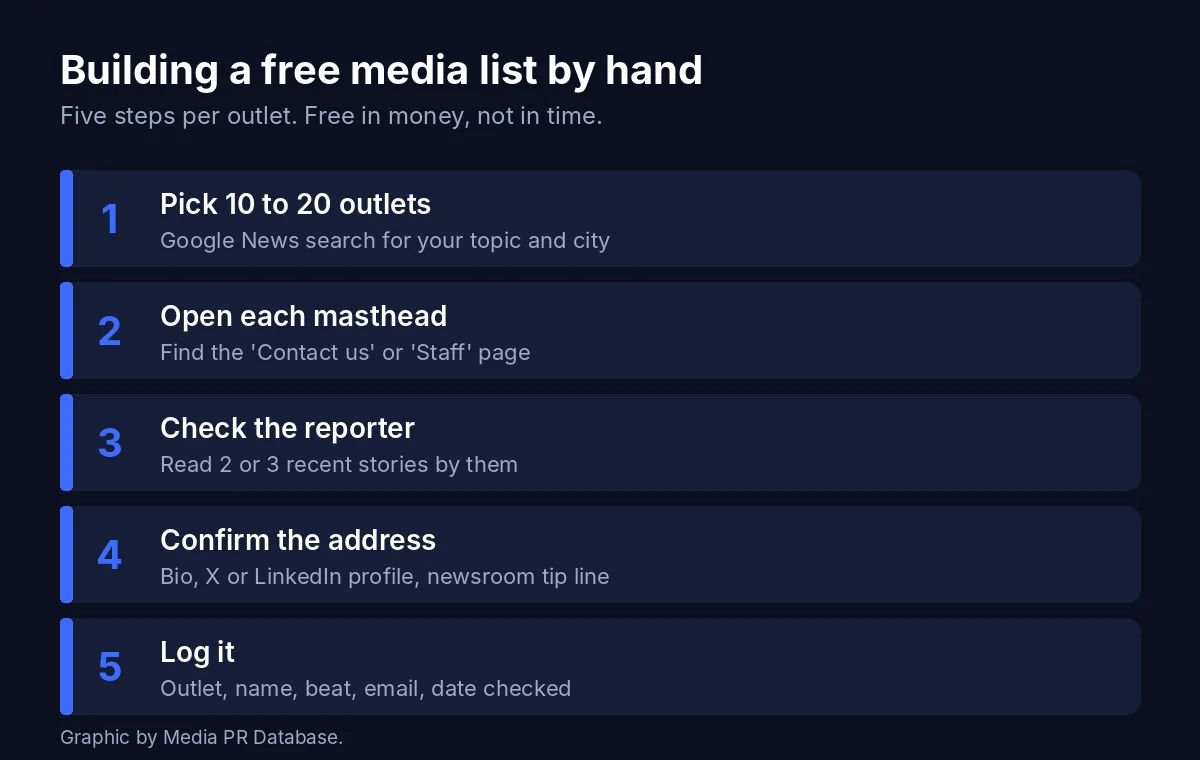
A simple DIY workflow
- Pick 10 to 20 outlets. Search Google News for your topic and city, and note which outlets covered something similar.
- Open each outlet's contact or staff page. Copy the newsroom email or the tip line.
- Find the right reporter. Read two or three recent stories and note the byline.
- Confirm the address. Check the reporter's bio, X or LinkedIn profile.
- Log it. Keep columns for outlet, name, beat, email, source and the date you checked. A row might read: Example Daily News, Jane Doe, business, newsroom@example.com, staff page, Nov. 13.
Do not guess email formats (firstname.lastname@ and so on) and send to them blind. Guessed addresses bounce, and bounces hurt the reputation of your sending domain.
4. Free media list tools
The fastest free option is a tool that has already done the collecting and shows you the outlets. These are ours; all of them are free and need no signup.
Local News Finder
The Local News Finder shows the newspapers, news sites, TV and radio stations for a country, state and city. It covers outlets in 195 countries and all 50 US states. You get: outlet names, types and websites. You do not get: emails. Time cost: a minute per place.
Free Media List Builder
The media list builder filters outlets by country, US state, outlet type and coverage, tells you how many outlets match, and previews the first 10 with their websites. You can copy that list into a spreadsheet and add contacts yourself. The limit: the preview is short and emails unlock with Pro.
Media Pitch Generator
Once you have a list, the media pitch generator asks six questions and gives you a short pitch email, three subject lines and a follow-up. It runs in your browser, so nothing you type is sent to our server.
Media PR Database free search
Our free tier is search. You can search every outlet, podcast and newsletter and see each outlet's type, coverage, city and how many contacts it has. The email addresses are hidden until you upgrade, and the CSV download is part of the paid plans. Location pages such as the Ohio media list, the Georgia media list or the Ireland media list show what is available for each place before you pay.
Example: a free search for "newport" shows two local outlets in Newport, Rhode Island, Newport Life Magazine and Newport This Week, with five newsroom emails between them. You see the outlets and the count; the addresses unlock with Pro.
Comparison table: free media database options
| Option | Cost | What you get | Main limit | Time cost |
|---|---|---|---|---|
| Muck Rack | Custom quote | Free tools for journalists only | No self-serve PR trial; demo first | Sales process |
| Cision | Quote on request | Pricing form | No public free tier | Sales process |
| Semrush AI PR Toolkit | 7-day trial, then from $149/mo | Tool access | Contact views, exports and sending limited on trial | Low |
| Prezly | 14-day trial, then from 100 EUR/mo (annual) | Newsroom and contact manager | Trial length; directory access: check their site | Low |
| Source of Sources | Free | Queries up to 3 times a day | Removal for off-topic pitches | Medium |
| HARO | Free | Query emails | Crowded popular queries | Medium |
| Qwoted Basic | Free; Pro $1,188/yr | Reporter requests | Volume sits in Pro | Low to medium |
| MentionMatch (Help a B2B Writer) | Check their site | B2B writer requests | B2B blogs, not newsrooms | Low |
| Google News, mastheads, bios | Free | Outlets, bylines, some emails | Manual, no export | High |
| Wikipedia newspaper lists | Free | Outlet names by state or country | Incomplete, no contacts | High |
| Local News Finder, Media List Builder | Free | Outlet names, types, websites | No emails | Low |
| Media PR Database free search | Free | Every outlet with type, city and contact count | Emails hidden, no CSV | Low |
Prices and free tiers from each vendor's page on the date given in the section above. Prices change, so check before you buy.
The hidden cost of free: your time
Free options are free in money. They are not free in hours. The DIY route, in particular, means visiting each outlet, finding the right person and checking the address, one by one. That is fine for 15 local outlets. It becomes a real cost for 150 outlets across several states or countries.
A simple way to decide: estimate how many outlets you need, how long each one takes you to research, and what an hour of your time is worth. If the total is more than the price of a tool, the "free" option is the expensive one. If you only need a handful of local contacts once, free wins.
When paying makes sense
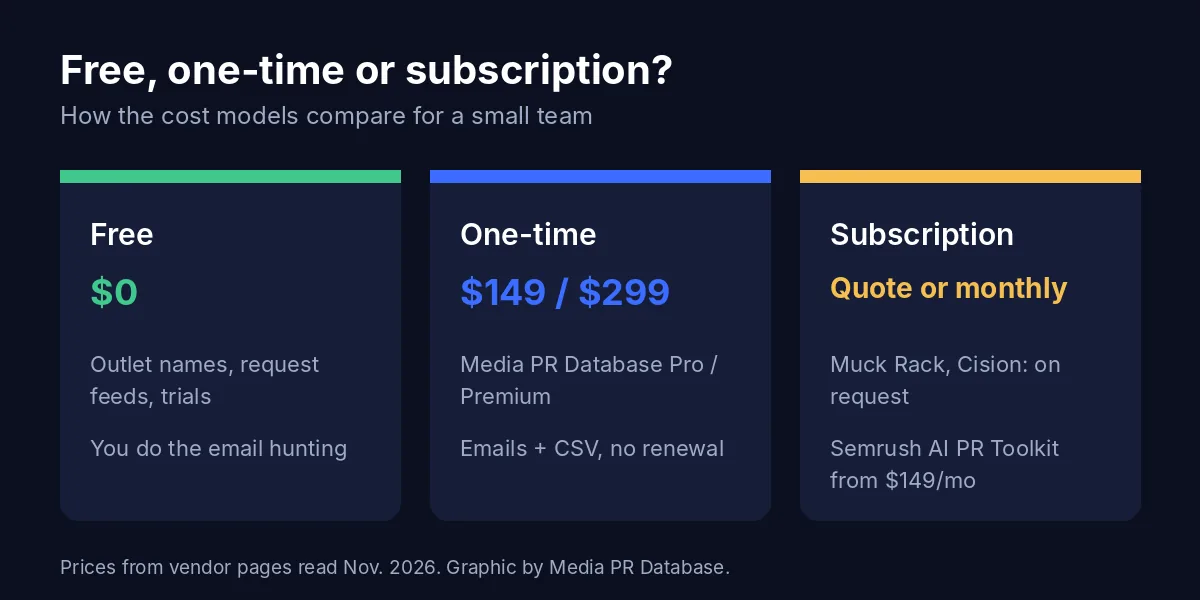
Stay free if...
- You need fewer than about 20 local outlets for one announcement.
- Your main goal is expert quotes, which request feeds handle well.
- You already have relationships with the reporters who matter.
Pay once if...
- You pitch in bursts, such as a launch, a funding round or a seasonal campaign.
- You need many outlets across states or countries.
- You want a CSV you can load into your own email tool.
This is where Media PR Database's one-time plans fit. Pro is $149 one-time and unlocks every news outlet and journalist email with one-click CSV downloads. Premium is $299 one-time and adds 2,997 podcasts and 123 newsletters as a bonus, plus export formats for Instantly, Smartlead and Lemlist. You pay once for a year of access and nothing renews automatically.
Subscribe if...
- You pitch every week and also need monitoring and reports for leadership or clients.
- Several people on your team need the same tool and shared lists.
Then a suite such as Muck Rack or Cision may be worth the sales process, or a monthly tool such as the Semrush AI PR Toolkit (from $149/month). Before you sign, check the contract term, whether the advertised price needs annual billing, and what happens if you go over your limits. Our roundup of the best PR tools for small teams compares the options side by side.
A worked example
A two-person startup launching in Ohio and Georgia can pull outlet names free from the media list builder and visit each site for contacts, or filter the same outlets and download the emails as a CSV with a one-time plan. Either way, the pitch still has to be short, specific and sent one to one. See how to get press coverage and PR strategy for startups for that part.
Sources
- Muck Rack, Pricing (read Nov. 13, 2026): custom pricing, free tools for journalists only, Starter exports limited, demo length.
- Cision, Request Pricing (read Nov. 13, 2026): pricing by request form.
- Semrush, Pricing and plans (read Nov. 6, 2026): AI PR Toolkit prices and 7-day trial limits.
- Prezly, Pricing (read Nov. 6, 2026): plans and 14-day free trial.
- Source of Sources: free query emails and rules.
- HARO and Featured.com pricing (read Oct. 2026).
- Qwoted, Pricing (read Oct. 2026): free Basic and Pro plan.
- MentionMatch (read Nov. 13, 2026): Help a B2B Writer redirect, source count, how it works.
- Medill Local News Initiative, The State of Local News: 2025 Report: outlet counts, closures, news deserts.
- Wikipedia, List of newspapers in Ohio (read Nov. 13, 2026).
The bottom line
You can get a lot for $0: outlet names from free list tools and Wikipedia, bylines from Google News, newsroom addresses from mastheads, and expert-quote requests from Source of Sources, HARO and Qwoted's free plan. What you cannot get for free is a large, checked list of emails you can export in one go. For a small local campaign, free is enough. For anything bigger, compare the hours against a one-time price. Start with a free search of the outlets in your market, and pay only when the list is clearly worth it.
FAQ
Is there a completely free media database?
Not one with exportable journalist emails at scale. Free options give you outlet names (free list tools, Wikipedia lists, Google News), expert-quote requests (Source of Sources, HARO, Qwoted's free Basic plan) and short trials of paid tools with contact data limited. You can combine them to build a small list by hand.
Does Muck Rack have a free trial or free plan?
Muck Rack's pricing page says its free tools are only for journalists and that the PR platform needs a paid subscription with custom pricing. It offers a demo, which it says typically lasts 30 to 45 minutes, and then a proposal.
How can I find journalist emails for free?
Look for the reporter's byline on recent stories through Google News, then check the outlet's contact or staff page and the reporter's bio or LinkedIn profile. Many outlets publish a newsroom email or tip line. Do not guess email formats, because guessed addresses bounce and hurt your sending domain.
What is the best free journalist database for local news?
For outlet names, a free tool such as the Local News Finder, which shows newspapers, TV and radio stations by city, plus your state's Wikipedia list of newspapers. For emails, you then need each outlet's contact page or a paid plan such as Media PR Database Pro.
Are free PR databases accurate?
Free lists are only as current as their last update. Wikipedia's list of newspapers in Ohio, for example, carries a notice that it is incomplete, and Medill counted 148 US newspapers that vanished in one year. Check each contact before you send, whether the list is free or paid.
Is a one-time media database cheaper than a subscription?
For teams that pitch in bursts, usually yes. Media PR Database Pro costs $149 one-time and Premium $299 one-time for a year of access with no automatic renewal, while subscription tools such as the Semrush AI PR Toolkit start at $149 per month.
Build your media list in minutes
Search free, then download any country or state list as CSV in one click.
Keep reading
What Is a Media List? Definition, Example and Free Template
What a media list is, the nine columns every media list needs, a real example with masked emails, a copy-paste media list template, how to build a media list in one hour, how many outlets to include and how to keep it clean.
Media listsWhat Is a Media Database? (And Do You Actually Need One?)
What a media database is, what is inside one, how it differs from a media list, monitoring tool or wire service, what Cision, Muck Rack and Meltwater really cost, and when a cheaper or free option is enough.
PR toolsPR Database Software: One-Time vs Subscription
PR database software compared by pricing model: subscriptions with annual contracts and quote-only pricing, one-time plans from $149, pay-per-use wire packages and free options, with a 12 and 24 month cost table built from published prices.