Newsletter Advertising: How to Find and Pitch Newsletters
A practical guide to newsletter advertising and sponsorships: pricing models (flat fee, CPM, CPC), how ad networks like beehiiv's work, how to find and vet newsletters, what to ask for, and how to get free earned mentions with a pitch.
Short answer: newsletter advertising means paying a newsletter to feature your product in an issue, usually as a sponsored block at the top, middle or bottom. It is priced as a flat fee per issue, per 1,000 opens or subscribers (CPM), or per click (CPC). You can buy directly from the newsletter, or through an ad network that matches advertisers with many newsletters. And there is a second route most companies miss: pitching newsletters like journalists, so they mention you for free because your news is useful to their readers.
This guide explains both routes: how paid newsletter ads are priced, how to find and vet newsletters, what to ask before you pay, and how to pitch for earned mentions, with a template. It is written by Media PR Database, which includes 123 newsletters that take sponsors and stories as a bonus in our Premium plan, alongside 9,596 news outlets and 2,997 podcasts.
Why newsletters are worth it
- The audience chose to be there. Readers subscribed, so a newsletter's list is usually tightly defined by topic: marketing, SaaS, real estate, a single city.
- Ads sit inside content people read. A sponsored block in a newsletter someone opens every morning gets a different kind of attention than a banner.
- Many writers are journalists too. A growing number of reporters publish their own newsletters. Treat them as press, not only as ad space.
How newsletter ads are priced
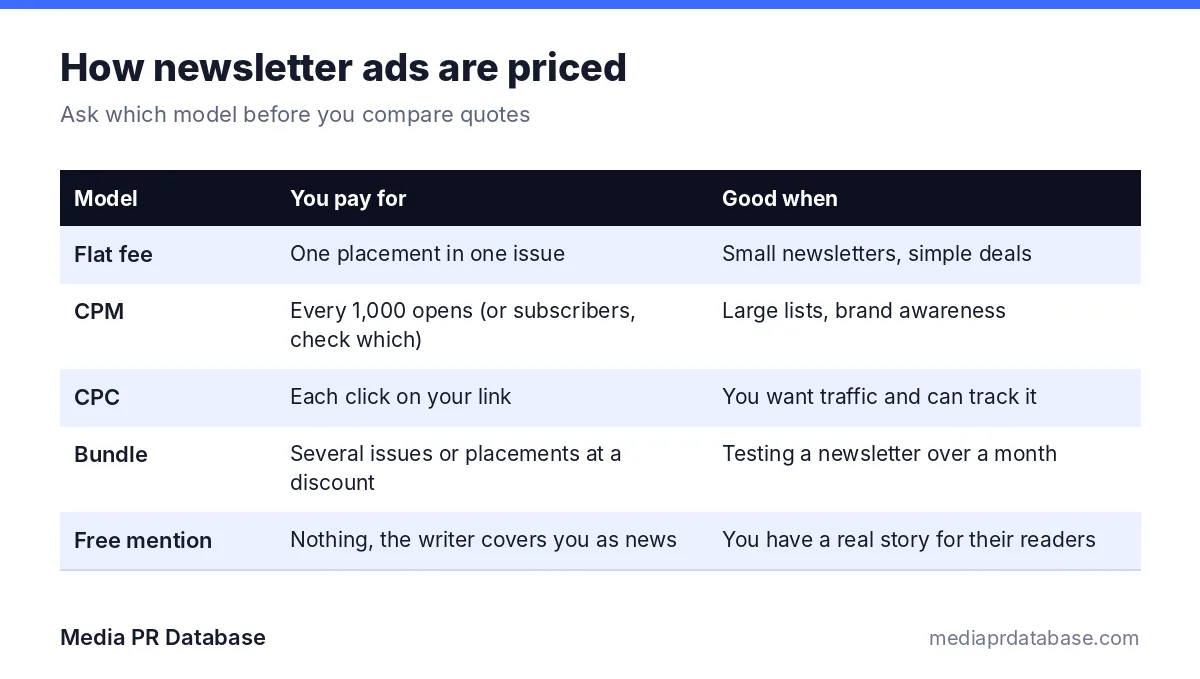
Flat fee
One price for one placement in one issue. Common for small and mid-size newsletters because it is simple. Your cost per reader depends on how many people actually open that issue, so always ask for average opens.
CPM (cost per thousand)
You pay for every 1,000 readers. The key question is 1,000 of what: subscribers or unique opens. Opens are the fairer measure. beehiiv, for example, says payouts in its Ad Network are based on CPM or CPC, and that the CPM model pays per 1,000 unique opens delivered in a send (beehiiv, Ad Network FAQ, updated Nov. 3, 2026).
CPC (cost per click)
You pay only for clicks on your link. Good when you want traffic and can measure what happens after the click. Ask how clicks are counted and whether bot clicks are filtered; beehiiv's FAQ, for example, separates "verified" and "payable" clicks.
Bundles
Several issues at a discount. Book a bundle only after a single test issue proves the audience responds.
Rates vary widely by niche, list size and placement, so there is no honest single "average price." Get the newsletter's media kit, convert every quote to cost per 1,000 opens, and compare like for like.
Where to find newsletters
1. Ad networks and marketplaces
Newsletter platforms run ad networks that connect advertisers with many publications at once. beehiiv's Ad Network is open to publishers on its paid plans, who tag their publication by topic so the network can match them with advertisers, and beehiiv says it handles sourcing advertisers, delivering creatives, reporting and payments. Publishers on its higher plans can also sell direct sponsorships (beehiiv Ad Network FAQ). Networks are the fastest way to reach many newsletters, but you have less say over exactly which ones run your ad.
2. Direct from the newsletter
Most newsletters with sponsors have an "Advertise" or "Sponsor" link in the footer or on their website, often with a media kit. Buying direct gives you the most control and a relationship with the writer.
3. A newsletter list you can filter
Our newsletter directory lists newsletters that take sponsors and stories, with their websites and contact emails for Premium members. Use it to build a shortlist by topic, then check each one using the steps below.
4. Your own reading
Ask customers which newsletters they read. Ten answers from real buyers are worth more than a hundred names from a list.
Vet a newsletter before you pay
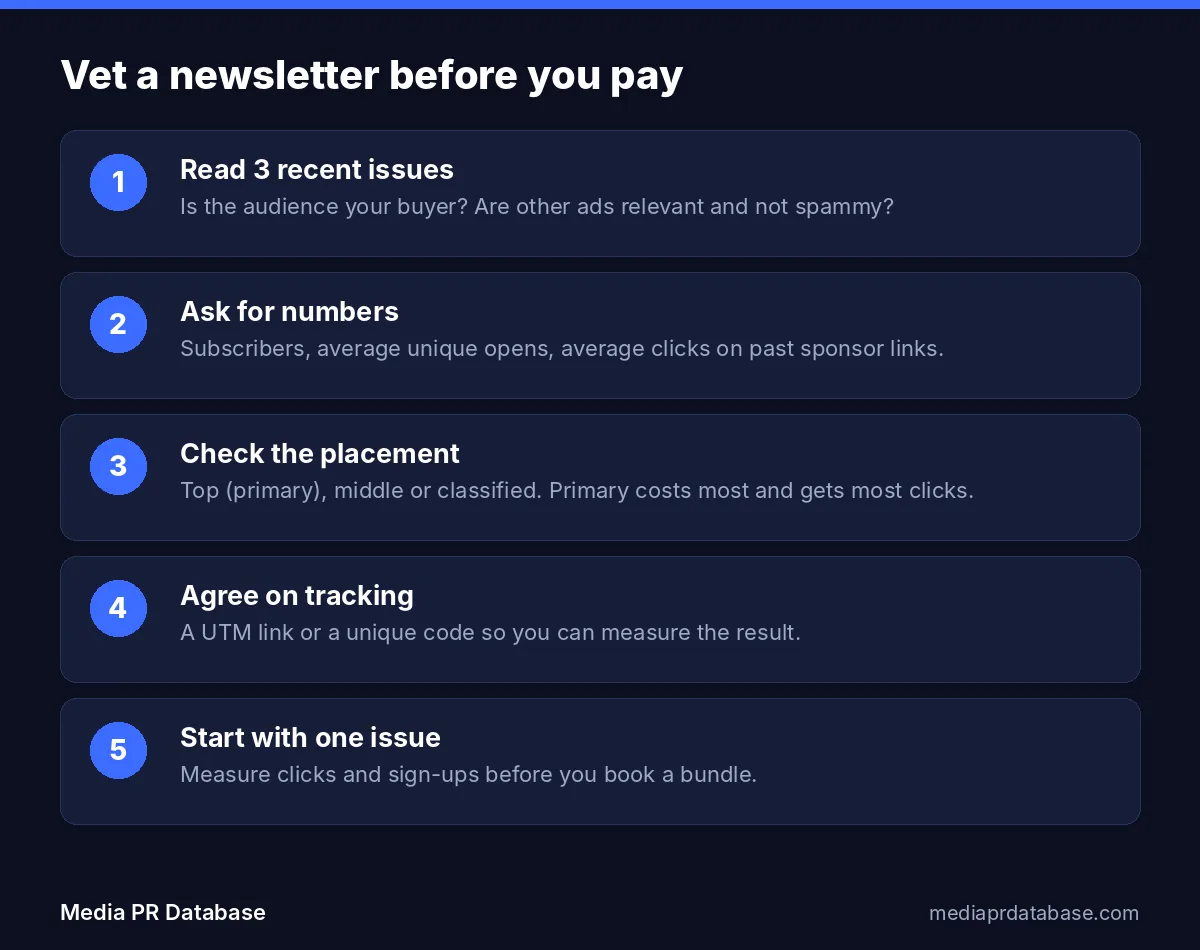
- Read three recent issues. Is the audience your buyer? Are other sponsors relevant and respectable?
- Ask for numbers: subscribers, average unique opens per issue, and average clicks on past sponsor links. A large list with few opens is a small newsletter.
- Check the placement. The primary (top) slot costs most and is seen most. Classifieds at the bottom are cheap and best for simple offers.
- Agree on tracking: a UTM-tagged link or a unique discount code so you can measure results yourself.
- Start with one issue and measure sign-ups or sales, not only clicks.
Writing the ad
- Write like the newsletter. Match its tone; many writers will adapt your copy anyway.
- One message, one link. A headline, two or three sentences on the benefit, one call to action.
- Offer something specific: a free tool, a report, a trial, a discount for that audience.
The free route: earned newsletter mentions
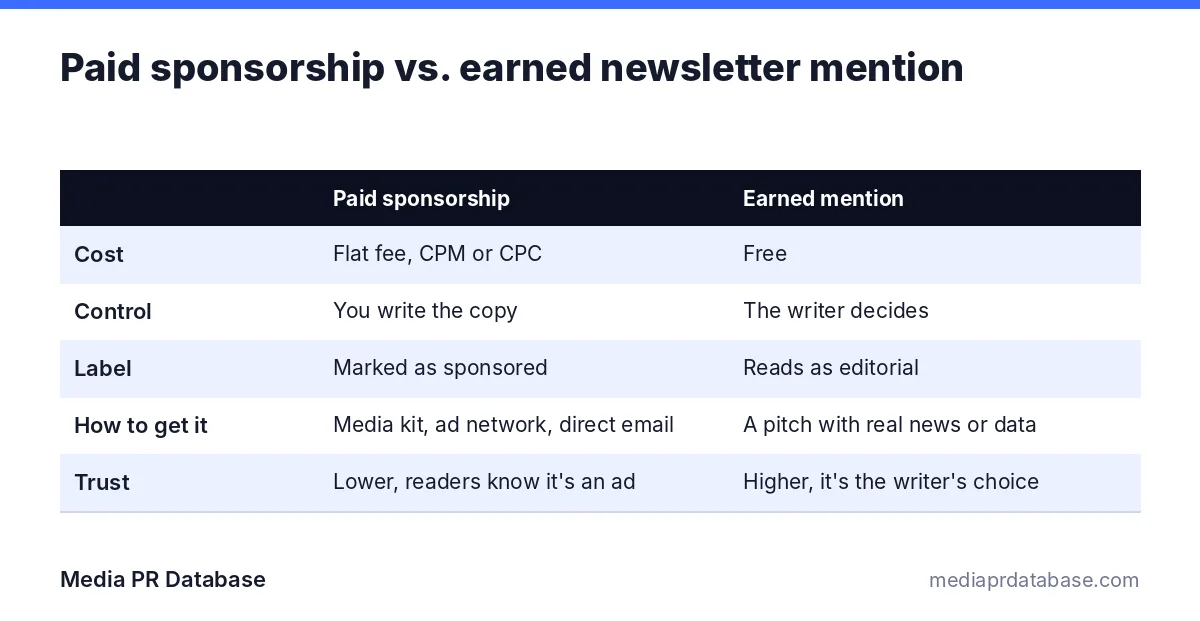
Many newsletters are curated: the writer picks links, tools, data and stories readers will find useful. If you have something genuinely useful for their readers, you can pitch it like you would pitch a journalist. It costs nothing, and a mention chosen by the writer carries more trust than an ad.
What newsletter writers tend to pick up:
- Original data with one striking number. See our list of news story ideas.
- Free tools and templates their readers can use today.
- An expert view on something the newsletter covered recently.
- A launch that solves a problem their readers have.
Newsletter pitch template
Subject: For your readers: [one-line hook with the key number or benefit]

Hi [First name],

I read [newsletter name] every week. Your piece on [recent topic] was the reason I'm writing.

We just published [what it is: data, free tool, report]. The headline finding is [one number or result]. It's free, no sign-up needed: [link]

It might fit a future issue for readers who [what they want to do]. Happy to send a chart, a short quote or more detail.

Thanks,
[Name]
[Title, Company]
Keep it short, personal and useful. One follow-up a week later is enough. Our media pitch email template has more versions, and the free Media Pitch Generator can draft one.
Paid or earned? Use both
- Start with earned. Pitch your best data or free tool to 20 relevant newsletters. Note which writers reply.
- Then test paid in the two or three newsletters whose audiences match best, one issue each.
- Double down on what drives sign-ups, and keep pitching news to the rest.
Newsletters work well alongside podcasts; see how to get on podcasts as a guest. For the broader toolkit, see best PR tools for small teams.
Get the newsletter list
Media PR Database Premium ($299 one-time) includes 123 newsletters that take sponsors and stories, 2,997 podcasts that take guests, and all 9,596 news outlets with 16,692 newsroom and journalist emails, plus one-click CSV and export to Instantly, Smartlead and Lemlist. Pro ($149 one-time) covers the news outlets only. No subscription. See pricing.
Sources
- beehiiv, Ad Network FAQ (updated Nov. 3, 2026; read Nov. 14, 2026).
The bottom line
Newsletter advertising works when the audience matches and you measure the result. Ask whether CPM means opens or subscribers, test one issue before you buy a bundle, and track every link. At the same time, pitch newsletters like journalists: a free, useful mention chosen by the writer is often worth more than the ad.
FAQ
How much does newsletter advertising cost?
It depends on the newsletter's audience size, opens, niche and placement. Prices are set as a flat fee per issue, a CPM per 1,000 opens or subscribers, or a CPC per click. Ask for the media kit and compare quotes as cost per 1,000 opens.
What is a good CPM for newsletter ads?
There is no single good number, because rates vary by niche and audience. Make sure you know whether the CPM is per 1,000 subscribers or per 1,000 unique opens. Opens are the fairer basis; beehiiv's Ad Network, for example, pays publishers per 1,000 unique opens on CPM deals.
How do I find newsletters to advertise in?
Use newsletter ad networks, check the Advertise or Sponsor page of newsletters you know, ask customers what they read, or filter a newsletter directory by topic. Media PR Database Premium includes 123 newsletters that take sponsors and stories.
Can I get featured in a newsletter for free?
Yes. Many newsletters are curated. Pitch the writer something useful for their readers, such as original data, a free tool or an expert view, in a short personal email.
What should a newsletter ad include?
One headline, two or three sentences on the benefit for that audience, and one tracked link or code. Match the newsletter's tone.
Should I buy a newsletter bundle?
Only after a single test issue shows the audience responds. Measure sign-ups or sales, not only clicks, before committing to several issues.
Build your media list in minutes
Search free, then download any country or state list as CSV in one click.
Keep reading
PR Database Software: One-Time vs Subscription
PR database software compared by pricing model: subscriptions with annual contracts and quote-only pricing, one-time plans from $149, pay-per-use wire packages and free options, with a 12 and 24 month cost table built from published prices.
Pitching40 News Story Ideas Journalists Actually Cover
40 news story ideas for startups, small businesses and PR freelancers, grouped by type: data, trends, local firsts, people, reactions, milestones, visuals and seasonal hooks, with real campaign examples and a 60-second test.
Press releasesMedia Advisory vs Press Release: Differences and Templates
Media advisory vs press release: what each one is for, when to send it, how long it should be, a real NASA media advisory broken down, and copy-and-paste templates for both.