How to Get on Podcasts as a Guest (With Pitch Template)
How to get on podcasts as a guest: why podcast guesting works (Infinite Dial 2026 data), how to find and research the right shows, a copy-paste podcast guest pitch template with 3 variants, a one-sheet checklist, follow-up, recording prep and promotion.
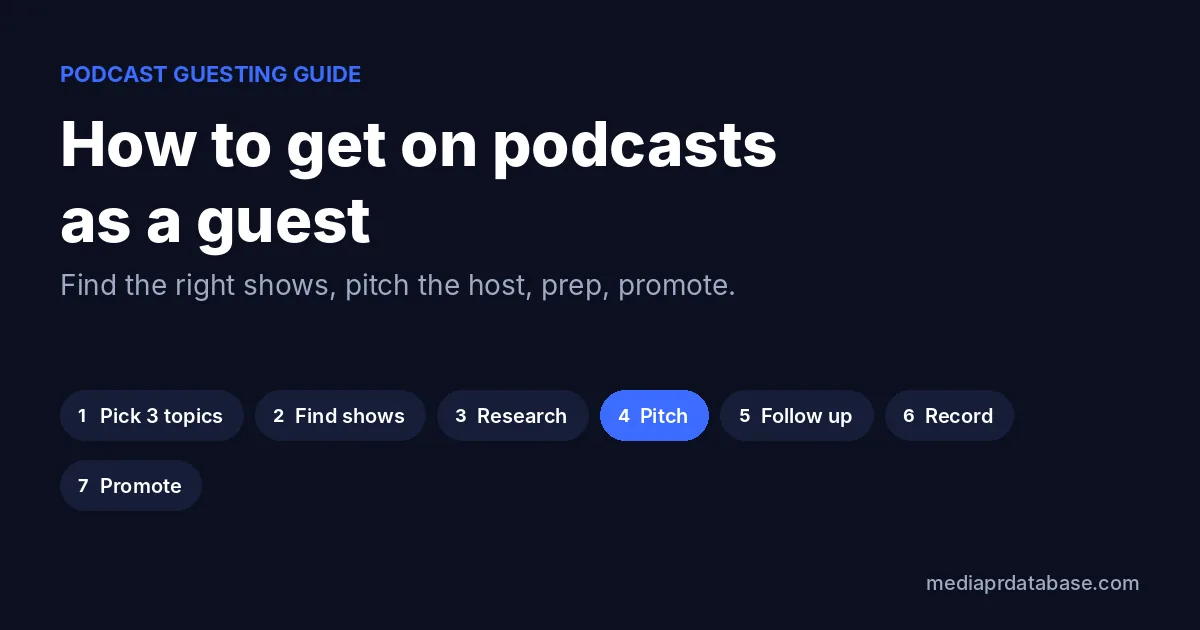
Short answer: to get on podcasts as a guest, pick two or three topics you can talk about better than most people, build a list of 30 to 50 shows whose recent guests look like you, listen to at least one episode of each, then send each host a short, personal pitch with a ready episode idea, three talking points, proof you are a good guest and a link to your one-sheet. Follow up once after a week. After the episode airs, promote it hard, because that is what gets you booked again.
This guide walks through every step of podcast guesting: why it works, where to find shows (free and paid), how to research a host in ten minutes, a podcast guest pitch template with three variants, a one-sheet checklist, the follow-up, how to prepare for the recording, how to promote the episode and the mistakes that get pitches deleted. It comes from Media PR Database, a directory of 9,596 news outlets in 195 countries with 16,692 newsroom and journalist emails, plus 2,997 podcasts with host and booking emails in the Premium plan. We look at a lot of shows that take guests, and at a lot of pitches.
Why podcast guesting works
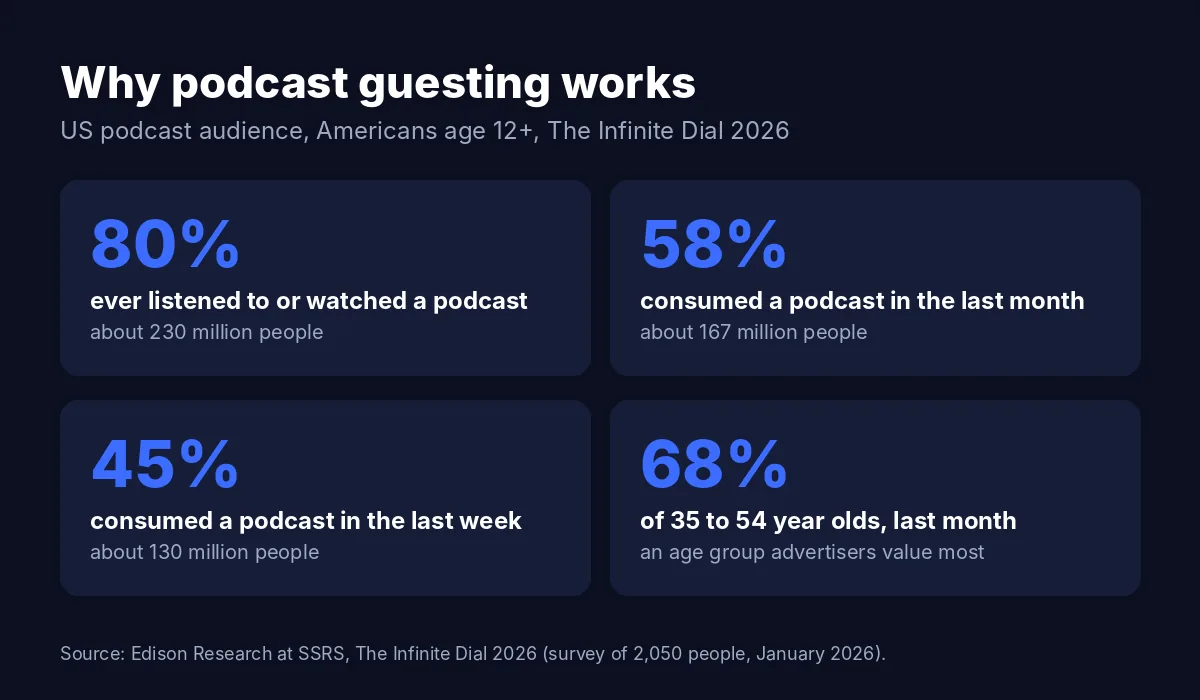
Podcasts have become one of the biggest media channels in the United States, and the audience is still growing. The Infinite Dial 2026, the long-running annual survey of digital media habits from Edison Research at SSRS, found that (Edison Research at SSRS, The Infinite Dial 2026):
- 80% of Americans age 12+ (about 230 million people) have ever listened to or watched a podcast, an all-time high.
- 58% (about 167 million) consumed a podcast in the last month, and 45% (about 130 million) in the last week. Both are record highs.
- 68% of 35 to 54 year olds consumed a podcast in the last month, which the study calls one of advertising's most valued age groups.
- 57% of Americans age 12+ have both listened to and watched a podcast. Podcasting is now an audio and video medium.
The trend is steady. A year earlier, The Infinite Dial 2025 put the share of Americans who had ever consumed a podcast at 73% and monthly consumers at 55% (The Infinite Dial 2025). The same release said YouTube was the service used most often for podcasts, by 33% of US weekly podcast listeners, based on Edison Podcast Metrics. In plain terms: if you appear on a show that also publishes video, you can be seen as well as heard.
For a guest, the numbers are only half the story. What makes podcast guesting different from a news mention is the format:
- Long attention. A news story might quote you for one sentence. A podcast gives you 20 to 60 minutes to explain how you think.
- A warm introduction. The host vouches for you to an audience that already trusts them.
- A lasting asset. Episodes stay online for years, come with show notes and a link, and are easy to clip for social media.
- Easier access than big media. Many shows publish weekly and need a new guest every week. Most hosts want good pitches.
That last point is the opportunity. A national newspaper gets thousands of pitches. A niche podcast in your field may get a handful of relevant ones a month, and the host still has a calendar to fill.
Step 1: decide what you will talk about
Hosts do not book people. They book episodes. Before you look for a single show, write down two or three topics you can speak on with real authority, and turn each one into an episode a host could publish.
A good guest topic has three parts:
- A specific angle. Not "marketing," but "how we got our first B2B customers with no ad budget."
- Something only you can share. Your numbers, your mistakes, a process you built, a story from your clients.
- A takeaway for the listener. Steps, a framework or a warning they can use the next day.
For each topic, write a working episode title and three talking points. You will reuse these in every pitch, in your one-sheet and when the host asks "what do you want to cover?"
Example topic sheet
Topic 1: First customers without ads
Working title: "How a [team size]-person startup won [number] B2B customers with cold email"
Talking points:
1. The list: how we picked [number] target accounts
2. The email: the 3-line message that got a [X]% reply rate
3. The mistake: what we stopped doing after month two

Topic 2: Pricing for small software companies
Working title: "Why we killed our free plan (and revenue went up)"
...

Topic 3: Hiring a first marketer
Working title: "Your first marketing hire: generalist or specialist?"
...
Use your own real numbers in place of the placeholders above. A specific number from your business is the strongest thing you can put in a pitch, and the fastest way to lose a host is a number that does not hold up when they ask about it on air.
Step 2: find the right podcasts
The right show is not the biggest show. It is the one whose listeners are your buyers, readers or donors, and whose host books guests like you. Aim for a list of 30 to 50 shows in three tiers: a few large "reach" shows, a solid middle of niche shows with engaged audiences, and some smaller new shows where you can practice.
Use a podcast database with booking emails
The fastest route is a list that already has the contact. The Premium plan of Media PR Database includes 2,997 podcasts that accept guests, each with a host or booking contact email, as a bonus on top of every news outlet. You can browse them free by podcast category, then unlock emails and download the whole list as a CSV. Current categories include:
| Podcast category | Shows |
|---|---|
| News, Society and Culture | 558 |
| Lifestyle and Family | 408 |
| Health and Wellness | 403 |
| Sports and Gaming | 325 |
| Finance and Investing | 271 |
| Business and Entrepreneurship | 270 |
| Technology and AI | 195 |
| Education and Science | 190 |
| Marketing and PR | 158 |
| Industry and B2B | 119 |
| Careers and HR | 100 |
Counts as listed on our podcasts page on November 2, 2026. Emails stay masked (for example •••••@n••.org) until you unlock them with Premium. Premium is $299 one-time, with no subscription; see pricing.
Free ways to find shows
You can also build a list by hand. It takes longer, but it costs nothing:
- Apple Podcasts charts. The Apple Podcasts Top Charts show the most popular shows and can be browsed by country. The top of the charts is dominated by big media brands, so use it to understand a category, then look further down for niche shows.
- "Listeners also follow." Open a show you would love to be on in your podcast app and look at related shows. These tend to share an audience.
- Where your peers have been. Search the name of a competitor, a peer or an author in your field plus "podcast." Every result is a show that already books people like you.
- Matchmaking platforms. PodMatch matches podcast guests and hosts, gives guests a public one-sheet profile and handles messaging and scheduling inside the platform. It is a paid monthly service; check its current pricing on the site.
- Local media. City and regional news sites often run their own podcasts. Our location pages list outlets by place, for example New York media, Texas media, the UK media list and Canadian outlets. Check each outlet's site for a podcast.
Whichever route you use, put every show in a simple sheet with the show name, host name, category, contact email, last episode date, one recent episode you listened to and a status column. That sheet is your podcast booking pipeline. Our guide to building a media list covers the same columns for news outlets.
Step 3: research each show in ten minutes
The single biggest difference between pitches that get booked and pitches that get ignored is whether the guest clearly knows the show. Before you write to a host, spend ten minutes on these checks:
- Is it active? Look at the date of the last episode. If nothing has been published in two or three months, move on.
- Does it have guests? Some shows are solo or co-host only. Scroll through the last ten episode titles.
- Who are the recent guests? If they are all bestselling authors and you are a first-time founder, start with a smaller show. If they look like you, you are in the right place.
- Is there a guest form? Many shows have a "be a guest" page or a form in the show notes. If there is one, use it. It is the host telling you how they want to be pitched.
- Listen to one episode. At least the first 15 minutes of a recent one. Note one specific moment, question or opinion you can mention.
- Note the format. Length, interview or conversation, audio only or video too, recorded remotely or in a studio.
- Find the host's name. "Hi there" tells the host you sent the same email to 200 people.
Write what you find in your sheet. It feeds straight into the first line of your pitch.
Step 4: write the podcast guest pitch
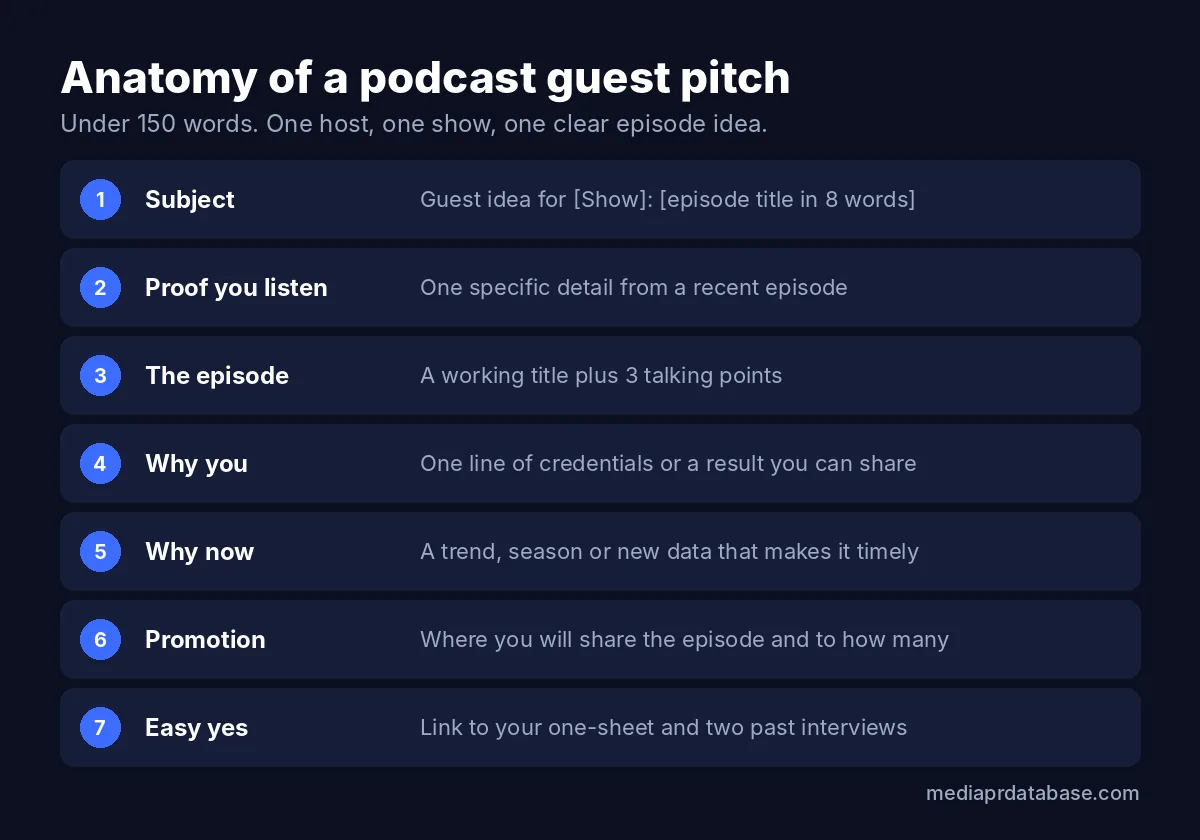
A podcast guest pitch is a short email that sells one episode to one host. Keep it under 150 words, write it to a person, and make it easy to say yes.
Podcast guest pitch template
Subject: Guest idea for [Show name]: [episode title in 8 words or less]

Hi [Host first name],

I listened to your episode with [recent guest] on [topic], and
[one specific thing you liked, disagreed with or want to build on].

I'd love to come on [Show name] to talk about [episode idea]:
- [Talking point 1]
- [Talking point 2]
- [Talking point 3]

Why me: I'm [role] at [company], where [one result or credential
with a real number].

Why now: [trend, season, news or new data that makes it timely].

I'll share the episode with [newsletter of X readers / LinkedIn
following / customer list] and send you clips for social.

My one-sheet with past interviews is here: [link]

Thanks,
[Name]
[Title, company, website]
Every bracket should be filled with something specific to that show. If you can paste the same paragraph into a pitch to a different podcast without changing it, rewrite it.
Variant 1: the expert or founder pitch
Best for business, marketing, finance and industry shows, where the host wants a practical lesson.
Subject: Guest idea: how we [result] without [usual cost]

Hi [Host first name],

Your point in [episode] about [topic] stuck with me, because we
tested the opposite at [company] and [what happened].

Episode idea: "[Working title]"
- What we tried first and why it failed
- The [3-step process / framework] that worked
- What a listener can copy this week, even with a small team

I'm [role] at [company]. [One sentence of proof, e.g. a number,
a client type or how long you have done it.]

Happy to share our real numbers on air. Past interviews and a
one-sheet: [link]

Best,
[Name]
Variant 2: the story or personal experience pitch
Best for lifestyle, health, family, culture and interview shows that run on stories.
Subject: A story for [Show name]: [short hook]

Hi [Host first name],

I've been listening since [episode or season], and your
conversation with [guest] about [topic] made me want to write.

[Two sentences: what happened to you, and the turning point.]

I think your listeners would get the most from:
- [The moment that changed things]
- [What you learned that others can use]
- [The question people ask you most]

I've told this story on [past show or outlet], and here is a
short clip: [link]. My one-sheet: [link]

Thank you for considering it,
[Name]
Variant 3: the timely or data pitch
Best for news, society, science and technology shows that react to what is happening this week.
Subject: [Timely topic] episode idea, with new data

Hi [Host first name],

With [news event or trend] in the headlines, I think your
listeners would want to know [question].

We just [ran a survey of X people / analysed X records / published
a report], and three findings stood out:
- [Finding 1 with the real number]
- [Finding 2]
- [Finding 3]

I lead [team or study] at [organisation] and can explain what
it means for [listener type] in plain language.

Full report: [link]. Available to record [two or three time windows].

Best,
[Name]
If you want a first draft fast, our free media pitch generator has a "Podcast or interview guest" mode. Enter your topic, angle and credentials and it builds a pitch you can then personalise for each host. For more examples, see our 17 media pitch samples (one is a podcast guest pitch) and the general media pitch email template.
Subject lines that get podcast pitches opened
- Guest idea for [Show]: [episode title]
- [Recent guest]'s episode + a follow-up idea
- Episode idea: why [common belief] is wrong
- [Number] lessons from [specific experience] for [Show] listeners
- Listener here, with an episode idea on [topic]
Avoid "Collaboration opportunity," "Interview request" and anything in capital letters. They read like a mass email, because they usually are one.
Step 5: build a guest one-sheet (media kit)
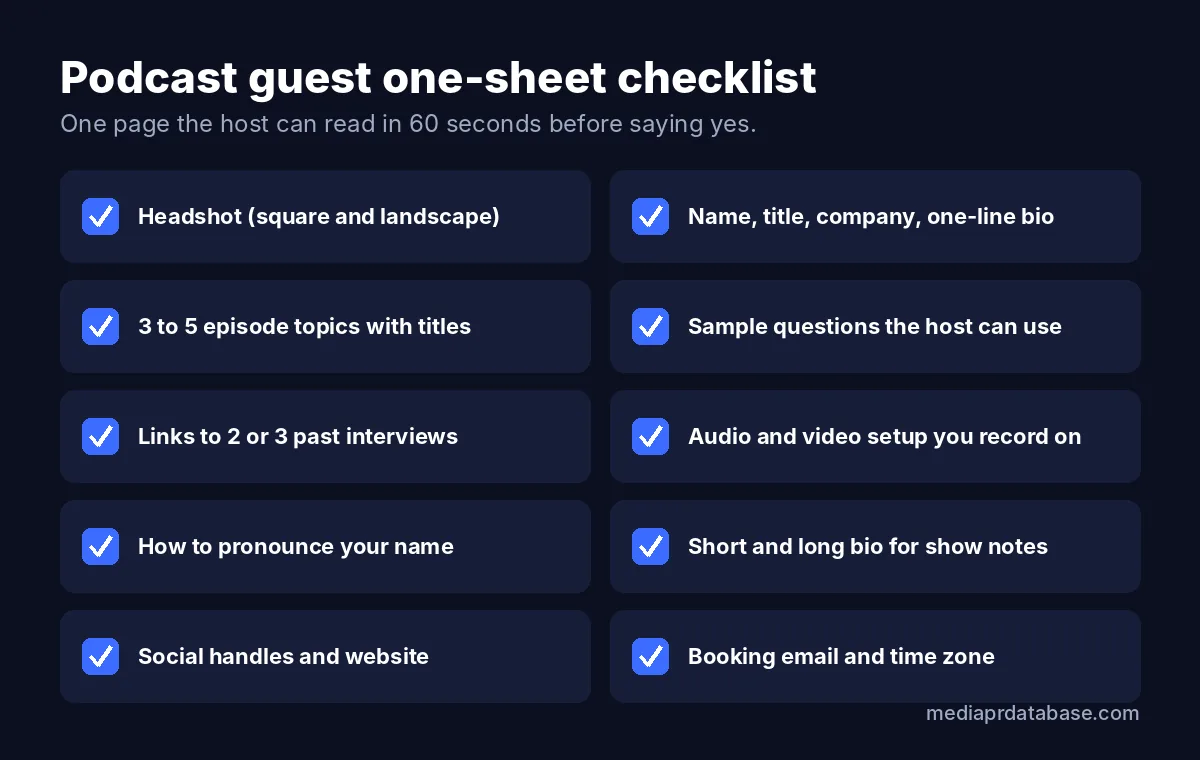
A guest one-sheet is a single page, often a simple web page or PDF, that tells a host everything they need to book you. Link to it from every pitch instead of attaching files. Many hosts check it before replying, and producers use it to write the intro and show notes.
Guest kit checklist
- Headshot in square and landscape format, high resolution, recent.
- Name, title, company and a one-line bio ("Founder of X, helps Y do Z").
- Three to five episode topics, each with a working title and two or three talking points.
- Sample questions the host can use or adapt. Hosts on a weekly schedule appreciate this.
- Links to two or three past interviews, podcast or video, so the host can hear how you speak.
- Your setup: microphone, camera and whether you can record video.
- How to pronounce your name and your company's name.
- Short bio (50 words) and long bio (150 words) for show notes.
- Website and social handles, and where you will share the episode.
- Booking email and time zone.
If you have no past interviews yet, record a two-minute video of yourself answering one of your sample questions. It does the same job.
Step 6: send, track and follow up
Send pitches in small batches, ten to fifteen a week, so you can personalise each one and keep up with replies. Track every pitch in your sheet with the date sent and the status: sent, followed up, booked, declined, no reply.
When to follow up
Follow up once, about a week after the first email, in the same thread. If there is still no answer, leave it and try again in a few months with a new idea. Many podcast hosts run their show alongside a full-time job and batch their email, so silence often means "not yet," not "no."
Subject: Re: Guest idea for [Show name]: [episode title]

Hi [Host first name],

Just floating this back up in case it got buried. Since I wrote,
[one new thing: a new data point, a related news story, a clip].

If the topic doesn't fit, I'm happy to suggest another angle or
to stay on your list for later.

Thanks,
[Name]
When a host says yes
Reply quickly, confirm the date, time zone, recording platform and whether there is video, and send your one-sheet again. Ask if the host wants anything before the call, such as a short list of questions or a guest form.
Step 7: prepare for the recording
A great recording is what turns one booking into several, because hosts talk to each other and recommend good guests.
Technical setup
- Use a USB or XLR microphone or, at least, wired earbuds with a mic. Laptop microphones pick up the room.
- Wear headphones so the host's voice does not bleed into your mic.
- Record in a small, soft room. Curtains, carpet and a closed door help more than an expensive mic.
- Use a wired connection if you can, close other apps and turn off notifications.
- For video, sit facing a window or a lamp, put the camera at eye level and check what is behind you.
- Test the platform the host uses, the day before, on the same device.
Content preparation
- Listen to one more episode to get the host's style and their usual first and last questions.
- Prepare two or three short stories, each under two minutes, that illustrate your talking points.
- Have one or two real numbers ready, and make sure you can back them up.
- Decide on one clear call to action: a single web address that is easy to say and remember.
- Keep answers short. Let the host lead, and answer the question they asked.
On the day
Join five minutes early, ask the host how they say their name and what they want the listener to take away, and do not pitch your product in every answer. The more useful you are, the more people will look you up afterwards.
Step 8: promote the episode after it airs
Hosts book guests who bring listeners. Promotion is how you thank the host and how you get the next booking.
- Share on launch day on your strongest channel, and tag the host and the show.
- Cut short clips of 30 to 60 seconds for LinkedIn, Instagram, TikTok or YouTube Shorts, if the show records video and the host is happy for you to use it.
- Email your list with one line on why the episode is worth their time.
- Add it to your website on a "Podcasts and press" page. This becomes social proof for your next pitch.
- Leave a rating and review for the show, and send the host a short thank-you note.
- Ask for an introduction. If it went well, ask the host if they know another show that would suit you.
Common podcast guesting mistakes
- Pitching a show you have never heard. Hosts can tell in one line.
- Pitching yourself, not an episode. "I'd be a great guest" is not an episode idea.
- Using "Dear Host." Find the name. It is almost always in the show notes.
- Long emails and attachments. Keep it under 150 words and link to the one-sheet.
- Pitching a solo show. Check that the show has guests before you write.
- Turning the interview into an ad. Teach first. Mention your business once or twice where it fits.
- Bad audio. A laptop mic in a kitchen can make an episode unusable.
- Disappearing after the recording. No promotion means no second invitation.
- Following up five times. Once is enough. Then move on and come back later with a new idea.
- Paying to be featured without checking. Some shows charge guests. That can be fine, but know it is advertising and check the audience before you pay.
How many pitches does it take?
There is no reliable industry-wide booking rate, and results vary with your topic, credentials and how well you match each show. Plan on pitching in batches, tracking your own reply and booking rates in your sheet, and improving the pitch every couple of weeks. A small list of well-matched shows almost always beats a large list of random ones.
Where Media PR Database fits
Media PR Database is a one-time-payment media database. The free plan lets you search every outlet, podcast and newsletter and see type, category and contact count with emails hidden. Pro ($149, one-time) unlocks every newsroom and journalist email for 9,596 outlets in 195 countries and all 50 US states, with CSV download. Premium ($299, one-time) adds the bonus databases of 2,997 podcasts and 123 newsletters with their contact emails, plus files formatted for Instantly, Smartlead and Lemlist. If podcast booking is your main goal, Premium is the plan to choose. See pricing or browse podcasts by category first. If you also want news coverage, read our list of HARO alternatives for journalist request services.
Sources
We read each source on November 2, 2026.
- Edison Research at SSRS, The Infinite Dial 2026: podcast reach (80% ever, 58% monthly, 45% weekly, 68% of 35 to 54 year olds monthly, 57% listened and watched); survey of 2,050 people age 12+ in January 2026.
- Edison Research, The Infinite Dial 2025: 73% ever consumed and 55% monthly in 2025; YouTube used most often by 33% of US weekly podcast listeners (Edison Podcast Metrics).
- Apple Podcasts Top Charts: public charts by country.
- PodMatch: guest and host matching, guest one-sheet profiles, paid monthly plans.
- Media PR Database podcasts page: 2,997 podcasts with contact emails and category counts.
The bottom line
Getting on podcasts is a repeatable process, not luck. Choose a few topics you own, build a list of shows whose guests look like you, listen before you pitch, send a short email that sells one episode, follow up once, show up prepared and promote the result. Do that every week for a couple of months and the bookings start to bring more bookings.
FAQ
How do I get on podcasts as a guest with no experience?
Start with smaller and newer shows in your niche, which are often happy to book first-time guests. Pick a specific topic, prepare three talking points, listen to the show, and send a short personal pitch. Record a two-minute video answering one sample question to use in place of past interviews. Each episode you do becomes proof for the next pitch.
How do I find podcast booking emails?
Check the show's website, a 'be a guest' page or form, the show notes and the podcast's social profiles. Matchmaking platforms such as PodMatch connect guests and hosts inside the platform. Media PR Database Premium includes 2,997 podcasts with host or booking emails that you can filter by category and download as a CSV.
What should a podcast guest pitch include?
The host's name, one specific detail from a recent episode, a working episode title, three talking points, one line on why you are qualified, why the topic is timely, how you will promote the episode and a link to your one-sheet. Keep it under 150 words.
How long should I wait to follow up on a podcast pitch?
About a week. Follow up once, in the same email thread, with something new such as a fresh data point or a related news story. If there is still no answer, move on and try again in a few months with a different idea.
Do podcasts pay guests, or do guests pay podcasts?
Most podcast guest appearances are unpaid on both sides: the host gets content and the guest gets exposure. Some shows charge guests a fee to appear. That is a form of advertising, so check the audience, downloads and past guests before you pay.
What is a podcast guest one-sheet?
A one-page summary, usually a web page or PDF, that helps a host book you. It includes your headshot, short and long bio, three to five episode topics, sample questions, links to past interviews, your recording setup, social links and booking contact.
Build your media list in minutes
Search free, then download any country or state list as CSV in one click.
Keep reading
PR Database Software: One-Time vs Subscription
PR database software compared by pricing model: subscriptions with annual contracts and quote-only pricing, one-time plans from $149, pay-per-use wire packages and free options, with a 12 and 24 month cost table built from published prices.
NewslettersNewsletter Advertising: How to Find and Pitch Newsletters
A practical guide to newsletter advertising and sponsorships: pricing models (flat fee, CPM, CPC), how ad networks like beehiiv's work, how to find and vet newsletters, what to ask for, and how to get free earned mentions with a pitch.
Pitching40 News Story Ideas Journalists Actually Cover
40 news story ideas for startups, small businesses and PR freelancers, grouped by type: data, trends, local firsts, people, reactions, milestones, visuals and seasonal hooks, with real campaign examples and a 60-second test.